


Showcasing your capacity is easier when a respected credential does the talking. The ASCP-MLT exam leads to exactly that kind of credential, and the ASCP MEDICAL LABORATORY TECHNICIAN - MLT(ASCP) materials at GetValidTest — 562 practice questions with expert-verified answers — help you walk toward it with structure rather than guesswork.
ASCP ASCP-MLT Exam Overview:
| Certification Vendor: | ASCP Board of Certification (ASCP BOC) |
|---|---|
| Exam Name: | MEDICAL LABORATORY TECHNICIAN - MLT(ASCP) |
| Exam Number: | ASCP-MLT |
| Exam Duration: | 150 minutes |
| Certificate Validity Period: | 3 years (renewable via CMP) |
| Exam Format: | Multiple-choice questions, Computer Adaptive Testing (CAT) |
| Available Languages: | English |
| Real Exam Qty: | 100 |
| Related Certifications: | MLS(ASCP) PBT(ASCP) MLT(ASCPi) |
| Passing Score: | 400 (scale 0-999) |
| Exam Price: | $235 USD (standard); $215 USD (reduced for eligible regions) |
| Recommended Training: | ASCP Recommended Reading List ASCP BOC MLT Content Guideline |
| Exam Registration: | Pearson VUE Testing Center Scheduling ASCP BOC Official Application Portal |
| Sample Questions: |  |
| Exam Way: | Proctored computer-based testing at authorized Pearson VUE test centers |
| Pre Condition: | Associate degree or 60 semester hours from accredited institution + completion of NAACLS/ABHES-accredited MLT program OR approved education + clinical experience; multiple eligibility routes available |
| Official Syllabus URL: | https://www.ascp.org/boc/explore-credentials/view-all-credentials/MLT |
ASCP ASCP-MLT Exam Syllabus Topics:
| Section | Weight | Objectives |
|---|---|---|
| Topic 1: Hematology | 20-25% | - White blood cell morphology and diseases - Routine and automated hematology procedures - Red blood cell physiology and disorders - Hemostasis and coagulation testing |
| Topic 2: Urinalysis and Other Body Fluids | 5-10% | - Cerebrospinal, serous, and synovial fluids - Urine formation and composition - Semen and amniotic fluid testing - Physical, chemical, and microscopic analysis |
| Topic 3: Blood Banking (Immunohematology) | 15-20% | - Antibody detection and identification - Transfusion reactions and adverse events - Blood group systems and antigens - Compatibility testing - Blood components and storage |
| Topic 4: Clinical Chemistry | 20-25% | - Toxicology and liver/kidney function tests - Endocrinology and therapeutic drug monitoring - Electrolytes, acid-base balance, and blood gases - Carbohydrates, lipids, proteins, and enzymes |
| Topic 5: Laboratory Operations | 5-10% | - Laboratory mathematics and instrumentation - Pre-analytical, analytical, and post-analytical processes - Laboratory safety and regulatory compliance - Quality control and quality assurance |
| Topic 6: Immunology and Serology | 5-10% | - Infectious disease serology - Autoimmune and immunodeficiency disorders - Immunologic testing methodologies - Immune system principles and components |
| Topic 7: Microbiology | 15-20% | - Identification of pathogenic microorganisms - Mycology, parasitology, and virology - Specimen collection and culture techniques - Bacteriology and antimicrobial susceptibility |
Questions and Answers About the ASCP MEDICAL LABORATORY TECHNICIAN - MLT(ASCP) Exam
The ASCP-MLT exam consists of 100 questions to be answered within 150 minutes minutes. Timed practice under the same constraints is the standard way to make that pace feel comfortable rather than rushed.
The official training options for ASCP-MLT exam candidates include:
Official courses cover the theory; self-paced practice questions cover the application. Together they make a complete preparation loop.
Associate degree or 60 semester hours from accredited institution + completion of NAACLS/ABHES-accredited MLT program OR approved education + clinical experience; multiple eligibility routes available
The official outline organizes the ASCP-MLT exam into weighted domains such as:
- Microbiology (15-20%)
- Urinalysis and Other Body Fluids (5-10%)
- Laboratory Operations (5-10%)
The ASCP MEDICAL LABORATORY TECHNICIAN - MLT(ASCP) practice questions at GetValidTest follow this same objective map, so every hour of review lands on exam-relevant ground.
The ASCP-MLT exam is the official assessment for the ASCP MEDICAL LABORATORY TECHNICIAN - MLT(ASCP) certification from ASCP. It verifies that you can apply the published exam objectives to practical scenarios, and the resulting credential showcases your capacity in a way employers immediately recognize — a concrete step in any all-round self-improvement plan.
Twenty-four-hour online service, with real people behind it. Once you have purchased the ASCP-MLT exam materials, our staff shoulders the responsibility of answering your questions patiently and immediately — whether it is a download issue, a question about the content, or help understanding the refund policy. Good materials matter, but so does never being stuck alone with them.
You need 400 (scale 0-999) to pass the ASCP-MLT exam, and the fee is $235 USD (standard); $215 USD (reduced for eligible regions) per attempt. Solid preparation before booking is the most cost-effective strategy — practice until your timed scores sit consistently above the passing mark.
Yes, by design. Payments for the ASCP MEDICAL LABORATORY TECHNICIAN - MLT(ASCP) materials go through an established, secure payment platform, so your card data is protected by the gateway itself. Your personal information — email, address, purchase details — is never leaked or shared with third parties. And if anything does go wrong, the twenty-four-hour support team is there to set it right. A purchase should bring you study materials, not new troubles.
You can register through the official channels below:
Once your practice results are consistent, choose a date and let the deadline sharpen your final review.
ASCP MEDICAL LABORATORY TECHNICIAN - MLT(ASCP) Sample Questions:
Failure to tightly seal specimens for sweat electrolytes during collection and transport will cause:
- A. decreased values due to exposure to light
- B. decreased values due to exposure to air
- C. increased values due to evaporation
- D. increased values due to cellular contamination
Correct Answer: C 🗳️
Isotonic or normal saline is a 0.85 % solution of sodium chloride in water.
The concentration of sodium chloride in an isotonic solution is :
- A. 0.08 %
- B. 0.85 %
- C. 8.5 %
- D. 1 molar
Correct Answer: B 🗳️
The colonies seen growing on the bird seed agar appear smooth and have a distinct reddish-brown pigmentation. The active ingredient in bird seed (Guizotia abyssinica) agar is caffeic acid, which is extracted and placed in an agar containing 1% glucose. Of the cryptococci, and other species of yeasts, Cryptococcus neoformans selectively produces the enzyme phenoloxidase, which oxidizes the caffeic acid in the medium to melanin, producing the red-brown pigmentation.
The other yeast species included in this exercise do not possess phenoloxidase activity and therefore remain non-pigmented when grown on bird seed agar.
The colonies shown in this photograph were grown on Guizotia abyssinica (bird seed) agar at 30°C for 72 hours. The most likely identification is: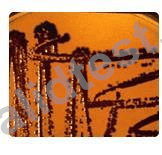
- A. Saccharomyces cerevisiae
- B. Cryptococcus laurentii
- C. Candida parapsilosis
- D. Cryptococcus neoformans
Correct Answer: D 🗳️
Blood Bank; Immunology
Which of the following best describes the primary function of antibodies:
- A. Stimulate the immune response
- B. Bind with antigen
- C. Protect B-lymphocytes
- D. Fix complement
Correct Answer: B 🗳️
CAMP is the correct answer because the case is typical of Streptococcus agalactiae(Group B strep). The main presumptive identification test is CAMP. Bile solubility is positive for Streptococcus pneumonia. Coagulase would be positive for Staphylococcus aureus. PYR is positive for Streptococcus pyogenes (Group A strep) which is ruled out by the resistance to bacitracin.
Microbiology
Spinal fluid cultures on a 3-day-old infant revealed beta-hemolytic, Gram-positive cocci occurring in pairs and chains. The organism was catalase-negative and bile esculin-negative. Resistance to 0.04 U disk of bacitracin was noted. The other test necessary to identify this organism is a positive test by:
- A. PYR
- B. Coagulase
- C. CAMP
- D. Bile solubility
Correct Answer: C 🗳️
Viewing page 1 out of 113 pages.
Viewing questions 1-5 out of 562 questions.


