


Preparation that respects your time focuses on what the exam actually tests, not on padding page counts. GetValidTest concentrates your DSA-C03 study effort into 289 verified practice questions mapped directly to the Snowflake SnowPro Advanced: Data Scientist Certification objectives.
Snowflake DSA-C03 Exam Overview:
| Certification Vendor: | Snowflake |
|---|---|
| Exam Name: | SnowPro Advanced: Data Scientist Certification Exam (DSA-C03) |
| Exam Number: | DSA-C03 |
| Exam Format: | Multiple choice, Multiple select |
| Available Languages: | English |
| Related Certifications: | SnowPro Core Certification |
| Recommended Training: | Snowflake Training & Learning Resources |
| Exam Registration: | Snowflake Certification Registration |
| Sample Questions: |  |
| Exam Way: | Online proctored or testing center |
| Pre Condition: | Recommended: SnowPro Core Certification or equivalent Snowflake experience |
| Official Syllabus URL: | https://www.snowflake.com/certifications/ |
Snowflake DSA-C03 Exam Syllabus Topics:
| Section | Objectives |
|---|---|
| Data Science Fundamentals in Snowflake | - Data preprocessing and transformation in Snowflake - Applied statistics and data exploration |
| Machine Learning with Snowpark | - Model training and evaluation workflows - Using Snowpark for Python-based ML workflows |
| Advanced Analytics and Optimization | - Scalable analytics design patterns - Performance optimization of data queries |
| Data Engineering for Machine Learning | - Data pipelines using Snowflake - SQL-based feature engineering |
| Model Deployment and Operationalization | - Monitoring and lifecycle management - Model deployment in Snowflake ecosystem |
DSA-C03 Preparation Questions and Answers
This package includes 289 practice questions for the Snowflake SnowPro Advanced: Data Scientist Certification exam. Every answer is verified by an experienced team of experts, so you can trust what you study.
Is there recommended training for the Snowflake SnowPro Advanced: Data Scientist Certification exam?
Many candidates combine practice questions with official training. Recommended options include:
One purchase covers the full journey: three versions of the material (PDF, PC test engine, and online version), a free demo to try before buying, 365 days of free updates delivered automatically, and customer service you can reach whenever a question comes up. Nothing essential is sold separately.
The Snowflake SnowPro Advanced: Data Scientist Certification practice questions are organized around the official exam objectives. Key topics include:
- Advanced Analytics and Optimization ()
- Machine Learning with Snowpark ()
- Data Science Fundamentals in Snowflake ()
Keeping your revision mapped to these objectives makes every session productive.
Yes. Candidates who come back for additional certifications receive discounts when they buy further practice packages. If you already hold one of our products, ask our staff about the current returning-customer offer before your next purchase.
You can register for the Snowflake SnowPro Advanced: Data Scientist Certification exam through the official channels:
Recommended: SnowPro Core Certification or equivalent Snowflake experience
You can confirm the current eligibility requirements on the official DSA-C03 exam page before you register.
Snowflake SnowPro Advanced: Data Scientist Certification Sample Questions:
You are developing a regression model in Snowflake to predict housing prices. You've trained a model using Snowflake ML functions and now need to rigorously validate its performance. You have a separate validation dataset stored in a table named 'HOUSING VALIDATION'. Which of the following SQL statements, when executed in Snowflake, would accurately calculate the Root Mean Squared Error (RMSE) of your model's predictions against the actual prices in the validation dataset, assuming your model is named 'HOUSING PRICE MODEL' and the prediction function generated by CREATE SNOWFLAKE.ML.FORECAST is called PREDICT?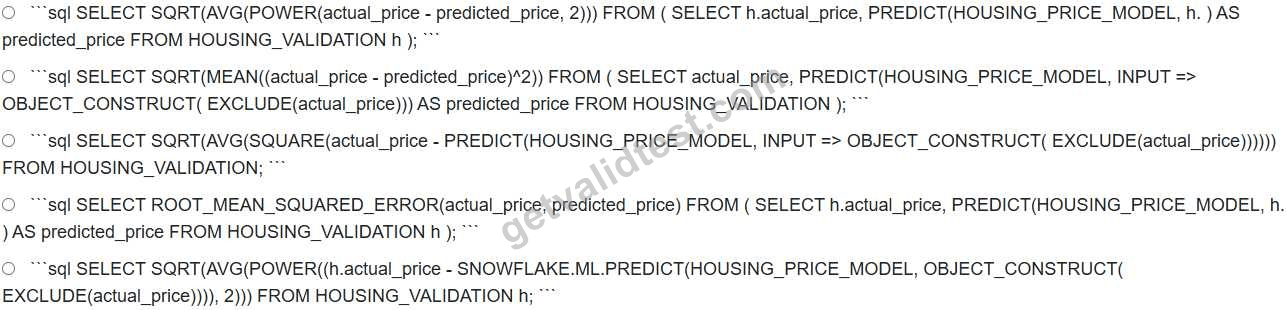
- A. Option A
- B. Option C
- C. Option B
- D. Option D
- E. Option E
Correct Answer: E 🗳️
Explanation: Only visible for GetValidTest members. You can sign-up / login (it's free).
You are working on a customer churn prediction model and are using Snowpark Feature Store. One of your features, is updated daily. You notice that your model's performance degrades over time, likely due to stale feature values being used during inference. You want to ensure that the model always uses the most up-to-date feature values. Which of the following strategies would be the MOST effective way to address this issue using Snowpark Feature Store and avoid model staleness during online inference?
- A. Implement a real-time feature retrieval service that directly queries the underlying Snowflake table containing the using Snowpark, bypassing the Feature Store.
- B. Define a custom User-Defined Function (UDF) in Snowflake that retrieves the 'customer_lifetime_value' from the Feature Store on demand whenever the model makes a prediction and set 'feature_retrieval_mode='fresh'S.
- C. Configure with the attribute to manage data staleness and use the during inference, ensuring that the model always uses recent feature values.
- D. Use the method on the Feature Store client during inference, ensuring that you always pass the current timestamp.
- E. Configure the Feature Group containing to automatically refresh every hour using a scheduled Snowpark Python function.
Correct Answer: C 🗳️
Explanation: Only visible for GetValidTest members. You can sign-up / login (it's free).
You are developing a data transformation pipeline in Python that reads data from Snowflake, performs complex operations using Pandas DataFrames, and writes the transformed data back to Snowflake. You've implemented a function, 'transform data(df)', which processes a Pandas DataFrame. You want to leverage Snowflake's compute resources for the DataFrame operations as much as possible, even for intermediate transformations before loading the final result. Which of the following strategies could you employ to optimize this process, assuming you have a configured Snowflake connection "conn"?
- A. Use Snowpark Python DataFrame API to perform the transformation directly on Snowflake's compute and then load results into the same table. Call 'df_snowpark = session.create_dataframe(df)'.
- B. Use 'snowflake.connector.pandas_tools.write_pandas(conn, df, table_name, auto_create_table=Truey to write the transformed DataFrame to Snowflake and let Snowflake handle the transformations using SQL.
- C. Chunk the Snowflake table into smaller DataFrames using 'fetchmany()' , apply to each chunk, and then append each transformed chunk to a Snowflake table using multiple INSERT statements. Call columns=[col[0] for col in cur.description]))'
- D. Read the entire Snowflake table into a single Pandas DataFrame, apply , and then write the entire transformed DataFrame back to Snowflake.
- E. Create a series of Snowflake UDFs that perform the individual transformations within Snowflake, load the data into Pandas DataFrames, apply UDFs on these DataFrames, and use to upload to Snowflake.
Correct Answer: A 🗳️
Explanation: Only visible for GetValidTest members. You can sign-up / login (it's free).
You are tasked with automating the retraining of a fraud detection model in Snowflake. The model is deployed as a Snowflake User-Defined Function (UDF). The training data resides in a Snowflake table named 'TRANSACTIONS. You want to trigger retraining if the model's performance, as measured by AUC, drops below 0.80. The model's AUC is tracked in a Snowflake table named 'MODEL PERFORMANCE. Which of the following strategies provides the MOST efficient and robust solution for automating this retraining process within Snowflake, minimizing latency and external dependencies?
- A. Create an external function that is invoked periodically by a Snowflake Task. The external function queries 'MODEL PERFORMANCE and uses a cloud provider's machine learning service (e.g., AWS SageMaker) to retrain the model and update the UDF using Snowflake's external functions capabilities for model deployment.
- B. Implement a Snowflake Task that executes a stored procedure. The stored procedure queries 'MODEL_PERFORMANCE. If the AUC is below 0.80, it executes a Snowflake ML pipeline using 'snowflake.ml.modeling' to retrain the model directly within Snowflake and updates the UDF in place using 'CREATE OR REPLACE FUNCTION'.
- C. Use a Snowflake Task that executes a stored procedure. The stored procedure queries 'MODEL PERFORMANCE, and if the AUC is below 0.80, it triggers a Data Engineering pipeline (e.g., using Airflow or Databricks) to retrain the model and update the UDF.
- D. Schedule a job on an external system (e.g., a cron job on a Linux server) to periodically query 'MODEL PERFORMANCE and trigger a model retraining process if the AUC is below 0.80. This process would retrain the model externally and update the UDF in Snowflake.
- E. Manually monitor on a dashboard and trigger retraining via a Snowflake Worksheet when needed.
Correct Answer: B 🗳️
Explanation: Only visible for GetValidTest members. You can sign-up / login (it's free).
You've trained a machine learning model using Scikit-learn and saved it as 'model.joblib'. You need to deploy this model to Snowflake. Which sequence of commands will correctly stage the model and create a Snowflake external function to use it for inference, assuming you already have a Snowflake stage named 'model_stage'?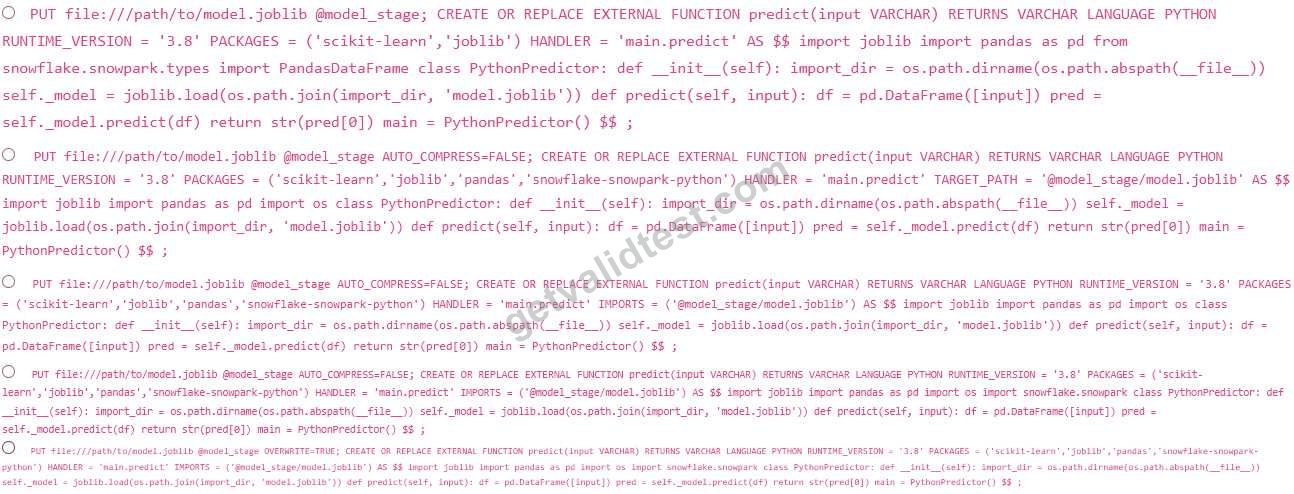
- A. Option A
- B. Option C
- C. Option B
- D. Option D
- E. Option E
Correct Answer: E 🗳️
Explanation: Only visible for GetValidTest members. You can sign-up / login (it's free).
Viewing page 1 out of 58 pages.
Viewing questions 1-5 out of 289 questions.


