


2025 Realistic CBAP 100% Pass Guaranteed Download Exam Q&A
Accurate CBAP Answers 365 Days Free Updates
The CBAP certification exam is a challenging but rewarding process for business analysts looking to advance their careers and demonstrate their expertise in the field. With the right preparation and dedication, passing the exam can open up new opportunities and solidify a professional's reputation as a skilled business analyst.
The Certified Business Analysis Professional (CBAP) application is an exam that tests the knowledge of professionals in the field of business analysis. Cetified business analysis professional (CBAP) appliaction certification is offered by the International Institute of Business Analysis (IIBA), a global professional association for business analysts. The CBAP certification distinguishes individuals who have reached business analysis mastery by demonstrating knowledge and expertise in areas such as requirements analysis, stakeholder engagement, and strategy analysis.
NEW QUESTION # 144
A business analyst (BA) is preparing a requirement package for access management system. A state diagram foe entity 'User* has been prepared. The BA wants to check the completeness of requirements by comparing different models. Which diagram should be used with a state diagram to verity that all functions are defined to work with entity "User" for the different roles?
- A. Use case diagram
- B. Data flow diagram
- C. Functional diagram
- D. Sequence diagram
Answer: A
Explanation:
A use case diagram is a technique that helps to depict the interactions between a system and its actors using graphical symbols and relationships. A use case diagram shows the actors that are involved in the system, the use cases that represent the functions or services that the system provides, and the associations that indicate how the actors and use cases are related. A use case diagram can be used with a state diagram to verify that all functions are defined to work with entity "User" for the different roles, as it can help to identify the use cases that correspond to the states and transitions of the entity, and to ensure that the use cases are complete, consistent, and accurate. A sequence diagram is a technique that helps to represent the sequence and timing of the messages that are exchanged between the objects or components of a system. A sequence diagram shows the objects or components that participate in the interaction, the messages that are sent and received by the objects or components, and the time order of the messages. A sequence diagram can help to illustrate the dynamic behavior and logic of the system, but it does not show the interactions between the system and its actors. A functional diagram is a technique that helps to represent the functions or processes that are performed by a system or a solution using graphical symbols and relationships. A functional diagram shows the functions or processes that are relevant to the domain, the inputs and outputs of each function or process, and the decomposition and hierarchy of the functions or processes. A functional diagram can help to define and analyze the functional requirements, but it does not show the interactions between the system and its actors. A data flow diagram is a technique that helps to create a high-level overview of a business process by showing the movement and transformation of data between entities and processes. A data flow diagram uses graphical symbols and arrows to represent the sources and destinations of data, the processes that manipulate data, the data stores that store data, and the data flows that transfer data. A data flow diagram can help to understand and document the data logic and structure of the business process, but it does not show the interactions between the system and its actors. References: BABOK Guide v3, Chapter 10: Techniques, Section 10.50: Use Case Diagram, p. 564-566; Section 10.49: Sequence Diagram, p. 562-563; Section 10.22:
Functional Decomposition, p. 528-529; Section 10.18: Data Flow Diagrams, p. 522-524.
NEW QUESTION # 145
The business sponsor of a project to automate a high risk, high profile process has expressed concerns that some activities people perform will be missed. The business analyst (BA) has already created a process flow with associated user stories.
Which of the following actions will address the sponsor's concerns?
- A. Schedule a formal review with the stakeholders
- B. Demonstrate traceability to the business case
- C. Record the concerns in the risk register
- D. Review the final approved elicitation results
Answer: A
Explanation:
Explanation
A formal review with the stakeholders is a way to validate the elicitation results and ensure that nothing is missed or misunderstood. The review can also help to build trust and confidence among the stakeholders and the BA. The other options are not directly related to addressing the sponsor's concerns. References: CBAP / CCBA Certified Business Analysis Study Guide, 2nd Edition, Chapter 5: Elicitation and Collaboration, p.
173-174; [A Guide to the Business Analysis Body of Knowledge (BABOK Guide), Version 3], Chapter 4:
Elicitation and Collaboration, Section 4.4: Confirm Elicitation Results, p. 107-108.
NEW QUESTION # 146
The stakeholders are interested in ensuring that expected value is assessed prior to acceptance. To determine if the solution is providing expected value and ensure the accuracy of the measurements, the stakeholders and the business analyst (BA) determine that they need to measure.
- A. impacts, problems, and dependencies.
- B. benefits, penalties, and costs.
- C. performance, trends, and variances.
- D. strategy, solution, and scope.
Answer: C
NEW QUESTION # 147
You are creating the solution scope for an identified problem in your organization. You are working with several stakeholders during this process including the domain subject matter expert, the implementation subject matter expert, the project manager, and the sponsor. Which of these stakeholders will be responsible for writing the project scope?
- A. Domain subject matter expert
- B. Sponsor
- C. Project manager
- D. Business analyst
Answer: C
NEW QUESTION # 148
A business analyst (BA) finds conflicting requirements gathered from several stakeholders. Aside from interviews what additional activities can the BA use to safeguard against this happening?
- A. Brainstorming and estimation
- B. User stories and scope modeling
- C. Item tracking and mind mapping
- D. Reviews and workshops
Answer: D
Explanation:
Reviews and workshops are effective techniques for validating and negotiating requirements with stakeholders. They can help the BA to identify and resolve any conflicting or contradictory requirements, as well as to gain consensus and agreement among the stakeholders. Reviews can be done in various forms, such as walkthroughs, inspections, or peer reviews. Workshops can be used to facilitate collaborative discussions, brainstorming, and decision making among the stakeholders. Both techniques can help the BA to safeguard against conflicting requirements by ensuring that the requirements are clear, accurate, complete, and aligned with the business goals and needs123. References:
* 1: BABOK Guide v3, Chapter 4: Elicitation and Collaboration, Section 4.5: Validate Requirements
* 2: BABOK Guide v3, Chapter 5: Requirements Life Cycle Management, Section 5.5: Approve Requirements
* 3: BABOK Guide v3, Chapter 10: Techniques, Section 10.32: Reviews, Section 10.50: Workshops
NEW QUESTION # 149
A very large insurer of General Liability and Property Damage insurance has an upward trend of increased claims over the past 5 years.
The Risk Control Area for that company has just completed a 12 month Pilot of a new improved Risk Control Site.
The purpose of the site is to help their customers manage their exposures and ideally prevent them from having claims. There were 100 customers that were part of the Pilot that represented 25 different industries.
The business goals were to increase use of the site and provide tools to help customer awareness of their exposures, so that they may reduce existing exposures and ultimately reduce claims.
The sites Features were as follows:
* Improvements to the search engine to all customers to search for articles, tools and services on the site.
* A checklist function that allow customer to create their own unique Checklists or utilize a sample provided by ABC company to use daily, weekly etc for an area of their facility.
* A promotion feature - where Risk preventing Articles, and tools on the site are marketed toward a customer.
* A profile section allowing for Customer Name, Address and contact Phone number.
After the 12 months pilot, the business sponsor received an assessment of what was working and what was not. The Assessment of the pilot revealed overall site activity had significantly increased, however only 5% of the time the promotions were viewed. And the most shocking was that total claims increased by nearly 20% for these 100 customers during the pilot period. The business sponsor was perplexed as he had an expectation of reduced claims and at least for 30% viewing of promotions since the project team had spend a lot of careful time and effort on this feature. A BA was assigned to do further analysis regarding the low use of the promotions and why claims were not being reduced.
Regarding the use of promotion the BA looked into other similar companies to see what they did differently to get their customer to look at their promotions. The BA found that similar companies had promotions that targeted the industry the customer was in so it was more relevant to them and they were more interested to view the promotion. In addition the BA sent out survey to all 100 pilot customers asking probing questions about what they thought of the site and if they felt it had decreased their exposure to risk sufficiently. The Survey responses came back with raving positive comments and providing examples of how the site had been helping in the reduction of claims from the customer's perspective. In addition the survey also revealed insight that the customers found the promotion often irrelevant to their industry.
The BA asked for a dump of all documentation of the 100 claims that were filed over the 12 month pilot period.
The BA found the nearly 90% of the claim field were all in one region of the country and were all for property damage related to several severe winter storms in the region and the claims were nearly all unavoidable by the customers. The BA brought all this analysis back to the business sponsor and made the recommendation to the business sponsor to require the customer to select 1 of 25 industries in their profile. This would in turn allow for the ability to show industry specific promotions and promote search results relative to a customer's industry to be stored at the top giving the customer a more personalized experience.
What technique led the BA to the source of the increase in claims?
- A. Survey
- B. Data mining
- C. Document analysis
- D. Decision modelling
Answer: C
NEW QUESTION # 150
Holly's organization uses a plan-driven approach to business analysis. When it comes to communication in Holly's organization what type of communication will likely be required?
- A. Ad hoc
- B. Chain of command
- C. Face-to-face
- D. Formal
Answer: D
NEW QUESTION # 151
Company A is a nation-wide leader in commercial demolition. Having just celebrated its 100th year of operations, the company decided to begin doing work internationally. The current system used for reporting company finances is unable to keep pace with the potential demands of doing work in geographically dispersed locations. Therefore, the company decided to replace its client-based Profit & Loss (P&L) reporting system with a more robust, web-based system. This will ensure transparency across the organization and enable better decision making.
The business analyst (BA) at Company A has recently completed several rounds of elicitation to determine the requirements for the new, web-based system. Over 1250 requirements were elicited. An initial Requirements Traceability Matrix (RTM) has been drafted, and a subset of the RTM can be seen below: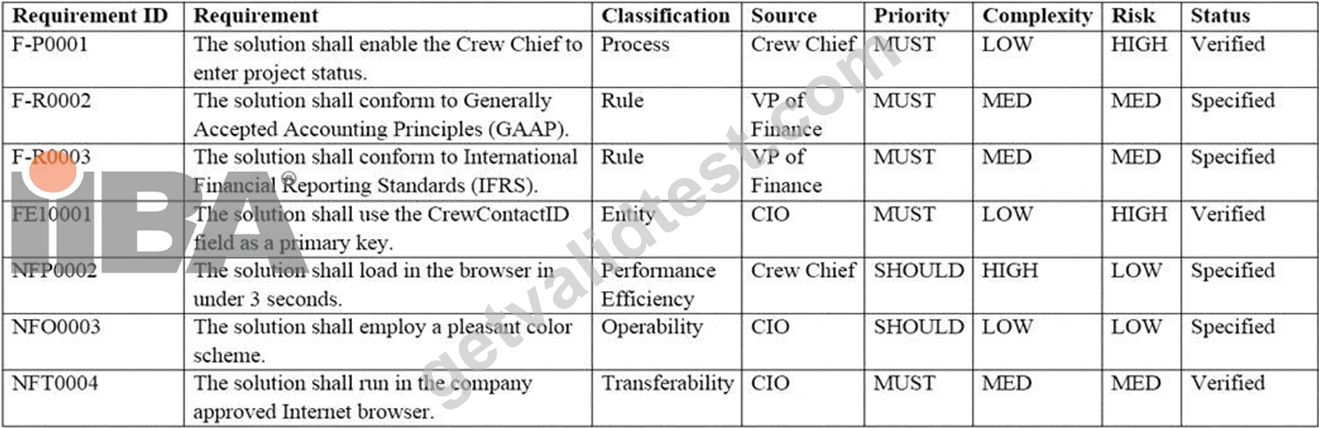
The BA will create a Data Model to meet which requirement?
- A. Requirement ID F-R0002
- B. Requirement ID NFP0002
- C. Requirement ID F-R0003
- D. Requirement ID FE10001
Answer: D
Explanation:
The business analyst (BA) will create a Data Model to meet Requirement ID FE10001, as it is related to the entity classification, specifically stating "The solution shall use the CrewContactID field as a primary key." This requirement indicates the need for structuring data and defining how data elements are related, which is typically addressed through a Data Model. References: The answer can be verified from the following sources:
* A Guide to the Business Analysis Body of Knowledge(BABOKGuide) Version 3, Chapter 9: Data Modeling, p. 326-331.
* Business Analysis Professional (CBAP) Learning documents or resources available on IIBA's official website and bookstore.
NEW QUESTION # 152
What does the T in SWOT analysis mean?
- A. Threats
- B. Trial
- C. Time
- D. Test
Answer: A
Explanation:
Explanation/Reference:
Explanation:
NEW QUESTION # 153
You are the business analyst for your organization and have many solutions available to an identified problem. You would like a way to quickly and fairly determine which solution is the best choice for your organization.
Which of the following approaches would allow you to determine the top-rated solutions for your organization?
- A. Acceptance and evaluation criteria
- B. Vendor assessment
- C. Scoring system
- D. Voting system
Answer: C
NEW QUESTION # 154
Company A is a nation-wide leader in commercial demolition. Having just celebrated its 100th year of operations, the company decided to begin doing work internationally. The current system used for reporting company finances is unable to keep pace with the potential demands of doing work in geographically dispersed locations. Therefore, the company decided to replace its client-based Profit & Loss (P&L) reporting system with a more robust, web-based system. This will ensure transparency across the organization and enable better decision making.
The business analyst (BA) at Company A has recently completed several rounds of elicitation to determine the requirements for the new, web-based system. Over 1250 requirements were elicited. An initial Requirements Traceability Matrix (RTM) has been drafted, and a subset of the RTM can be seen below: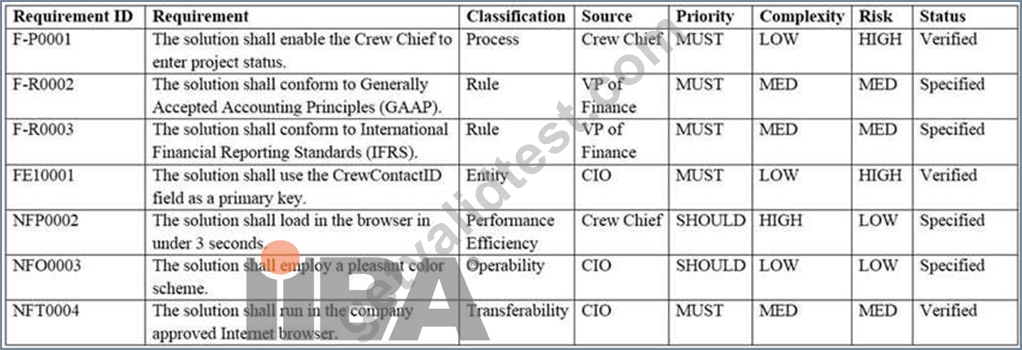
The risk associated with Requirement ID F-P0001 is HIGH. The BA has gone back to the Crew Chief to determine why this requirement's risk is HIGH. The Crew Chief stated that it was based on an assumption.
Which of the following assumptions would make this requirement's risk high?
- A. The users will require specialized training.
- B. The web-based interface will be complex.
- C. The system will be inaccessible in remote locations.
- D. The cost of the solution outweighs its benefit.
Answer: D
Explanation:
Explanation
NEW QUESTION # 155
A business analyst (BA) working on a recently implemented project is approached by the sponsor to provide artifacts that can be used organization wide for the long -term. Which of the following should the BA provide?
- A. High-level business requirements document
- B. Process models
- C. Project solution architecture
- D. Transition requirements document
Answer: B
Explanation:
Explanation
The BA should provide process models as artifacts that can be used organization wide for the long-term.
Process models are graphical representations of the activities, inputs, outputs, and interactions of a business process. They can help to document, analyze, improve, and communicate the current and future states of a process. They can also serve as a basis for developing other artifacts, such as requirements, test cases, user manuals, and training materials. Process models can be useful for various stakeholders, such as business users, managers, developers, testers, and trainers, to understand and optimize the business process. References:
CBAP / CCBA Certified Business Analysis Study Guide, 2nd Edition, Chapter 6: Requirements Analysis and Design Definition, Section 6.4: Model and Validate Requirements, p. 263-264 A Guide to the Business Analysis Body of Knowledge (BABOK Guide), Version 3, Chapter 6:
Requirements Analysis and Design Definition, Section 6.4: Model Requirements, p. 159-160 A Guide to the Business Analysis Body of Knowledge (BABOK Guide), Version 3, Chapter 9:
Solution Evaluation, Section 9.5: Assess Organizational Readiness, p. 261-262
NEW QUESTION # 156
Which of the following types of charts shows which resources are needed in the project and allows you to group the resources by project phase or other attributes?
- A. Organizational Breakdown Structure
- B. Gantt chart
- C. Resource Breakdown Structure
- D. Pareto chart
Answer: C
Explanation:
Explanation/Reference:
Explanation:
NEW QUESTION # 157
Which knowledge area describes the communication and collaboration with the stakeholders
- A. Elicitation and Collaboration
- B. Requirements Life Cycle Management
- C. Requirements Analysis and Design Definition
- D. Business Analysis Planning and Monitoring
Answer: A
NEW QUESTION # 158
A business analyst (BA) is working on a payment system (PS) implementation. A set of systems which should interact with a new system has been identified. The business analyst defined that a user with role of
"Supervisor" in the PS must pass a two-factor authentication before an execution of the functions: "Change system parameters" and "Set up new supervisor." A user must have the role of "Supervisor" to use the standard functions "Send mail notification" or "Send SMS notification".
The BA defined the following use cases:
*"Change system parameters"
*"Setup new supervisor"
*"Send mail notification"
*"Send SMS notification"
*"Send notification"
*"Pass a two-factor authentication"
The BA wants to create a Use Case diagram.
Which technique should be used to define a communications protocol between the PS and other systems?
- A. Vertical prototyping
- B. Concept modelling
- C. System analysis
- D. Interface analysis
Answer: C
NEW QUESTION # 159
......
CBAP dumps Exam Material with 499 Questions: https://www.getvalidtest.com/CBAP-exam.html
CBAP DUMPS Q&As with Explanations Verified & Correct Answers: https://drive.google.com/open?id=1sloUTuMIe7yz_tFvgvks6e8jwBgZCNPu