


KCNA Premium Files Updated Jun-2026 Practice Valid Exam Dumps Question
Practice with KCNA Dumps for Kubernetes Cloud Native Associate Certified Exam Questions & Answer
NEW QUESTION # 110
Explain the concept of "histogram" metrics in Prometheus and provide an example of when they would be beneficial for monitoring.
- A. Histogram metrics are only applicable to monitoring Kubernetes clusters, not for general system monitoring.
- B. Histogram metrics are used for storing and retrieving time series data in a compressed format, optimizing storage space.
- C. Histogram metrics provide a detailed distribution of values for a specific metric, allowing for analysis of performance bottlenecks or outlier behavior.
- D. Histogram metrics are designed to track changes in metric values over time, providing a historical view of performance trends.
- E. Histogram metrics are used to create custom dashboards with interactive elements for visualizing data.
Answer: C
Explanation:
Histogram metrics provide a distribution of values for a metric. This is beneficial for monitoring scenarios where you want to understand the spread of values, such as response times of a web service. You can use the histogram to see how many requests fall within different response time buckets, helping identify performance bottlenecks or outlier requests. Histogram metrics can help identify performance issues that might not be evident with a simple average or sum metric.
NEW QUESTION # 111
You are using Istio to manage traffic flow in a microservices architecture. Your application consists of three services: 'service-A', 'service-B', and 'service-C', where 'service-A' depends on 'service-B' and 'service-B' depends on 'service-C'. You want to implement a canary rollout for 'service-B' to test a new version before rolling it out to all users. How would you configure Istio to achieve this?
- A. Create a new Istio VirtualService for 'service-B' and route a percentage of traffic to the new version
- B. Use the 'istio.io/canary' annotation on 'service-B' and configure the rollout percentage
- C. Use the 'istio.io/route' annotation on 'service-B' to specify a weighted distribution of traffic to different versions
- D. Configure 'service-A' to automatically retry requests if they fail to 'service-B' and route to the new version
- E. Deploy the new version of 'service-B' with a different Kubernetes namespace and use Istio to route traffic to the new namespace
Answer: A
Explanation:
Istio's VirtualService allows you to define routing rules that can direct a percentage of traffic to a specific version of a service- This enables you to perform canary rollouts by gradually introducing the new version of 'service-B' to a subset of users- Option A is not a valid Istio configuration option- Option C creates unnecessary complexity Option D is related to retries, not canary rollouts. Option E is closer but doesn't specify the percentage split.
NEW QUESTION # 112
Kubernetes ___ protect you against voluntary interruptions (such as deleting Pods, draining nodes) to run applications in a highly available manner.
- A. Resource Limits and Requests
- B. Pod Disruption Budgets
- C. Taints and Tolerations
- D. Pod Topology Spread Constraints
Answer: B
Explanation:
The correct answer is B: Pod Disruption Budgets (PDBs). A PDB is a policy object that limits how many Pods of an application can be voluntarily disrupted at the same time. "Voluntary disruptions" include actions such as draining a node for maintenance (kubectl drain), cluster upgrades, or an administrator deleting Pods.
The core purpose is to preserve availability by ensuring that a minimum number (or percentage) of replicas remain running and ready while those planned disruptions occur.
A PDB is typically defined with either minAvailable (e.g., "at least 3 Pods must remain available") or maxUnavailable (e.g., "no more than 1 Pod can be unavailable"). Kubernetes uses this budget when performing eviction operations. If evicting a Pod would violate the PDB, the eviction is blocked (or delayed), which forces maintenance workflows to proceed more safely-either by draining more slowly, scaling up first, or scheduling maintenance in stages.
Why the other options are not correct: topology spread constraints (A) influence scheduling distribution across failure domains but don't directly protect against voluntary disruptions. Taints and tolerations (C) control where Pods can schedule, not how many can be disrupted. Resource requests/limits (D) control CPU
/memory allocation and do not guard availability during drains or deletions.
PDBs also work best when paired with Deployments/StatefulSets that maintain replicas and with readiness probes that accurately represent whether a Pod can serve traffic. PDBs do not prevent involuntary disruptions (node crashes), but they materially reduce risk during planned operations-exactly what the question is targeting.
=========
NEW QUESTION # 113
You are tasked with deploying a microservices application on Kubernetes. The application relies heavily on communication between its different services, and you need to ensure reliable and secure communication. Which of the following open standards are most relevant for this scenario?
- A. Kubernetes API
- B. Open Container Initiative (OCI)
- C. Service Level Objectives (SLOs)
- D. Cloud Native Computing Foundation (CNCF)
- E. Open Service Mesh (OSM)
Answer: E
Explanation:
Open Service Mesh (OSM) is an open standard focused on providing a secure and reliable way to connect microservices. It helps with service discovery, load balancing, traffic management, and security features, making it ideal for deploying microservices applications on Kubernetes.
NEW QUESTION # 114
What is the primary interface for Kubernetes cluster?
- A. Kubernetes Api
- B. YAML
- C. JSON
- D. Control Plane
- E. Kubelet
Answer: A
Explanation:
https://kubernetes.io/docs/concepts/overview/components/#kube-apiserver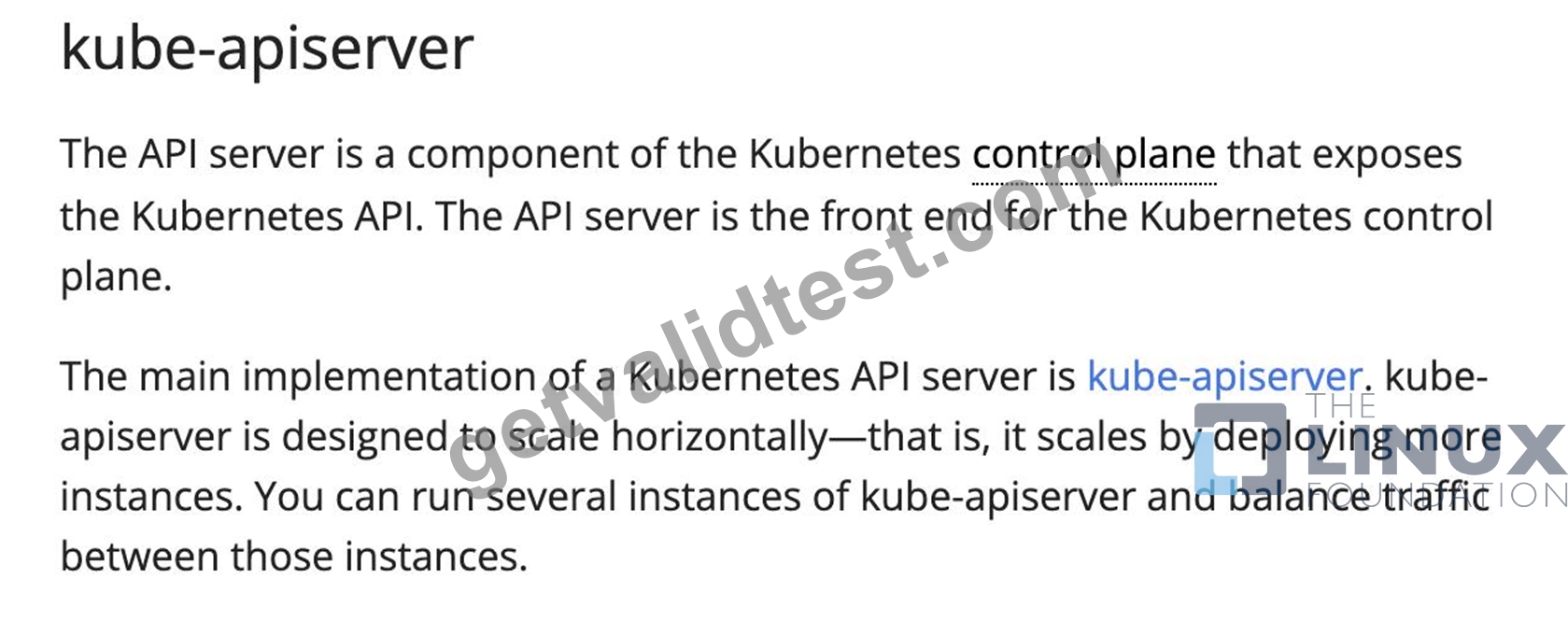
NEW QUESTION # 115
Which statement best describes the role of kubelet on a Kubernetes worker node?
- A. kubelet acts as the primary API component that stores and manages cluster state information.
- B. kubelet monitors cluster-wide resource usage and assigns Pods to the most suitable nodes for execution.
- C. kubelet configures networking rules on each node to handle traffic routing for Services in the cluster.
- D. kubelet manages the container runtime and ensures that all Pods scheduled to the node are running as expected.
Answer: D
Explanation:
The kubelet is the primary node-level agent in Kubernetes and is responsible for ensuring that workloads assigned to a worker node are executed correctly. Its core function is to manage container execution on the node and ensure that all Pods scheduled to that node are running as expected, which makes option A the correct answer.
Once the Kubernetes scheduler assigns a Pod to a node, the kubelet on that node takes over responsibility for running the Pod. It continuously watches the API server for Pod specifications that target its node and then interacts with the container runtime (such as containerd or CRI-O) through the Container Runtime Interface (CRI). The kubelet starts, stops, and restarts containers to match the desired state defined in the Pod specification.
In addition to lifecycle management, the kubelet performs ongoing health monitoring. It executes liveness, readiness, and startup probes, reports Pod and node status back to the API server, and enforces resource limits defined in the Pod specification. If a container crashes or becomes unhealthy, the kubelet initiates recovery actions such as restarting the container.
Option B is incorrect because configuring Service traffic routing is the responsibility of kube-proxy and the cluster's networking layer, not the kubelet. Option C is incorrect because cluster-wide resource monitoring and Pod placement decisions are handled by the kube-scheduler. Option D is incorrect because cluster state is managed by the API server and stored in etcd, not by the kubelet.
In summary, the kubelet acts as the executor and supervisor of Pods on each worker node. It bridges the Kubernetes control plane and the actual runtime environment, ensuring that containers are running, healthy, and aligned with the declared configuration. Therefore, Option A is the correct and verified answer.
NEW QUESTION # 116
You have deployed an application in Kubernetes with a container image that has known vulnerabilities. Which of the following security measures is MOST effective in mitigating the risk of these vulnerabilities?
- A. Deploying the application in a separate namespace.
- B. Using a container security scanner to identify and fix vulnerabilities.
- C. Disabling Kubernetes RBAC and granting full access to all users.
- D. Running all containers with the '--privileged' flag enabled.
- E. Deploying the application in a private Kubernetes cluster.
Answer: B
Explanation:
Using a container security scanner to identify and fix vulnerabilities is the most effective measure for mitigating the risk of known vulnerabilities in your container images. These scanners analyze your images for known security issues and provide recommendations for patching or upgrading them. This helps you proactively address potential vulnerabilities and improve the overall security of your Kubernetes applications.
NEW QUESTION # 117
Which of the following workload requires a headless Service while deploying into the namespace?
- A. CronJob
- B. DaemonSet
- C. StatefulSet
- D. Deployment
Answer: C
Explanation:
A StatefulSet commonly requires a headless Service, so A is the correct answer. In Kubernetes, StatefulSets are designed for workloads that need stable identities, stable network names, and often stable storage per replica. To support that stable identity model, Kubernetes typically uses a headless Service (spec.clusterIP:
None) to provide DNS records that map directly to each Pod, rather than load-balancing behind a single virtual ClusterIP.
With a headless Service, DNS queries return individual endpoint records (the Pod IPs) so that each StatefulSet Pod can be addressed predictably, such as pod-0.service-name.namespace.svc.cluster.local. This is critical for clustered databases, quorum systems, and leader/follower setups where members must discover and address specific peers. The StatefulSet controller then ensures ordered creation/deletion and preserves identity (pod-0, pod-1, etc.), while the headless Service provides discovery for those stable hostnames.
CronJobs run periodic Jobs and don't require stable DNS identity for multiple replicas. Deployments manage stateless replicas and normally use a standard Service that load-balances across Pods. DaemonSets run one Pod per node, and while they can be exposed by Services, they do not intrinsically require headless discovery.
So while you can use a headless Service for other designs, StatefulSet is the workload type most associated with "requires a headless Service" due to how stable identities and per-Pod addressing work in Kubernetes.
NEW QUESTION # 118
In a cloud native environment, who is usually responsible for maintaining the workloads running across the different platforms?
- A. The Site Reliability Engineering (SRE) team.
- B. The team of developers.
- C. The Support Engineering team (SE).
- D. The cloud provider.
Answer: A
Explanation:
B (the Site Reliability Engineering team) is correct. In cloud-native organizations, SREs are commonly responsible for the reliability, availability, and operational health of workloads across platforms (multiple clusters, regions, clouds, and supporting services). While responsibilities vary by company, the classic SRE charter is to apply software engineering to operations: build automation, standardize runbooks, manage incident response, define SLOs/SLIs, and continuously improve system reliability.
Maintaining workloads "across different platforms" implies cross-cutting operational ownership: deployments need to behave consistently, rollouts must be safe, monitoring and alerting must be uniform, and incident practices must work across environments. SRE teams typically own or heavily influence the observability stack (metrics/logs/traces), operational readiness, capacity planning, and reliability guardrails (error budgets, progressive delivery, automated rollback triggers). They also collaborate closely with platform engineering and application teams, but SRE is often the group that ensures production workloads meet reliability targets.
Why other options are less correct:
* The cloud provider (A) maintains the underlying cloud services, but not your application workloads' correctness, SLOs, or operational processes.
* Developers (C) do maintain application code and may own on-call in some models, but the question asks "usually" in cloud-native environments; SRE is the widely recognized function for workload reliability across platforms.
* Support Engineering (D) typically focuses on customer support and troubleshooting from a user perspective, not maintaining platform workload reliability at scale.
So, the best and verified answer is B: SRE teams commonly maintain and ensure reliability of workloads across cloud-native platforms.
=========
NEW QUESTION # 119
What Linux feature is used to provide isolation for containers?
- A. Processes
- B. Services
- C. Control groups
- D. NetworkPolicy
Answer: C
Explanation:
Control groups provide isolation for container processes, keeping them separate from other process-es on the host.
NEW QUESTION # 120
How does dynamic storage provisioning work?
- A. A Pod requests dynamically provisioned storage by including a StorageClass and the Pod name in their PersistentVolumeClaim.
- B. An administrator creates a PersistentVolume and includes the name of the PersistentVolume in their Pod YAML definition file.
- C. An administrator creates a StorageClass and includes it in their Pod YAML definition file without creating a PersistentVolumeClaim.
- D. A user requests dynamically provisioned storage by including an existing StorageClass in their PersistentVolumeClaim.
Answer: D
Explanation:
Dynamic provisioning is the Kubernetes mechanism where storage is created on-demand when a user creates a PersistentVolumeClaim (PVC) that references a StorageClass, so A is correct. In this model, the user does not need to pre-create a PersistentVolume (PV). Instead, the StorageClass points to a provisioner (typically a CSI driver) that knows how to create a volume in the underlying storage system (cloud disk, SAN, NAS, etc.). When the PVC is created with storageClassName: <class>, Kubernetes triggers the provisioner to create a new volume and then binds the resulting PV to that PVC.
This is why option B is incorrect: you do not put a StorageClass "in the Pod YAML" to request provisioning.
Pods reference PVCs, not StorageClasses directly. Option C is incorrect because the PVC does not need the Pod name; binding is done via the PVC itself. Option D describes static provisioning: an admin pre-creates PVs and users claim them by creating PVCs that match the PV (capacity, access modes, selectors). Static provisioning can work, but it is not dynamic provisioning.
Under the hood, the StorageClass can define parameters like volume type, replication, encryption, and binding behavior (e.g., volumeBindingMode: WaitForFirstConsumer to delay provisioning until the Pod is scheduled, ensuring the volume is created in the correct zone). Reclaim policies (Delete/Retain) define what happens to the underlying volume after the PVC is deleted.
In cloud-native operations, dynamic provisioning is preferred because it improves developer self-service, reduces manual admin work, and makes scaling stateful workloads easier and faster. The essence is: PVC + StorageClass # automatic PV creation and binding.
=========
NEW QUESTION # 121
You have a Kubernetes cluster with a custom network plugin that provides advanced networking capabilities. What needs to be considered when configuring this custom network plugin?
- A. Deploy the plugin as a DaemonSet on each Kubernetes node.
- B. Ensure that the custom plugin adheres to the Kubernetes CNI (Container Network Interface) specification.
- C. Configure the plugin to support Kubernetes service discovery and load balancing.
- D. Test the plugin thoroughly with your applications to ensure compatibility and performance.
- E. Integrate the plugin with the Kubernetes API server to manage network resources.
Answer: A,B,C,D,E
Explanation:
All of the options are important considerations when configuring a custom network plugin in Kubernetes- - A Adherence to the CNI specification ensures interoperability with Kubernetes and other CNI plugins- - B: Support for service discovery and load balancing is crucial for seamless integration with Kubernetes services. - C: Integration with the Kubernetes API server allows the plugin to be managed and controlled by Kubernetes- - D Deploying the plugin as a DaemonSet ensures its availability and consistent behavior across all nodes. - E Thorough testing is essential to guarantee compatibility with your applications and the desired performance characteristics.
NEW QUESTION # 122
Which Kubernetes resource workload ensures that all (or some) nodes run a copy of a Pod?
- A. StatefulSet
- B. DaemonSet
- C. kubectl
- D. Deployment
Answer: B
Explanation:
A DaemonSet is the workload controller that ensures a Pod runs on all nodes or on a selected subset of nodes
, so A is correct. DaemonSets are used for node-level agents and infrastructure components that must be present everywhere-examples include log collectors, monitoring agents, storage daemons, CNI components, and node security tools.
The DaemonSet controller watches for node additions/removals. When a new node joins the cluster, Kubernetes automatically schedules a new DaemonSet Pod onto that node (subject to constraints such as node selectors, affinities, and taints/tolerations). When a node is removed, its DaemonSet Pod naturally disappears with it. This creates the "one per node" behavior that differentiates DaemonSets from other workload types.
A Deployment manages a replica count across the cluster, not "one per node." A StatefulSet manages stable identity and ordered operations for stateful replicas; it does not inherently map one Pod to every node. kubectl is a CLI tool and not a workload resource.
DaemonSets can also be scoped: by using node selectors, node affinity, and tolerations, you can ensure Pods run only on GPU nodes, only on Linux nodes, only in certain zones, or only on nodes with a particular label.
That's why the question says "all (or some) nodes."
Therefore, the correct and verified answer is DaemonSet (A).
NEW QUESTION # 123
'kubectl delete -n my-ns po,svc --all' will delete pods and services including uninitialized ones in the namespace 'my-ns'
- A. TRUE
- B. FALSE
Answer: A
Explanation:
https://kubernetes.io/docs/reference/generated/kubectl/kubectl-commands#delete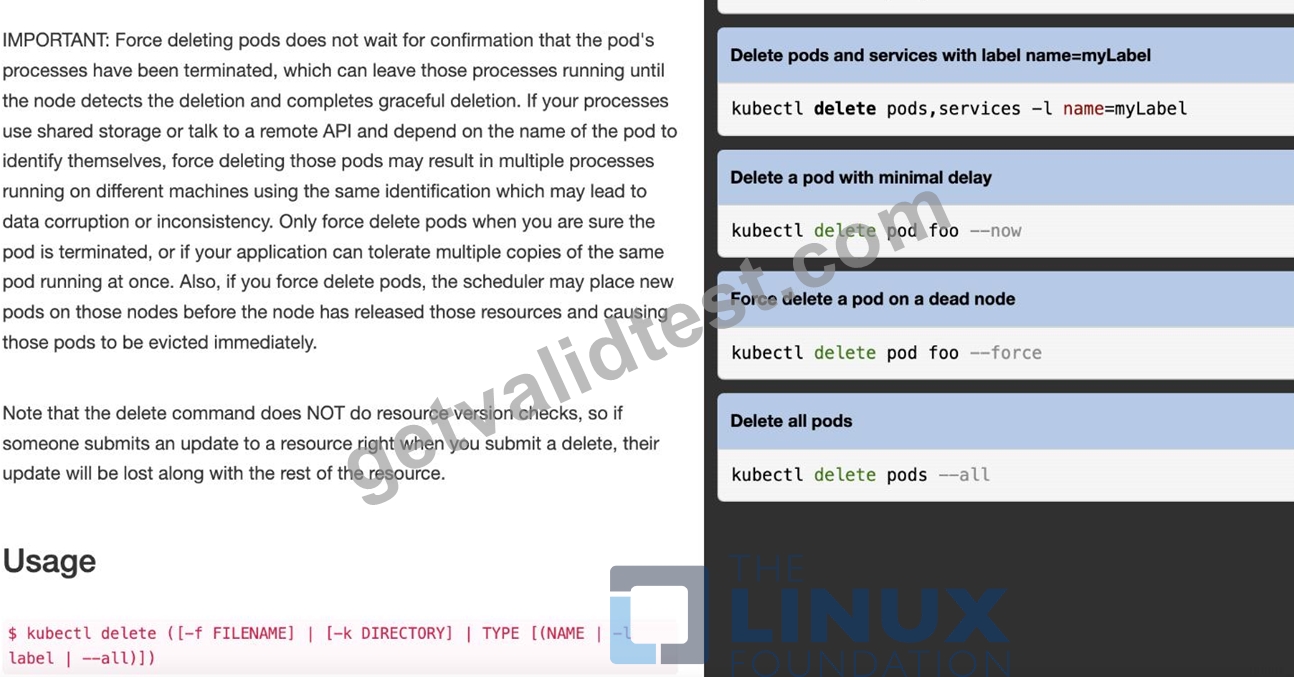
NEW QUESTION # 124
You have a Kubernetes cluster with a pod that uses a resource limit of 100m CPU. What happens if the pod requests more CPU resources than the limit?
- A. The pod will continue to run using the requested amount of CPU.
- B. The pod will be automatically scaled down to 100m CPU.
- C. The pod will be throttled and its performance will be impacted.
- D. The pod will be killed and restarted.
- E. The pod will be scheduled on a different node with more available resources.
Answer: C
Explanation:
The pod will be throttled and its performance will be impacted. The CPIJ limit acts as a hard ceiling, preventing the pod from consuming more resources than specified. Even if the pod requests more CPU, it will be constrained to the limit, leading to performance degradation. The pod will not be killed, restarted, or automatically scaled down. It will continue to run, but its performance will be affected due to the resource constraint.
NEW QUESTION # 125
Can a Kubernetes Service expose multiple ports?
- A. No, you can only expose one port per each Service.
- B. Yes, but you must specify an unambiguous name for each port.
- C. Yes, the only requirement is to use different port numbers.
- D. No, because the only port you can expose is port number 443.
Answer: B
Explanation:
Yes, a Kubernetes Service can expose multiple ports, and when it does, each port should have a unique, unambiguous name, making B correct. In the Service spec, the ports field is an array, allowing you to define multiple port mappings (e.g., 80 for HTTP and 443 for HTTPS, or grpc and metrics). Each entry can include port (Service port), targetPort (backend Pod port), and protocol.
The naming requirement becomes important because Kubernetes needs to disambiguate ports, especially when other resources refer to them. For example, an Ingress backend or some proxies/controllers can reference Service ports by name. Also, when multiple ports exist, a name helps humans and automation reliably select the correct port. Kubernetes documentation and common practice recommend naming ports whenever there is more than one, and in several scenarios it's effectively required to avoid ambiguity.
Option A is incorrect because multi-port Services are common and fully supported. Option C is insufficient: while different port numbers are necessary, naming is the correct distinguishing rule emphasized by Kubernetes patterns and required by some integrations. Option D is incorrect and nonsensical-Services can expose many ports and are not restricted to 443.
Operationally, exposing multiple ports through one Service is useful when a single backend workload provides multiple interfaces (e.g., application traffic and a metrics endpoint). You can keep stable discovery under one DNS name while still differentiating ports. The backend Pods must still listen on the target ports, and selectors determine which Pods are endpoints. The key correctness point for this question is: multi-port Services are allowed, and each port should be uniquely named to avoid confusion and integration issues.
NEW QUESTION # 126
What is the practice of bringing financial accountability to the variable spend model of cloud resources?
- A. FinOps
- B. FaaS
- C. DevOps
- D. CloudCost
Answer: A
Explanation:
The practice of bringing financial accountability to cloud spending-where costs are variable and usage- based-is called FinOps, so D is correct. FinOps (Financial Operations) is an operating model and culture that helps organizations manage cloud costs by connecting engineering, finance, and business teams. Because cloud resources can be provisioned quickly and billed dynamically, traditional budgeting approaches often fail to keep pace. FinOps addresses this by introducing shared visibility, governance, and optimization processes that enable teams to make cost-aware decisions while still moving fast.
In Kubernetes and cloud-native architectures, variable spend shows up in many ways: autoscaling node pools, over-provisioned resource requests, idle clusters, persistent volumes, load balancers, egress traffic, managed services, and observability tooling. FinOps practices encourage tagging/labeling for cost attribution, defining cost KPIs, enforcing budget guardrails, and continuously optimizing usage (right-sizing resources, scaling policies, turning off unused environments, and selecting cost-effective architectures).
Why the other options are incorrect: FaaS (Function as a Service) is a compute model (serverless), not a financial accountability practice. DevOps is a cultural and technical practice focused on collaboration and delivery speed, not specifically cloud cost accountability (though it can complement FinOps). CloudCost is not a widely recognized standard term in the way FinOps is.
In practice, FinOps for Kubernetes often involves improving resource efficiency: aligning requests/limits with real usage, using HPA/VPA appropriately, selecting instance types that match workload profiles, managing cluster autoscaler settings, and allocating shared platform costs to teams via labels/namespaces. It also includes forecasting and anomaly detection, because cloud-native spend can spike quickly due to misconfigurations (e.g., runaway autoscaling or excessive log ingestion).
So, the correct term for financial accountability in cloud variable spend is FinOps (D).
=========
NEW QUESTION # 127
Which component of the kubernetes control-plane (master) are all requests to deploy and manage objects posted to?
- A. ETCD
- B. Controller Manager
- C. Kube-proxy
- D. API Server
- E. Kubelet
Answer: D
Explanation:
https://kubernetes.io/docs/reference/command-line-tools-reference/kube-apiserver/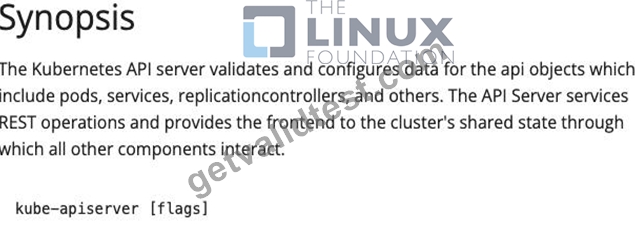
NEW QUESTION # 128
......
REAL KCNA Exam Questions With 100% Refund Guarantee : https://www.getvalidtest.com/KCNA-exam.html
Get Special Discount Offer on KCNA Dumps PDF: https://drive.google.com/open?id=1hEtljkbLXLWRA8oTbVt_msCeqgSzkwnW