


[2026] FCSS_SASE_AD-25 Answers FCSS_SASE_AD-25 Free Demo Are Based On The Real Exam
FCSS_SASE_AD-25 [Jun-2026 Newly Released] Exam Questions For You To Pass
Fortinet FCSS_SASE_AD-25 Exam Syllabus Topics:
| Topic | Details |
|---|---|
| Topic 1 |
|
| Topic 2 |
|
| Topic 3 |
|
| Topic 4 |
|
NEW QUESTION # 24
What are two advantages of using zero-trust tags? (Choose two.)
- A. Zero-trust tags can be used to allow or deny access to network resources.
- B. Zero-trust tags can be assigned to endpoint profiles based on user groups.
- C. Zero-trust tags can determine the security posture of an endpoint.
- D. Zero-trust tags can help monitor endpoint system resource usage.
Answer: A,C
Explanation:
Zero-trust tags assess endpoint compliance based on defined posture rules and are used in access policies to control whether a device is permitted or denied access to specific network resources.
NEW QUESTION # 25
Refer to the exhibits.
Antivirus is installed on a Windows 10 endpoint, but the windows application firewall is stopping it from running. What will the endpoint security posture check be?
- A. FortiClient will prompt the user to enable antivirus.
- B. FortiClient telemetry will be disconnected because of failed compliance.
- C. FortiClient will block the endpoint from getting access to the network.
- D. FortiClient will tag the endpoint as FortiSASE-Non-Compliant.
Answer: C
NEW QUESTION # 26
Which authentication method overrides any other previously configured user authentication on FortiSASE?
- A. RADIUS
- B. MFA
- C. Local
- D. SSO
Answer: D
Explanation:
Single Sign-On (SSO) overrides any other previously configured user authentication method on FortiSASE, taking precedence for user authentication.
NEW QUESTION # 27
Refer to the exhibit.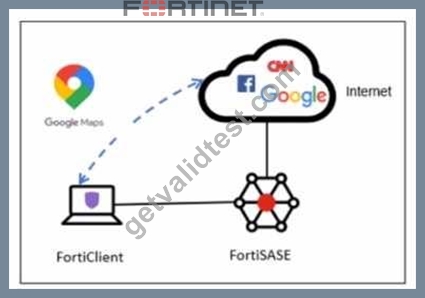
A company has a requirement to inspect all the endpoint internet traffic on FortiSASE, and exclude Google Maps traffic from the FortiSASE VPN tunnel and redirect it to the endpoint physical Interface. Which configuration must you apply to achieve this requirement?
- A. Configure a static route with the Google Maps FQDN on the endpoint to redirect traffic
- B. Configure the Google Maps FQDN as a split tunneling destination on the FortiSASE endpoint profile.
- C. Change the default DNS server configuration on FortiSASE to use the endpoint system DNS.
- D. Exempt the Google Maps FQDN from the endpoint system proxy settings.
Answer: B
Explanation:
To meet the requirement of inspecting all endpoint internet traffic on FortiSASE while excluding Google Maps traffic from the FortiSASE VPN tunnel and redirecting it to the endpoint's physical interface, you should configure split tunneling. Split tunneling allows specific traffic to bypass the VPN tunnel and be routed directly through the endpoint's local interface.
Split Tunneling Configuration:
Split tunneling enables selective traffic to be routed outside the VPN tunnel.
By configuring the Google Maps Fully Qualified Domain Name (FQDN) as a split tunneling destination, you ensure that traffic to Google Maps bypasses the VPN tunnel and uses the endpoint's local interface instead.
Implementation Steps:
Access the FortiSASE endpoint profile configuration.
Add the Google Maps FQDN to the split tunneling destinations list.
This configuration directs traffic intended for Google Maps to bypass the VPN tunnel and be routed directly through the endpoint's physical network interface.
FortiOS 7.2 Administration Guide: Provides details on split tunneling configuration.
FortiSASE 23.2 Documentation: Explains how to set up and manage split tunneling for specific destinations.
NEW QUESTION # 28
Refer to the exhibit.
To allow access, which web tiller configuration must you change on FortiSASE?
- A. FortiGuard category-based filter
- B. inline cloud access security broker (CASB) headers
- C. URL Filter
- D. content filter
Answer: D
NEW QUESTION # 29
Which statement best describes the Digital Experience Monitor (DEM) feature on FortiSASE?
- A. It provides end-to-end network visibility from all the FortiSASE security PoPs to a specific SaaS application.
- B. It is used for performing device compliance checks on endpoints.
- C. It gathers all the vulnerability information from all the FortiClient endpoints.
- D. It monitors the FortiSASE POP health based on ping probes.
Answer: A
Explanation:
The Digital Experience Monitor (DEM) in FortiSASE measures and monitors network performance from the FortiSASE Points of Presence (PoPs) to specific SaaS or cloud applications, helping identify and troubleshoot performance issues across the service path.
NEW QUESTION # 30
Refer to the exhibits.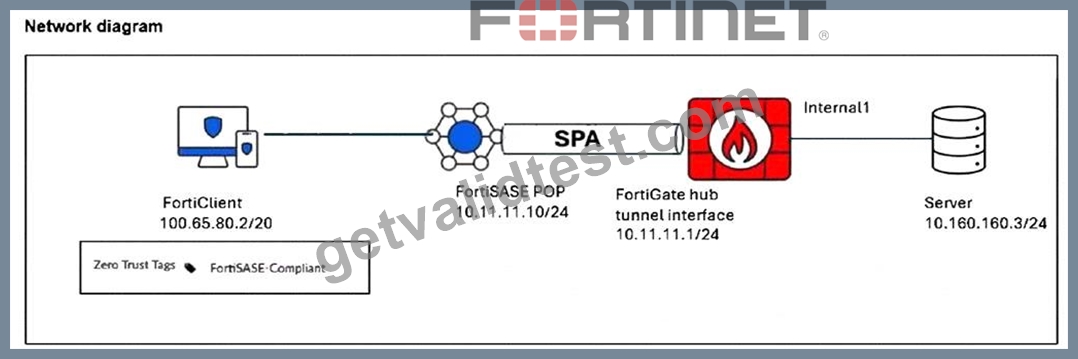
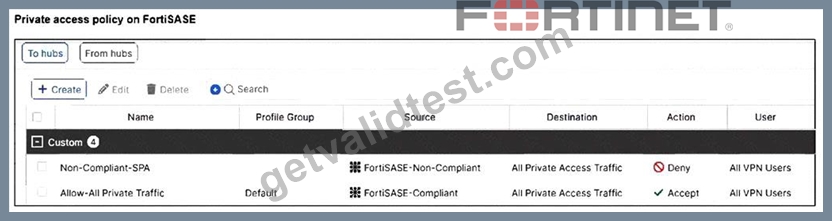

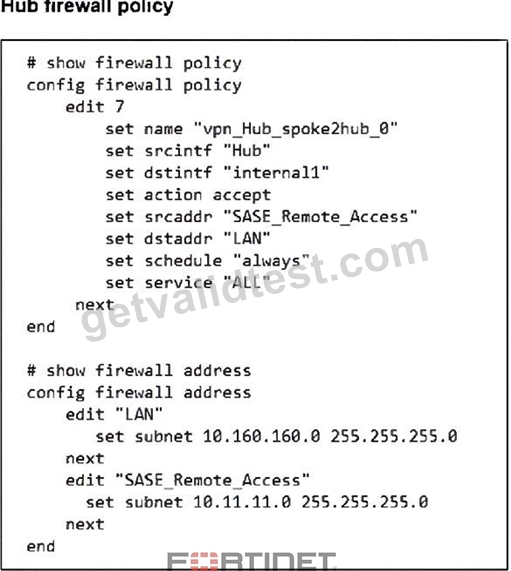
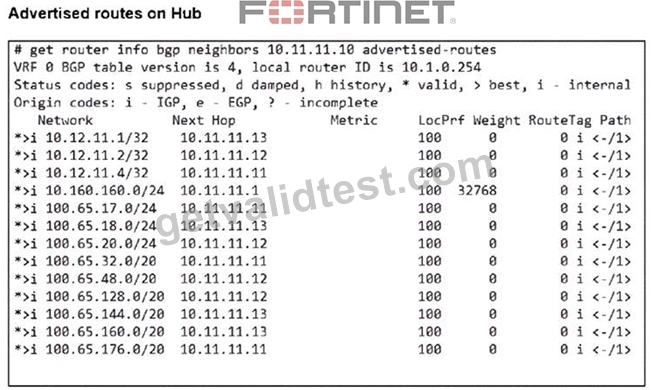
A FortiSASE administrator has configured FortiSASE as a spoke to a FortiGate hub. The tunnel is up to the FortiGate hub. However, the remote FortiClient is not able to access the web server hosted behind the FortiGate hub.
Based on the exhibits, what is the reason for the access failure?
- A. The hub is not advertising the required routes.
- B. The server subnet BGP route was not received on FortiSASE.
- C. A private access policy has denied the traffic because of failed compliance
- D. The hub firewall policy does not include the FortiClient address range.
Answer: B
Explanation:
The FortiSASE BGP learned routes do not include the 10.160.160.0/24 subnet (server network). Although the FortiGate hub is advertising this route (10.160.160.0/24) to FortiSASE, it is not visible in the FortiSASE BGP route table - indicating a routing issue. Without this route, FortiSASE cannot forward traffic from FortiClient to the server.
NEW QUESTION # 31
Which policy type is used to control traffic between the FortiClient endpoint to FortiSASE for secure internet access?
- A. thin edge policy
- B. VPN policy
- C. private access policy
- D. secure web gateway (SWG) policy
Answer: B
NEW QUESTION # 32
Which two of the following can release the network lockdown on the endpoint applied by FortiSASE?
(Choose two.)\
- A. When the endpoint connects to the FortiSASE tunnel
- B. When the endpoint is rebooted
- C. When the endpoint is determined as on-net
- D. When the endpoint is determined as compliant using ZTNA tags
Answer: A,D
Explanation:
FortiSASE releases network lockdown when the endpoint re-establishes the tunnel connection or when it is verified as compliant through ZTNA tag evaluation, ensuring it meets security posture requirements.
NEW QUESTION # 33
Which two components are part of onboarding a secure web gateway (SWG) endpoint? (Choose two)
- A. FortiSASE invitation code
- B. FortiClient installer
- C. FortiSASE CA certificate
- D. proxy auto-configuration (PAC) file
Answer: C,D
Explanation:
Onboarding a Secure Web Gateway (SWG) endpoint involves several components to ensure secure and effective integration with FortiSASE. Two key components are the FortiSASE CA certificate and the proxy auto-configuration (PAC) file.
FortiSASE CA Certificate:
The FortiSASE CA certificate is essential for establishing trust between the endpoint and the FortiSASE infrastructure.
It ensures that the endpoint can securely communicate with FortiSASE services and inspect SSL/TLS traffic.
Proxy Auto-Configuration (PAC) File:
The PAC file is used to configure the endpoint to direct web traffic through the FortiSASE proxy.
It provides instructions on how to route traffic, ensuring that all web requests are properly inspected and filtered by FortiSASE.
FortiOS 7.2 Administration Guide: Details on onboarding endpoints and configuring SWG.
FortiSASE 23.2 Documentation: Explains the components required for integrating endpoints with FortiSASE and the process for deploying the CA certificate and PAC file.
NEW QUESTION # 34
Which two settings are automatically pushed from FortiSASE to FortiClient in a new FortiSASE deployment with default settings? (Choose two.)
- A. zero trust network access (ZTNA) tags
- B. tunnel profile
- C. real-time protection
- D. FortiSASE certificate authority (CA) certificate
Answer: B,D
Explanation:
In a default FortiSASE deployment, the tunnel profile (for secure connectivity) and the FortiSASE CA certificate (for SSL inspection and trusted communication) are automatically pushed to FortiClient endpoints.
NEW QUESTION # 35
What is the benefit of SD-WAN on-ramp deployment with FortiSASE?
- A. To manage branch location endpoints
- B. To secure internet traffic for branch users
- C. To provide device compliance checks using ZTNA tags
- D. To provide access to private applications using the bookmark portal
Answer: B
Explanation:
SD-WAN on-ramp with FortiSASE directs branch user internet traffic to the FortiSASE cloud for consistent security enforcement and protection, regardless of the branch location.
NEW QUESTION # 36
How can FortiView be utilized to enhance security posture within an organization?
- A. By displaying ads relevant to the IT department
- B. By broadcasting system updates
- C. By tracking the physical locations of network devices
- D. By providing detailed insights into application usage
Answer: D
NEW QUESTION # 37
Refer to the exhibits.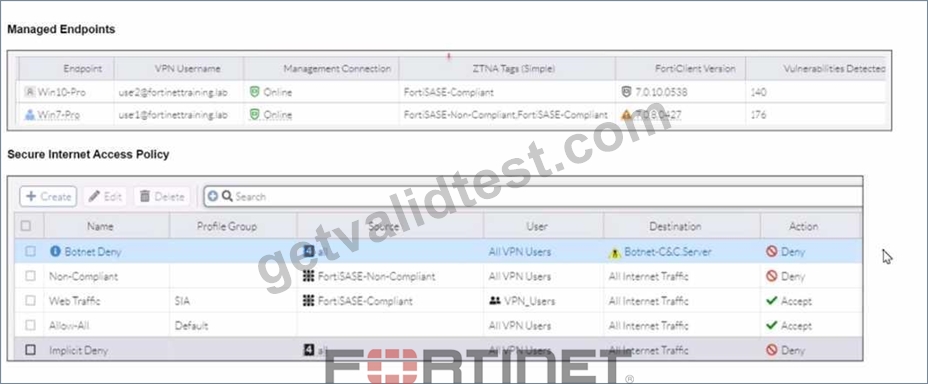
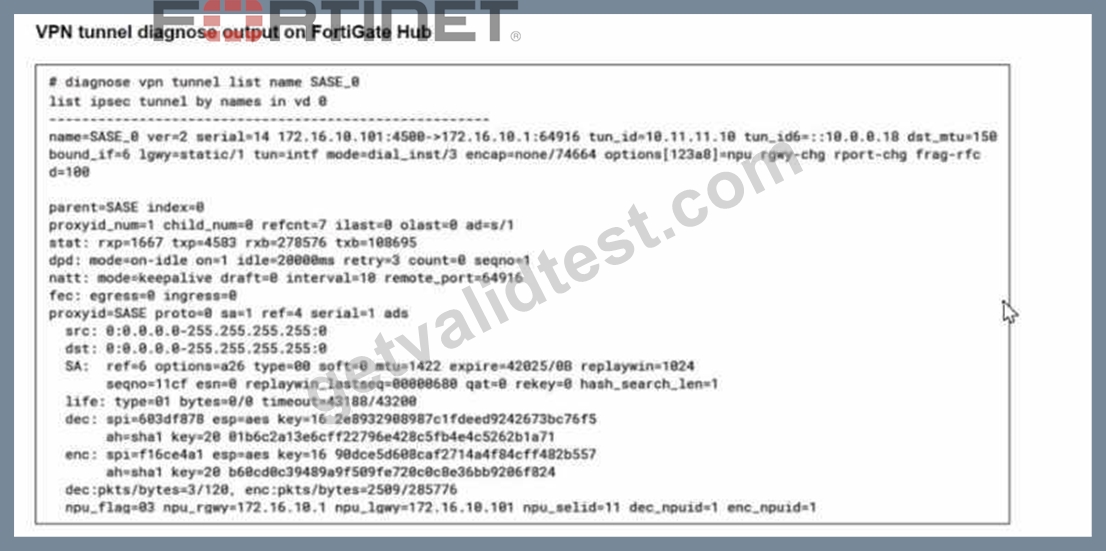
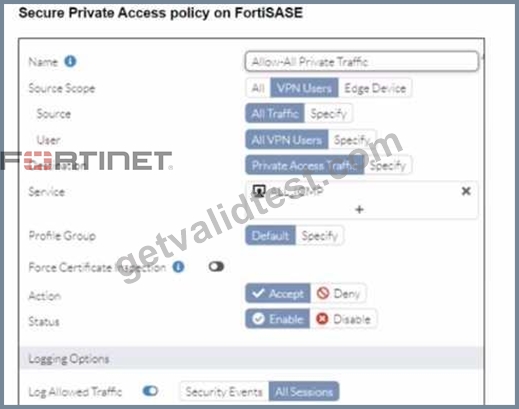
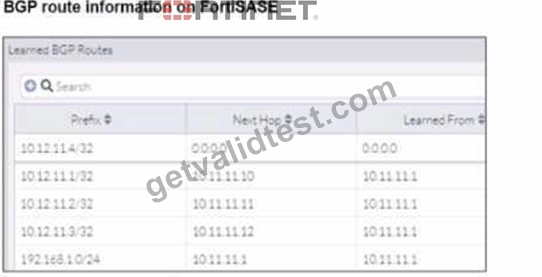

A FortiSASE administrator is trying to configure FortiSASE as a spoke to a FortiGate hub. The tunnel is up to the FortiGale hub. However, the administrator is not able to ping the webserver hosted behind the FortiGate hub. Based on the output, what is the reason for the ping failures?
- A. Quick mode selectors are restricting the subnet.
- B. The BGP route is not received.
- C. Network address translation (NAT) is not enabled on the spoke-to-hub policy.
- D. The Secure Private Access (SPA) policy needs to allow PING service.
Answer: B
NEW QUESTION # 38
What can be configured on FortiSASE as an additional layer of security for FortiClient registration?
- A. user verification
- B. application inventory
- C. device identification
- D. security posture tags
Answer: A
NEW QUESTION # 39
......
New 2026 Realistic Free Fortinet FCSS_SASE_AD-25 Exam Dump Questions and Answer: https://www.getvalidtest.com/FCSS_SASE_AD-25-exam.html
Fortinet FCSS_SASE_AD-25 Exam: Basic Questions With Answers: https://drive.google.com/open?id=1pKTKJwbDMIaY5zeZBvyvFzT4ICIIRRrq