


AIP-210 Dumps To Pass Certified AI Practitioner Exam in One Day (Updated 95 Questions)
AIP-210 Exam Brain Dumps - Study Notes and Theory
CertNexus AIP-210 Exam Syllabus Topics:
| Topic | Details |
|---|---|
| Topic 1 |
|
| Topic 2 |
|
| Topic 3 |
|
| Topic 4 |
|
NEW QUESTION # 31
You are building a prediction model to develop a tool that can diagnose a particular disease so that individuals with the disease can receive treatment. The treatment is cheap and has no side effects. Patients with the disease who don't receive treatment have a high risk of mortality.
It is of primary importance that your diagnostic tool has which of the following?
- A. High negative predictive value
- B. Low false negative rate
- C. High positive predictive value
- D. Low false positive rate
Answer: B
Explanation:
A false negative is an error where a positive case (belonging to the target class) is incorrectly predicted as negative (not belonging to the target class). A false negative rate is the ratio of false negatives to all actual positive cases. A low false negative rate means that most of the positive cases are correctly identified by the classifier.
For a diagnostic tool that can diagnose a particular disease so that individuals with the disease can receive treatment, it is of primary importance that it has a low false negative rate. This is because false negatives can have serious consequences for patients who have the disease but do not receive treatment, such as increased risk of mortality or complications. A low false negative rate can ensure that most patients who have the disease are diagnosed correctly and receive timely treatment.
NEW QUESTION # 32
Which of the following methods can be used to rebalance a dataset using the rebalance design pattern?
- A. Stacking
- B. Weighted class
- C. Bagging
- D. Boosting
Answer: B
Explanation:
Explanation
Weighted class is a technique to rebalance a dataset by assigning different weights to each class, according to their frequency in the dataset. The weights are inversely proportional to the class frequency, meaning that rare classes have higher weights and common classes have lower weights. This helps to reduce the bias towards the majority class and improve the model performance on the minority class. References: 4. Data Validation - Building Machine Learning Pipelines, A guide to React design patterns - LogRocket Blog
NEW QUESTION # 33
Which of the following options is a correct approach for scheduling model retraining in a weather prediction application?
- A. When the input format changes
- B. Once a month
- C. As new resources become available
- D. When the input volume changes
Answer: A
Explanation:
Explanation
The input format is the way that the data is structured, organized, and presented to the model. For example, the input format could be a CSV file, an image file, or a JSON object. The input format can affect how the model interprets and processes the data, and therefore how it makes predictions. When the input format changes, it may require retraining the model to adapt to the new format and ensure its accuracy and reliability. For example, if the weather prediction application switches from using numerical values to categorical values for some features, such as wind direction or cloud cover, it may need to retrain the model to handle these changes
.
NEW QUESTION # 34
In which of the following scenarios is lasso regression preferable over ridge regression?
- A. There is high collinearity among some of the features associated with the dependent variable.
- B. The sample size is much larger than the number of features.
- C. The number of features is much larger than the sample size.
- D. There are many features with no association with the dependent variable.
Answer: D
Explanation:
Explanation
Lasso regression is a type of linear regression that adds a regularization term to the loss function to reduce overfitting and improve generalization. Lasso regression uses an L1 norm as the regularization term, which is the sum of the absolute values of the coefficients. Lasso regression can shrink some of the coefficients to zero, which effectively eliminates some of the features from the model. Lasso regression is preferable over ridge regression when there are many features with no association with the dependent variable, as it can perform feature selection and reduce the complexity and noise of the model.
NEW QUESTION # 35
Which of the following is NOT a valid cross-validation method?
- A. Bootstrapping
- B. K-fold
- C. Leave-one-out
- D. Stratification
Answer: D
Explanation:
Stratification is not a valid cross-validation method, but a technique to ensure that each subset of data has the same proportion of classes or labels as the original data. Stratification can be used in conjunction with cross- validation methods such as k-fold or leave-one-out to preserve the class distribution and reduce bias or variance in the validation results. Bootstrapping, k-fold, and leave-one-out are all valid cross-validation methods that use different ways of splitting and resampling the data to estimate the performance of a machine learning model.
NEW QUESTION # 36
Which two of the following statements about the beta value in an A/B test are accurate? (Select two.)
- A. The Beta in an Alpha/Beta test represents one of the two variants of the A/B test.
- B. The statistical power of a test is the inverse of the Beta value, or 1 - Beta.
- C. The Beta value is the rate of type II errors for the test.
- D. The Beta value is the rate of type I errors for the test.
Answer: C
Explanation:
The Beta value in an A/B test is the probability of making a type II error, which is failing to reject the null hypothesis when it is false. The statistical power of a test is the probability of correctly rejecting the null hypothesis when it is false, which is equal to 1 - Beta. References: Formulas for Bayesian A/B Testing - Evan Miller, The Practical Guide To AB testing statistics | Convertize
NEW QUESTION # 37
Which of the following models are text vectorization methods? (Select two.)
- A. TF-IDF
- B. t-SNE
- C. PCA
- D. Lemmatization
- E. Skip-gram
- F. Tokenization
Answer: A,E
Explanation:
Explanation
Skip-gram and TF-IDF are both text vectorization methods that convert text into numerical feature vectors.
Skip-gram is a prediction-based word embedding method that learns vector representations of words from their contexts in a large corpus of text. TF-IDF is a frequency-based word weighting method that assigns scores to words based on their importance in a document and in a corpus of documents. References: Text Vectorization and Word Embedding | Guide to Master NLP (Part 5), What Is Text Vectorization? Everything You Need to Know - deepset
NEW QUESTION # 38 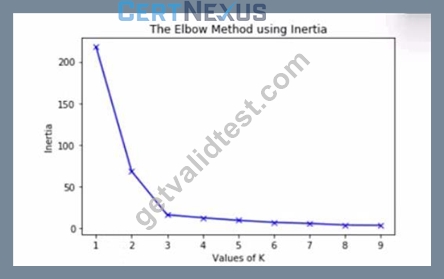
The graph is an elbow plot showing the inertia or within-cluster sum of squares on the y-axis and number of clusters (also called K) on the x-axis, denoting the change in inertia as the clusters change using k-means algorithm.
What would be an optimal value of K to ensure a good number of clusters?
- A. 0
- B. 1
- C. 2
- D. 3
Answer: B
Explanation:
Explanation
The optimal value of K is the one that minimizes the inertia or within-cluster sum of squares, while avoiding too many clusters that may overfit the data. The elbow plot shows a sharp decrease in inertia from K = 1 to K
= 2, and then a more gradual decrease from K = 2 to K = 3. After K = 3, the inertia does not change much as K increases. Therefore, the elbow point is at K = 3, which is the optimal value of K for this data. References:
How to Run K-Means Clustering in Python, K-means clustering - Wikipedia
NEW QUESTION # 39
A big data architect needs to be cautious about personally identifiable information (PII) that may be captured with their new IoT system. What is the final stage of the Data Management Life Cycle, which the architect must complete in order to implement data privacy and security appropriately?
- A. Destroy
- B. Detain
- C. Duplicate
- D. De-Duplicate
Answer: A
Explanation:
Explanation
The final stage of the data management life cycle is data destruction, which is the process of securely deleting or erasing data that is no longer needed or relevant for the organization. Data destruction ensures that data is disposed of in compliance with any legal or regulatory requirements, as well as any internal policies or standards. Data destruction also protects the organization from potential data breaches, leaks, or thefts that could compromise its privacy and security. Data destruction can be performed using various methods, such as overwriting, degaussing, shredding, or incinerating
NEW QUESTION # 40
A product manager is designing an Artificial Intelligence (AI) solution and wants to do so responsibly, evaluating both positive and negative outcomes.
The team creates a shared taxonomy of potential negative impacts and conducts an assessment along vectors such as severity, impact, frequency, and likelihood.
Which modeling technique does this team use?
- A. Threat
- B. Business
- C. Process
- D. Harms
Answer: D
Explanation:
Explanation
Harms modeling is a technique that helps product managers design AI solutions responsibly by evaluating both positive and negative outcomes. Harms modeling involves creating a shared taxonomy of potential negative impacts and conducting an assessment along vectors such as severity, impact, frequency, and likelihood. Harms modeling can help identify and mitigate any risks or harms that may arise from using AI solutions. References: [Harms Modeling for Responsible AI | by Google Developers | Google Developers],
[Harms Modeling for Responsible AI - YouTube]
NEW QUESTION # 41
An HR solutions firm is developing software for staffing agencies that uses machine learning.
The team uses training data to teach the algorithm and discovers that it generates lower employability scores for women. Also, it predicts that women, especially with children, are less likely to get a high-paying job.
Which type of bias has been discovered?
- A. Emergent
- B. Technical
- C. Automation
- D. Preexisting
Answer: D
Explanation:
Explanation
Preexisting bias is a type of bias that originates from historical or social contexts, such as stereotypes, prejudices, or discriminations. Preexisting bias can affect the data or the algorithm used for machine learning, as well as the outcomes or decisions made by machine learning. Preexisting bias can cause unfair or harmful impacts on certain groups or individuals based on their attributes, such as gender, race, age, or disability3. In this case, the software that uses machine learning generates lower employability scores for women and predicts that women, especially with children, are less likely to get a high-paying job. This indicates that the software has preexisting bias against women, which may reflect the historical or social inequalities or expectations in the labor market.
NEW QUESTION # 42
Why do data skews happen in the ML pipeline?
- A. There Is a mismatch between live input data and offline data.
- B. There is insufficient training data for evaluation.
- C. There is a mismatch between live output data and offline data.
- D. Test and evaluation data are designed incorrectly.
Answer: A
Explanation:
Data skews happen in the ML pipeline when the distribution or characteristics of the live input data differ from those of the offline data used for training and testing the model. This can lead to a degradation of the model performance and accuracy, as the model is not able to generalize well to new data. Data skews can be caused by various factors, such as changes in user behavior, data collection methods, data quality issues, or external events. References: What is training-serving skew in Machine Learning?, Data preprocessing for ML: options and recommendations
NEW QUESTION # 43
A big data architect needs to be cautious about personally identifiable information (PII) that may be captured with their new IoT system. What is the final stage of the Data Management Life Cycle, which the architect must complete in order to implement data privacy and security appropriately?
- A. Destroy
- B. Detain
- C. Duplicate
- D. De-Duplicate
Answer: A
Explanation:
The final stage of the data management life cycle is data destruction, which is the process of securely deleting or erasing data that is no longer needed or relevant for the organization. Data destruction ensures that data is disposed of in compliance with any legal or regulatory requirements, as well as any internal policies or standards. Data destruction also protects the organization from potential data breaches, leaks, or thefts that could compromise its privacy and security. Data destruction can be performed using various methods, such as overwriting, degaussing, shredding, or incinerating
NEW QUESTION # 44
Which of the following equations best represent an LI norm?
- A. |x|-|y|
- B. |x|+|y|^2
- C. |x| + |y|
- D. |x|^2+|y|^2
Answer: C
Explanation:
Explanation
An L1 norm is a measure of distance or magnitude that is defined as the sum of the absolute values of the components of a vector. For example, if x and y are two components of a vector, then the L1 norm of that vector is |x| + |y|. The L1 norm is also known as the Manhattan distance or the taxicab distance, as it represents the shortest path between two points in a grid-like city.
NEW QUESTION # 45
When should the model be retrained in the ML pipeline?
- A. More data become available for the training phase.
- B. A new monitoring component is added.
- C. Some outliers are detected in live data.
- D. Concept drift is detected in the pipeline.
Answer: D
Explanation:
Explanation
When concept drift is detected in the pipeline, it means that the model performance has degraded over time due to changes in the underlying data generating process. This requires retraining the model with new data that reflects the current situation and updating the model parameters accordingly. References: Use pipeline parameters to retrain models in the designer - Azure Machine Learning | Microsoft Learn, Retraining Model During Deployment: Continuous Training and Continuous Testing
NEW QUESTION # 46
Which of the following unsupervised learning models can a bank use for fraud detection?
- A. k-means
- B. Anomaly detection
- C. DB5CAN
- D. Hierarchical clustering
Answer: B
Explanation:
Anomaly detection is an unsupervised learning technique that identifies outliers or abnormal patterns in data, which can be useful for fraud detection. Anomaly detection algorithms can learn the normal behavior of transactions and flag the ones that deviate significantly from the norm, indicating possible fraud.
NEW QUESTION # 47
Which of the following sentences is true about model evaluation and model validation in ML pipelines?
- A. Model evaluation is defined as an external component.
- B. Model evaluation and validation are the same.
- C. Model validation occurs before model evaluation.
- D. Model validation is defined as a set of tasks to confirm the model performs as expected.
Answer: D
Explanation:
Explanation
Model validation is the process of checking whether the model meets the specified requirements and quality standards. It involves testing the model on a validation dataset, which is different from the training and testing datasets, and evaluating the model performance using appropriate metrics. References: Overview of ML Pipelines | Machine Learning, MLOps: Continuous delivery and automation pipelines in machine learning
NEW QUESTION # 48
Which two of the following decrease technical debt in ML systems? (Select two.)
- A. Design anti-patterns
- B. Model complexity
- C. Documentation readability
- D. Refactoring
- E. Boundary erosion
Answer: C,D
Explanation:
Explanation
Technical debt is a metaphor that describes the implied cost of additional work or rework caused by choosing an easy or quick solution over a better but more complex solution. Technical debt can accumulate in ML systems due to various factors, such as changing requirements, outdated code, poor documentation, or lack of testing. Some of the ways to decrease technical debt in ML systems are:
Documentation readability: Documentation readability refers to how easy it is to understand and use the documentation of an ML system. Documentation readability can help reduce technical debt by providing clear and consistent information about the system's design, functionality, performance, and maintenance. Documentation readability can also facilitate communication and collaboration among different stakeholders, such as developers, testers, users, and managers.
Refactoring: Refactoring is the process of improving the structure and quality of code without changing its functionality. Refactoring can help reduce technical debt by eliminating code smells, such as duplication, complexity, or inconsistency. Refactoring can also enhance the readability, maintainability, and extensibility of code.
NEW QUESTION # 49
A classifier has been implemented to predict whether or not someone has a specific type of disease.
Considering that only 1% of the population in the dataset has this disease, which measures will work the BEST to evaluate this model?
- A. Recall and explained variance
- B. Precision and recall
- C. Precision and accuracy
- D. Mean squared error
Answer: B
NEW QUESTION # 50
You have a dataset with thousands of features, all of which are categorical. Using these features as predictors, you are tasked with creating a prediction model to accurately predict the value of a continuous dependent variable. Which of the following would be appropriate algorithms to use? (Select two.)
- A. Logistic regression
- B. Lasso regression
- C. Ridge regression
- D. K-means
- E. K-nearest neighbors
Answer: B,C
Explanation:
Lasso regression and ridge regression are both types of linear regression models that can handle high- dimensional and categorical data. They use regularization techniques to reduce the complexity of the model and avoid overfitting. Lasso regression uses L1 regularization, which adds a penalty term proportional to the absolute value of the coefficients to the loss function. This can shrink some coefficients to zero and perform feature selection. Ridge regression uses L2 regularization, which adds a penalty term proportional to the square of the coefficients to the loss function. This can shrink all coefficients towards zero and reduce multicollinearity. References: [Lasso (statistics) - Wikipedia], [Ridge regression - Wikipedia]
NEW QUESTION # 51
Which of the following is the definition of accuracy?
- A. (True Positives + False Positives) / Total Predictions
- B. True Positives / (True Positives + False Negatives)
- C. True Positives / (True Positives + False Positives)
- D. (True Positives + True Negatives) / Total Predictions
Answer: D
Explanation:
Explanation
Accuracy is a measure of how well a classifier can correctly predict the class of an instance. Accuracy is calculated by dividing the number of correct predictions (true positives and true negatives) by the total number of predictions. True positives are instances that are correctly predicted as positive (belonging to the target class). True negatives are instances that are correctly predicted as negative (not belonging to the target class).
NEW QUESTION # 52
For a particular classification problem, you are tasked with determining the best algorithm among SVM, random forest, K-nearest neighbors, and a deep neural network. Each of the algorithms has similar accuracy on your data. The stakeholders indicate that they need a model that can convey each feature's relative contribution to the model's accuracy. Which is the best algorithm for this use case?
- A. SVM
- B. K-nearest neighbors
- C. Deep neural network
- D. Random forest
Answer: D
Explanation:
Explanation
Random forest is an ensemble learning method that combines multiple decision trees to create a more accurate and robust classifier or regressor. Random forest can convey each feature's relative contribution to the model's accuracy by measuring how much the prediction error increases when a feature is randomly permuted. This metric is called feature importance or Gini importance. Random forest can also provide insights into the interactions and dependencies among features by visualizing the decision trees .
NEW QUESTION # 53
A healthcare company experiences a cyberattack, where the hackers were able to reverse-engineer a dataset to break confidentiality.
Which of the following is TRUE regarding the dataset parameters?
- A. The model is underfitted and trained on a high quantity of patient records.
- B. The model is overfitted and trained on a low quantity of patient records.
- C. The model is overfitted and trained on a high quantity of patient records.
- D. The model is underfitted and trained on a low quantity of patient records.
Answer: B
Explanation:
Overfitting is a problem that occurs when a model learns too much from the training data and fails to generalize well to new or unseen data. Overfitting can result from using a low quantity of training data, a high complexity of the model, or a lack of regularization. Overfitting can also increase the risk of reverse- engineering a dataset from a model's outputs, as the model may reveal too much information about the specific features or patterns of the training data. This can break the confidentiality of the data and expose sensitive information about the individuals in the dataset .
NEW QUESTION # 54
Your dependent variable Y is a count, ranging from 0 to infinity. Because Y is approximately log-normally distributed, you decide to log-transform the data prior to performing a linear regression.
What should you do before log-transforming Y?
- A. Explore the data for outliers.
- B. Divide all the Y values by the standard deviation of Y.
- C. Subtract the mean of Y from all the Y values.
- D. Add 1 to all of the Y values.
Answer: D
Explanation:
Before log-transforming Y, we should add 1 to all of the Y values. This is because log transformation is undefined for zero or negative values, and some of the Y values may be zero. Adding 1 to all of the Y values can avoid this problem and ensure that the log transformation is valid and meaningful. Adding 1 to all of the Y values is also known as a log-plus-one transformation.
NEW QUESTION # 55
A market research team has ratings from patients who have a chronic disease, on several functional, physical, emotional, and professional needs that stay unmet with the current therapy. The dataset also captures ratings on how the disease affects their day-to-day activities.
A pharmaceutical company is introducing a new therapy to cure the disease and would like to design their marketing campaign such that different groups of patients are targeted with different ads. These groups should ideally consist of patients with similar unmet needs.
Which of the following algorithms should the market research team use to obtain these groups of patients?
- A. Logistic regression
- B. Naive-Bayes
- C. k-means clustering
- D. k-nearest neighbors
Answer: C
Explanation:
Explanation
k-means clustering is an algorithm that should be used by the market research team to obtain groups of patients with similar unmet needs. k-means clustering is an unsupervised learning technique that partitions the data into k clusters based on the similarity of the features. The algorithm iteratively assigns each data point to the cluster with the nearest centroid and updates the centroid until convergence. k-means clustering can help identify patterns and segments in the data that may not be obvious or intuitive. References: [K-means clustering - Wikipedia], [How to Run K-Means Clustering in Python]
NEW QUESTION # 56
......
AIP-210 Dumps PDF - Want To Pass AIP-210 Fast: https://www.getvalidtest.com/AIP-210-exam.html
100% Guaranteed Results AIP-210 Unlimited 95 Questions: https://drive.google.com/open?id=1D4MkF5pvI38KaqQkzPoGKF67xmivDThZ