


DP-201 Pre-Exam Practice Tests | (Updated 207 Questions)
Valid DP-201 Exam Q&A PDF - One Year Free Update
NEW QUESTION 108
You need to ensure that security policies for the unauthorized detection system are met.
What should you recommend? To answer, select the appropriate options in the answer area.
NOTE: Each correct selection is worth one point.
Answer:
Explanation:
Explanation:
Box 1: Blob storage
Configure blob storage for audit logs.
Scenario: Unauthorized usage of the Planning Assistance data must be detected as quickly as possible. Unauthorized usage is determined by looking for an unusual pattern of usage.
Data used for Planning Assistance must be stored in a sharded Azure SQL Database.
Box 2: Web Apps
SQL Advanced Threat Protection (ATP) is to be used.
One of Azure's most popular service is App Service which enables customers to build and host web applications in the programming language of their choice without managing infrastructure. App Service offers auto-scaling and high availability, supports both Windows and Linux. It also supports automated deployments from GitHub, Visual Studio Team Services or any Git repository. At RSA, we announced that Azure Security Center leverages the scale of the cloud to identify attacks targeting App Service applications.
References:
https://azure.microsoft.com/sv-se/blog/azure-security-center-can-identify-attacks-targeting-azure-app-service-applications/
NEW QUESTION 109
A company manufactures automobile parts. The company installs IoT sensors on manufacturing machinery.
You must design a solution that analyzes data from the sensors.
You need to recommend a solution that meets the following requirements:
Data must be analyzed in real-time.
Data queries must be deployed using continuous integration.
Data must be visualized by using charts and graphs.
Data must be available for ETL operations in the future.
The solution must support high-volume data ingestion.
Which three actions should you recommend? Each correct answer presents part of the solution.
NOTE: Each correct selection is worth one point.
- A. Develop an Azure Stream Analytics application that queries the data and outputs to Power BI. Use Azure Data Factory to deploy the Azure Stream Analytics application.
- B. Develop an application that sends the IoT data to an Azure Data Lake Storage container.
- C. Develop an application that sends the IoT data to an Azure Event Hub.
- D. Use Azure Analysis Services to query the data. Output query results to Power BI.
- E. Configure an Azure Event Hub to capture data to Azure Data Lake Storage.
- F. Develop an Azure Stream Analytics application that queries the data and outputs to Power BI. Use Azure Pipelines to deploy the Azure Stream Analytics application.
Answer: A,C,E
NEW QUESTION 110
You are planning a design pattern based on the Lambda architecture as shown in the exhibit.
Which Azure services should you use f2 or the cold path? To answer, drag the appropriate services to the correct layers. Each service may be used once, more than once, or not at all. You may need to drag the split bar between panes or scroll to view content.
NOTE: Each correct selection is worth one point.
Answer:
Explanation:
Explanation
Layer 2: Azure Data Lake Storage Gen2
Layer 3: Azure SQL Data Warehouse
Azure SQL Data Warehouse can be used for batch processing.
Note: Lambda architectures use batch-processing, stream-processing, and a serving layer to minimize the latency involved in querying big data.
References:
https://azure.microsoft.com/en-us/blog/lambda-architecture-using-azure-cosmosdb-faster-performance-low-tco-l
https://docs.microsoft.com/en-us/azure/architecture/data-guide/technology-choices/batch-processing
NEW QUESTION 111
Which consistency level should you use for Health Interface?
- A. Session
- B. Strong
- C. Bounded Staleness
- D. Consistent Prefix
Answer: B
Explanation:
Scenario: ADatum identifies the following requirements for the Health Interface application:
..reads must display be the most recent committed version of an item.
Azure Cosmos DB consistency levels include:
Strong: Strong consistency offers a linearizability guarantee. Linearizability refers to serving requests concurrently. The reads are guaranteed to return the most recent committed version of an item. A client never sees an uncommitted or partial write. Users are always guaranteed to read the latest committed write.
References:
https://docs.microsoft.com/en-us/azure/cosmos-db/consistency-levels
NEW QUESTION 112
You are designing a solution for the ad hoc analysis of data in Azure Databricks notebooks. The data will be stored in Azure Blob storage.
You need to ensure that Blob storage will support the recovery of the data if the data is overwritten accidentally.
What should you recommend?
- A. Enable diagnostics logging.
- B. Enable soft delete.
- C. Add a resource lock.
- D. Use read-access geo-redundant storage (RA-GRS).
Answer: B
Explanation:
Soft delete protects blob data from being accidentally or erroneously modified or deleted. When soft delete is enabled for a storage account, blobs, blob versions (preview), and snapshots in that storage account may be recovered after they are deleted, within a retention period that you specify.
Reference:
https://docs.microsoft.com/en-us/azure/storage/blobs/soft-delete-overview Design data processing solutions Testlet 1 Case study This is a case study. Case studies are not timed separately. You can use as much exam time as you would like to complete each case. However, there may be additional case studies and sections on this exam. You must manage your time to ensure that you are able to complete all questions included on this exam in the time provided.
To answer the questions included in a case study, you will need to reference information that is provided in the case study. Case studies might contain exhibits and other resources that provide more information about the scenario that is described in the case study. Each question is independent of the other questions in this case study.
At the end of this case study, a review screen will appear. This screen allows you to review your answers and to make changes before you move to the next section of the exam. After you begin a new section, you cannot return to this section.
To start the case study
To display the first question in this case study, click the Next button. Use the buttons in the left pane to explore the content of the case study before you answer the questions. Clicking these buttons displays information such as business requirements, existing environment, and problem statements. If the case study has an All Information tab, note that the information displayed is identical to the information displayed on the subsequent tabs. When you are ready to answer a question, click the Question button to return to the question.
Background
Trey Research is a technology innovator. The company partners with regional transportation department office to build solutions that improve traffic flow and safety.
The company is developing the following solutions:
Regional transportation departments installed traffic sensor systems on major highways across North America.
Sensors record the following information each time a vehicle passes in front of a sensor:
* Time
* Location in latitude and longitude
* Speed in kilometers per second (kmps)
* License plate number
* Length of vehicle in meters
Sensors provide data by using the following structure:
Traffic sensors will occasionally capture an image of a vehicle for debugging purposes.
You must optimize performance of saving/storing vehicle images.
Traffic sensor data
* Sensors must have permission only to add items to the SensorData collection.
* Traffic data insertion rate must be maximized.
* Once every three months all traffic sensor data must be analyzed to look for data patterns that indicate sensor malfunctions.
* Sensor data must be stored in a Cosmos DB named treydata in a collection named SensorData
* The impact of vehicle images on sensor data throughout must be minimized.
Backtrack
This solution reports on all data related to a specific vehicle license plate. The report must use data from the SensorData collection. Users must be able to filter vehicle data in the following ways:
* vehicles on a specific road
* vehicles driving above the speed limit
Planning Assistance
Data used for Planning Assistance must be stored in a sharded Azure SQL Database.
Data from the Sensor Data collection will automatically be loaded into the Planning Assistance database once a week by using Azure Data Factory. You must be able to manually trigger the data load process.
Privacy and security policy
* Azure Active Directory must be used for all services where it is available.
* For privacy reasons, license plate number information must not be accessible in Planning Assistance.
* Unauthorized usage of the Planning Assistance data must be detected as quickly as possible. Unauthorized usage is determined by looking for an unusual pattern of usage.
* Data must only be stored for seven years.
Performance and availability
* The report for Backtrack must execute as quickly as possible.
* The SLA for Planning Assistance is 70 percent, and multiday outages are permitted.
* All data must be replicated to multiple geographic regions to prevent data loss.
* You must maximize the performance of the Real Time Response system.
Financial requirements
Azure resource costs must be minimized where possible.
NEW QUESTION 113
You are designing an Azure SQL Data Warehouse for a financial services company. Azure Active Directory will be used to authenticate the users.
You need to ensure that the following security requirements are met:
* Department managers must be able to create new database.
* The IT department must assign users to databases.
* Permissions granted must be minimized.
Which role memberships should you recommend? To answer, drag the appropriate roles to the correct groups.
Each role may be used once, more than once, or not at all. You may need to drag the split bar between panes or scroll to view content.
NOTE: Each correct selection is worth one point.
Answer:
Explanation:
Explanation
Box 1: dbmanager
Members of the dbmanager role can create new databases.
Box 2: db_accessadmin
Members of the db_accessadmin fixed database role can add or remove access to the database for Windows logins, Windows groups, and SQL Server logins.
References:
https://docs.microsoft.com/en-us/azure/sql-database/sql-database-manage-logins
NEW QUESTION 114
You are planning a design pattern based on the Lambda architecture as shown in the exhibit.
Which Azure services should you use f2 or the cold path? To answer, drag the appropriate services to the correct layers. Each service may be used once, more than once, or not at all. You may need to drag the split bar between panes or scroll to view content.
NOTE: Each correct selection is worth one point.
Answer:
Explanation:
Explanation
Layer 2: Azure Data Lake Storage Gen2
Layer 3: Azure SQL Data Warehouse
Azure SQL Data Warehouse can be used for batch processing.
Note: Lambda architectures use batch-processing, stream-processing, and a serving layer to minimize the latency involved in querying big data.
References:
https://azure.microsoft.com/en-us/blog/lambda-architecture-using-azure-cosmosdb-faster-performance-low-tco-l
https://docs.microsoft.com/en-us/azure/architecture/data-guide/technology-choices/batch-processing
NEW QUESTION 115
You are designing a streaming solution that must meet the following requirements:
Accept input data from an Azure IoT hub.
Write aggregated data to Azure Cosmos DB.
Calculate minimum, maximum, and average sensor readings every five minutes.
Define calculations by using a SQL query.
Deploy to multiple environments by using Azure Resource Manager templates.
What should you include in the solution?
- A. Azure HDInsight with Spark Streaming
- B. Azure Functions
- C. Azure Stream Analytics
- D. Azure Databricks
Answer: D
Explanation:
Cosmos DB is ideally suited for IoT solutions. Cosmos DB can ingest device telemetry data at high rates.
Architecture
Data flow
Events generated from IoT devices are sent to the analyze and transform layer through Azure IoT Hub as a stream of messages. Azure IoT Hub stores streams of data in partitions for a configurable amount of time.
Azure Databricks, running Apache Spark Streaming, picks up the messages in real time from IoT Hub, processes the data based on the business logic and sends the data to Serving layer for storage. Spark Streaming can provide real time analytics such as calculating moving averages, min and max values over time periods.
Device messages are stored in Cosmos DB as JSON documents.
Reference:
https://docs.microsoft.com/en-us/azure/architecture/solution-ideas/articles/iot-using-cosmos-db
NEW QUESTION 116
You have an Azure Data Lake Storage account that has a virtual network service endpoint configured.
You plan to use Azure Data Factory to extract data from the Data Lake Storage account. The data will then be loaded to a data warehouse in Azure Synapse Analytics by using PolyBase.
Which authentication method should you use to access Data Lake Storage?
- A. service principal authentication
- B. account key authentication
- C. managed identity authentication
- D. shared access key authentication
Answer: C
Explanation:
Reference:
https://docs.microsoft.com/en-us/azure/data-factory/connector-azure-sql-data-warehouse#use-polybase-to-load-data-into-azure-sql-data-warehouse
NEW QUESTION 117
You are evaluating data storage solutions to support a new application.
You need to recommend a data storage solution that represents data by using nodes and relationships in graph structures.
Which data storage solution should you recommend?
- A. Azure Data Lake Store
- B. Blob Storage
- C. Azure Cosmos DB
- D. HDInsight
Answer: C
Explanation:
For large graphs with lots of entities and relationships, you can perform very complex analyses very quickly.
Many graph databases provide a query language that you can use to traverse a network of relationships efficiently.
Relevant Azure service: Cosmos DB
Reference:
https://docs.microsoft.com/en-us/azure/architecture/guide/technology-choices/data-store-overview
NEW QUESTION 118
You are designing an Azure SQL Data Warehouse for a financial services company. Azure Active Directory will be used to authenticate the users.
You need to ensure that the following security requirements are met:
* Department managers must be able to create new database.
* The IT department must assign users to databases.
* Permissions granted must be minimized.
Which role memberships should you recommend? To answer, drag the appropriate roles to the correct groups.
Each role may be used once, more than once, or not at all. You may need to drag the split bar between panes or scroll to view content.
NOTE: Each correct selection is worth one point.
Answer:
Explanation:
Explanation
Box 1: dbmanager
Members of the dbmanager role can create new databases.
Box 2: db_accessadmin
Members of the db_accessadmin fixed database role can add or remove access to the database for Windows logins, Windows groups, and SQL Server logins.
References:
https://docs.microsoft.com/en-us/azure/sql-database/sql-database-manage-logins
NEW QUESTION 119
You are designing a storage solution to store CSV files.
You need to grant a data scientist access to read all the files in a single container of an Azure Storage account. The solution must use the principle of least privilege and provide the highest level of security.
What are two possible ways to achieve the goal? Each correct answer presents part of the solution.
NOTE: Each correct selection is worth one point.
- A. Assign the Reader role to the storage account.
- B. Provide a user delegation shared access signature (SAS).
- C. Provide an account shared access signature (SAS).
- D. Assign the Storage Blob Data Reader role at the container level.
- E. Provide an access key.
Answer: B,D
Explanation:
Reference:
https://docs.microsoft.com/en-us/azure/storage/common/storage-auth-aad-rbac-portal
https://docs.microsoft.com/en-us/azure/storage/common/storage-sas-overview
NEW QUESTION 120
You plan to use Azure SQL Database to support a line of business app.
You need to identify sensitive data that is stored in the database and monitor access to the data.
Which three actions should you recommend? Each correct answer presents part of the solution.
NOTE: Each correct selection is worth one point.
- A. Enable Data Discovery and Classification.
- B. Implement Transparent Data Encryption (TDE).
- C. Use Advanced Threat Protection.
- D. Enable Auditing.
- E. Run Vulnerability Assessment.
Answer: C,D,E
NEW QUESTION 121
You are designing a recovery strategy for your Azure SQL Databases.
The recovery strategy must use default automated backup settings. The solution must include a Point-in time restore recovery strategy.
You need to recommend which backups to use and the order in which to restore backups.
What should you recommend? To answer, select the appropriate configuration in the answer area.
NOTE: Each correct selection is worth one point.
Answer:
Explanation:
Explanation
All Basic, Standard, and Premium databases are protected by automatic backups. Full backups are taken every week, differential backups every day, and log backups every 5 minutes.
References:
https://azure.microsoft.com/sv-se/blog/azure-sql-database-point-in-time-restore/
NEW QUESTION 122
A company plans to use Apache Spark Analytics to analyze intrusion detection data.
You need to recommend a solution to monitor mode for the dataset that
es for malicious activities and policy violations. Reports must be produced in an electronic format and sent to management. The solution must minimize administrative efforts.
What should you recommend?
- A. Azure Data Lake
- B. Azure HDInsight
- C. Azure Databricks
- D. Azure Data Factory
Answer: B
Explanation:
With Azure HDInsight you can set up Azure Monitor alerts that will trigger when the value of a metric or the results of a query meet certain conditions. You can condition on a query returning a record with a value that is greater than or less than a certain threshold, or even on the number of results returned by a query. For example, you could create an alert to send an email if a Spark job fails or if a Kafka disk usage becomes over 90 percent full.
References:
https://azure.microsoft.com/en-us/blog/monitoring-on-azure-hdinsight-part-4-workload-metrics-and-logs/
NEW QUESTION 123
You are planning a design pattern based on the Lambda architecture as shown in the exhibit.
Which Azure service should you use for the hot path?
- A. Azure Database for PostgreSQL
- B. Azure Data Factory
- C. Azure Databricks
- D. Azure SQL Database
Answer: C
Explanation:
In Azure, all of the following data stores will meet the core requirements supporting real-time processing:
* Apache Spark in Azure Databricks
* Azure Stream Analytics
* HDInsight with Spark Streaming
* HDInsight with Storm
* Azure Functions
* Azure App Service WebJobs
Note: Lambda architectures use batch-processing, stream-processing, and a serving layer to minimize the latency involved in querying big data.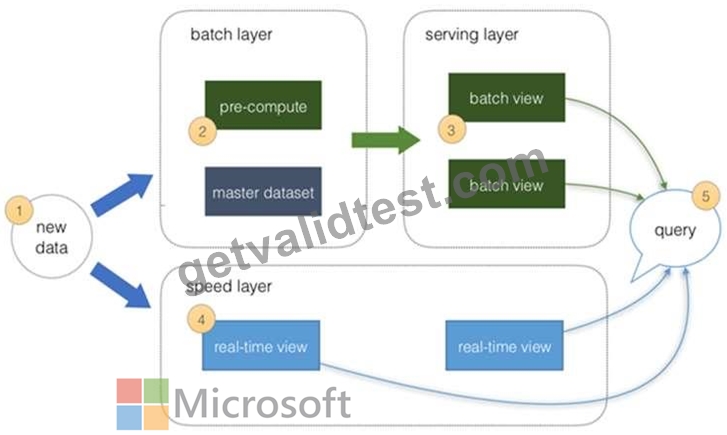
Reference:
https://azure.microsoft.com/en-us/blog/lambda-architecture-using-azure-cosmosdb-faster-performance-low- tco-low-devops/
https://docs.microsoft.com/en-us/azure/architecture/data-guide/technology-choices/stream-processing
NEW QUESTION 124
You plan to store 100 GB of data used by a line-of-business (LOB) app.
You need to recommend a data storage solution for the data. The solution must meet the following requirements:
Minimize storage costs.
Natively support relational queries.
Provide a recovery time objective (RTO) of less than one minute.
What should you include in the recommendation?
- A. Azure Blob storage
- B. Azure Cosmos DB
- C. Azure SQL Data Warehouse
- D. Azure SQL Database
Answer: A
NEW QUESTION 125
Which Azure service and feature should you recommend using to manage the transient data for Data Lake Storage? To answer, select the appropriate options in the answer area.
NOTE: Each correct selection is worth one point.
Answer:
Explanation:
Reference:
https://azure.microsoft.com/sv-se/blog/clean-up-files-by-built-in-delete-activity-in-azure-data-factory/
NEW QUESTION 126
You have an on-premises MySQL database that is 800 GB in size.
You need to migrate a MySQL database to Azure Database for MySQL. You must minimize service interruption to live sites or applications that use the database.
What should you recommend?
- A. Dump and restore
- B. MySQL Workbench
- C. Azure Database Migration Service
- D. Import and export
Answer: C
Explanation:
Explanation
You can perform MySQL migrations to Azure Database for MySQL with minimal downtime by using the newly introduced continuous sync capability for the Azure Database Migration Service (DMS). This functionality limits the amount of downtime that is incurred by the application.
References:
https://docs.microsoft.com/en-us/azure/mysql/howto-migrate-online
NEW QUESTION 127
You design data engineering solutions for a company that has locations around the world. You plan to deploy a large set of data to Azure Cosmos DB.
The data must be accessible from all company locations.
You need to recommend a strategy for deploying the data that minimizes latency for data read operations and minimizes costs.
What should you recommend?
- A. Use a single Azure Cosmos DB account. Enable multi-region writes.
- B. Use multiple Azure Cosmos DB accounts. Enable multi-region writes.
- C. Use a single Azure Cosmos DB account. Enable geo-redundancy.
- D. Use a single Azure Cosmos DB account Configure data replication.
- E. Use multiple Azure Cosmos DB accounts. For each account, configure the location to the closest Azure datacenter.
Answer: A
Explanation:
Explanation
With Azure Cosmos DB, you can add or remove the regions associated with your account at any time.
Multi-region accounts configured with multiple-write regions will be highly available for both writes and reads. Regional failovers are instantaneous and don't require any changes from the application.
References:
https://docs.microsoft.com/en-us/azure/cosmos-db/high-availability
NEW QUESTION 128
You need to design the solution for analyzing customer data.
What should you recommend?
- A. Azure Batch
- B. Azure Data Lake Storage
- C. Azure Cognitive Services
- D. Azure SQL Data Warehouse
- E. Azure Databricks
Answer: E
Explanation:
Explanation/Reference:
Explanation:
Customer data must be analyzed using managed Spark clusters.
You create spark clusters through Azure Databricks.
References:
https://docs.microsoft.com/en-us/azure/azure-databricks/quickstart-create-databricks-workspace-portal Testlet 3 Case study This is a case study. Case studies are not timed separately. You can use as much exam time as you would like to complete each case. However, there may be additional case studies and sections on this exam. You must manage your time to ensure that you are able to complete all questions included on this exam in the time provided.
To answer the questions included in a case study, you will need to reference information that is provided in the case study. Case studies might contain exhibits and other resources that provide more information about the scenario that is described in the case study. Each question is independent of the other question on this case study.
At the end of this case study, a review screen will appear. This screen allows you to review your answers and to make changes before you move to the next sections of the exam. After you begin a new section, you cannot return to this section.
To start the case study
To display the first question on this case study, click the Next button. Use the buttons in the left pane to explore the content of the case study before you answer the questions. Clicking these buttons displays information such as business requirements, existing environment, and problem statements. If the case study has an All Information tab, note that the information displayed is identical to the information displayed on the subsequent tabs. When you are ready to answer a question, click the Question button to return to the question.
Background
Current environment
The company has the following virtual machines (VMs):
Requirements
Storage and processing
You must be able to use a file system view of data stored in a blob.
You must build an architecture that will allow Contoso to use the DB FS filesystem layer over a blob store.
The architecture will need to support data files, libraries, and images. Additionally, it must provide a web- based interface to documents that contain runnable command, visualizations, and narrative text such as a notebook.
CONT_SQL3 requires an initial scale of 35000 IOPS.
CONT_SQL1 and CONT_SQL2 must use the vCore model and should include replicas. The solution must support 8000 IOPS.
The storage should be configured to optimized storage for database OLTP workloads.
Migration
You must be able to independently scale compute and storage resources.
You must migrate all SQL Server workloads to Azure. You must identify related machines in the on-
premises environment, get disk size data usage information.
Data from SQL Server must include zone redundant storage.
You need to ensure that app components can reside on-premises while interacting with components
that run in the Azure public cloud.
SAP data must remain on-premises.
The Azure Site Recovery (ASR) results should contain per-machine data.
Business requirements
You must design a regional disaster recovery topology.
The database backups have regulatory purposes and must be retained for seven years.
CONT_SQL1 stores customers sales data that requires ETL operations for data analysis. A solution is
required that reads data from SQL, performs ETL, and outputs to Power BI. The solution should use managed clusters to minimize costs. To optimize logistics, Contoso needs to analyze customer sales data to see if certain products are tied to specific times in the year.
The analytics solution for customer sales data must be available during a regional outage.
Security and auditing
Contoso requires all corporate computers to enable Windows Firewall.
Azure servers should be able to ping other Contoso Azure servers.
Employee PII must be encrypted in memory, in motion, and at rest. Any data encrypted by SQL Server
must support equality searches, grouping, indexing, and joining on the encrypted data.
Keys must be secured by using hardware security modules (HSMs).
CONT_SQL3 must not communicate over the default ports
Cost
All solutions must minimize cost and resources.
The organization does not want any unexpected charges.
The data engineers must set the SQL Data Warehouse compute resources to consume 300 DWUs.
CONT_SQL2 is not fully utilized during non-peak hours. You must minimize resource costs for during
non-peak hours.
NEW QUESTION 129
You need to recommend a solution to quickly identify all the columns in Health Review that contain sensitive health data.
What should you include in the recommendation?
- A. classifications
- B. data masking
- C. SQL Server auditing
- D. Azure tags
Answer: A
Explanation:
Data Discovery & Classification introduces a set of advanced capabilities aimed at protecting data and not just the data warehouse itself. Classification/Labeling - Sensitivity classification labels tagged on the columns can be persisted in the data warehouse itself.
Reference:
https://azure.microsoft.com/sv-se/blog/announcing-public-preview-of-data-discovery-classification-for- microsoft-azure-sql-data-warehouse/ Design for data security and compliance Testlet 4 Overview You are a data engineer for Trey Research. The company is close to completing a joint project with the government to build smart highways infrastructure across North America. This involves the placement of sensors and cameras to measure traffic flow, car speed, and vehicle details.
You have been asked to design a cloud solution that will meet the business and technical requirements of the smart highway.
Solution components
Telemetry Capture
The telemetry capture system records each time a vehicle passes in front of a sensor. The sensors run on a custom embedded operating system and record the following telemetry data:
* Time
* Location in latitude and longitude
* Speed in kilometers per hour (kmph)
* Length of vehicle in meters
Visual Monitoring
The visual monitoring system is a network of approximately 1,000 cameras placed near highways that capture images of vehicle traffic every 2 seconds. The cameras record high resolution images. Each image is approximately 3 MB in size.
Requirements. Business
The company identifies the following business requirements:
* External vendors must be able to perform custom analysis of data using machine learning technologies.
* You must display a dashboard on the operations status page that displays the following metrics: telemetry, volume, and processing latency.
* Traffic data must be made available to the Government Planning Department for the purpose of modeling changes to the highway system. The traffic data will be used in conjunction with other data such as information about events such as sporting events, weather conditions, and population statistics. External data used during the modeling is stored in on-premises SQL Server 2016 databases and CSV files stored in an Azure Data Lake Storage Gen2 storage account.
* Information about vehicles that have been detected as going over the speed limit during the last 30 minutes must be available to law enforcement officers. Several law enforcement organizations may respond to speeding vehicles.
* The solution must allow for searches of vehicle images by license plate to support law enforcement investigations. Searches must be able to be performed using a query language and must support fuzzy searches to compensate for license plate detection errors.
Requirements. Security
The solution must meet the following security requirements:
* External vendors must not have direct access to sensor data or images.
* Images produced by the vehicle monitoring solution must be deleted after one month. You must minimize costs associated with deleting images from the data store.
* Unauthorized usage of data must be detected in real time. Unauthorized usage is determined by looking for unusual usage patterns.
* All changes to Azure resources used by the solution must be recorded and stored. Data must be provided to the security team for incident response purposes.
Requirements. Sensor data
You must write all telemetry data to the closest Azure region. The sensors used for the telemetry capture system have a small amount of memory available and so must write data as quickly as possible to avoid losing telemetry data.
NEW QUESTION 130
You need to recommend a storage solution for a sales system that will receive thousands of small files per minute. The files will be in JSON, text, and CSV formats. The files will be processed and transformed before they are loaded into an Azure data warehouse. The files must be stored and secured in folders.
Which storage solution should you recommend?
- A. Azure Blob storage
- B. Azure Cosmos DB
- C. Azure Data Lake Storage Gen2
- D. Azure SQL Database
Answer: C
Explanation:
Azure provides several solutions for working with CSV and JSON files, depending on your needs. The primary landing place for these files is either Azure Storage or Azure Data Lake Store.1 Azure Data Lake Storage is an optimized storage for big data analytics workloads.
Incorrect Answers:
D: Azure Blob Storage containers is a general purpose object store for a wide variety of storage scenarios.
Blobs are stored in containers, which are similar to folders.
Reference:
https://docs.microsoft.com/en-us/azure/architecture/data-guide/scenarios/csv-and-json
NEW QUESTION 131
You are evaluating data storage solutions to support a new application.
You need to recommend a data storage solution that represents data by using nodes and relationships in graph structures.
Which data storage solution should you recommend?
- A. Blob Storage
- B. Cosmos DB
- C. Data Lake Store
- D. HDInsight
Answer: B
Explanation:
For large graphs with lots of entities and relationships, you can perform very complex analyses very quickly.
Many graph databases provide a query language that you can use to traverse a network of relationships efficiently.
Relevant Azure service: Cosmos DB
Reference:
https://docs.microsoft.com/en-us/azure/architecture/guide/technology-choices/data-store-overview
NEW QUESTION 132
You need to design the solution for the government planning department.
Which services should you include in the design?
- A. Azure SQL Data Warehouse and Elastic Queries
- B. Azure SQL Database and Polybase
- C. Azure SQL Data Warehouse and Polybase
- D. Azure SQL Database and Elastic Queries
Answer: C
Explanation:
Explanation
PolyBase is a new feature in SQL Server 2016. It is used to query relational and non-relational databases (NoSQL) such as CSV files.
Scenario: Traffic data must be made available to the Government Planning Department for the purpose of modeling changes to the highway system. The traffic data will be used in conjunction with other data such as information about events such as sporting events, weather conditions, and population statistics. External data used during the modeling is stored in on-premises SQL Server 2016 databases and CSV files stored in an Azure Data Lake Storage Gen2 storage account.
Reference:
https://www.sqlshack.com/sql-server-2016-polybase-tutorial/
NEW QUESTION 133
......
Designing an Azure Data Solution Free Update Certification Sample Questions: https://www.getvalidtest.com/DP-201-exam.html