


Get Oct-2023 Download Latest & Valid Questions For Adobe AD0-E720 exam
Ensure Success With Updated Verified AD0-E720 Exam Dumps
NEW QUESTION # 30
An Adobe Commerce developer has been asked to move a block called country from the container sidebar to the container content, the block has to be the last child on the content container.
Which layout instruction would be used to move the block?
- A. <move element="country" destination="content" after="last-child"/>
- B. <move element="country-element"destination="content-element"/>
- C. <moveelement = "country"destination="content" after="-"/>
Answer: C
Explanation:
Explanation
To move a block from one container to another, the developer needs to use the <move> layout instruction with the element attribute specifying the name of the block and the destination attribute specifying the name of the container. The after attribute can be used to position the block relative to other blocks in the same container.
The value "-" means that the block will be placed after all other blocks, i.e., as the last child. The value
"last-child" is not valid for the after attribute and will not work. The element and destination attributes should use the names of the blocks and containers, not their aliases or classes. References: [Layout instructions],
[Move an element]
NEW QUESTION # 31
An Adobe Commerce developer needs to improve the time of first render of the pages. How would the developer achieve this?
- A. Use the quick static files deployment strategy
- B. Enable CSS file merging
- C. Enable JavaScript minification
- D. Enable CSS critical path
Answer: D
Explanation:
Explanation
CSS critical path is a feature that improves the time of first render of the pages by inlining the CSS rules that are required to render the above-the-fold content of the page. This reduces the number of requests and bytes that need to be downloaded before the page is rendered. CSS critical path can be enabled in the Admin Panel by navigating to Stores > Configuration > Advanced > Developer > CSS Settings and setting Enable CSS Critical Path to Yes. References: Adobe Commerce Developer Documentation, Adobe Inc.
NEW QUESTION # 32
An Adobe Commerce developer wants to initialize a JS component via Layout XML in custom reference block test. component. Which Layout XML instruction would be used to initialize this JS component?
- A.

- B.

- C.

Answer: A
Explanation:
Explanation
Option A is the correct way to initialize a JS component via Layout XML in a custom reference block. The x-magento-init tag is used to specify the component name and the options. Option B is incorrect because it uses the data-mage-init attribute, which is only valid for HTML elements. Option C is incorrect because it uses the x-magento-component tag, which is deprecated and should not be used.
https://developer.adobe.com/commerce/frontend-core/
https://experienceleague.adobe.com/docs/certification/program/technical-certifications/ac/ac-expert/ac-e-fedevel
NEW QUESTION # 33
An Adobe commerce developer wants to initialize a JavaScript component using a data attribute. Which option would initialize the JavaScript component?
- A. <nav data-mage-init='{"<component_name>": {...}}'></nav>
- B. <nav data-init='{"<component_name>": {...}}'></nav>
- C. <nav data-bind='{"<component_name>": {...}}'></nav>
Answer: A
Explanation:
Explanation
To initialize a JavaScript component using a data attribute, the developer should use the data-mage-init attribute. This attribute allows the developer to specify the name and configuration of the component in a JSON format. For example:
<nav data-mage-init='{"Vendor_Module/js/nav": {"option1": "value1", "option2": "value2"}}'></nav> This will initialize the nav component from the Vendor_Module/js/nav file with the given options. The data-bind and data-init attributes are not valid and will not work, as they are not supported by Magento.
References: [JavaScript initialization], [data-mage-init]
NEW QUESTION # 34
An Adobe Commerce developer wants to completely overwrite _module. less of Orange_Checkout module, in their theme. Where would the developer place the file?
- A. Custom/theme/Orange_Checkout/frontend/web/css/_module.less
- B. Custom/theme/Orange_Checkout/web/css/source/_module.less
- C. Custom/theme/web/css/source/Orange_Checkout/_module.less
Answer: B
Explanation:
Explanation
To completely overwrite _module.less of Orange_Checkout module in a custom theme, the developer should place the file in the Custom/theme/Orange_Checkout/web/css/source directory. This will override the default
_module.less file from the Orange_Checkout module and apply the custom styles to the theme. The Custom/theme/Orange_Checkout/frontend/web/css/_module.less and Custom/theme/web/css/source/Orange_Checkout/_module.less paths are not valid and will not work, as they do not follow the theme structure or the module naming convention. References: [Theme structure], [Module naming convention]
NEW QUESTION # 35
An Adobe Commerce developer needs to create translations for the Orange/custom theme. Which directory would the developer place the translations?
- A. Orange/custom/translations
- B. Orange/custom/etc
- C. Orange/custom/il8n
Answer: C
Explanation:
Explanation
To create translations for a theme, the developer needs to place the translation files in the il8n directory of the theme. The translation files should have the format <language code>_<country code>.csv, such as en_US.csv or fr_FR.csv. The etc and translations directories are not used for storing translation files. References:
[Translations overview], [Translate theme strings]
NEW QUESTION # 36
An Adobe Commerce developer needs to pass JSON data to a JavaScript component while keeping XSS prevention strategies in mind.
Which two options would the developer use? (Choose two.)
- A.

- B.

- C.

- D.

Answer: B,D
Explanation:
Explanation
To pass JSON data to a JavaScript component while keeping XSS prevention strategies in mind, the developer should use the following options:
Option A: Use the x-magento-init script tag with the data-mage-init attribute and the JSON.parse function to initialize the component with the JSON data. This option is secure because it does not use any HTML tags or attributes that can be exploited by XSS attacks.
Option C: Use the text/x-magento-init script tag with the type attribute and the JSON.parse function to initialize the component with the JSON data. This option is secure because it does not use any HTML tags or attributes that can be exploited by XSS attacks.
The following options are not secure and should not be used:
Option B: Use the script tag with the type attribute and the escapeHtmlAttr function to initialize the component with the JSON data. This option is not secure because it uses the escapeHtmlAttr function, which is meant for escaping HTML attributes, not JSON data. This function can introduce double quotes in the JSON data, which can break the JSON syntax and cause errors.
Option D: Use the script tag with the type attribute and the escapeJsQuote function to initialize the component with the JSON data. This option is not secure because it uses the escapeJsQuote function, which is meant for escaping JavaScript strings, not JSON data. This function can introduce backslashes in the JSON data, which can break the JSON syntax and cause errors.
NEW QUESTION # 37
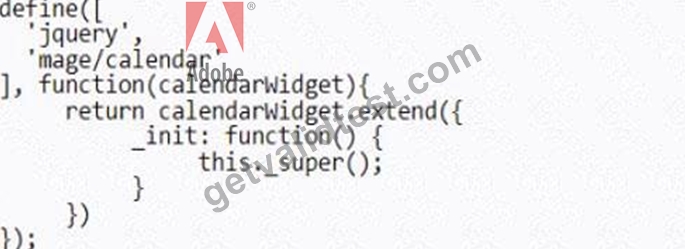
An Adobe Commerce developer wants to add a custom widget that extends the default Calendar Widget. What would the contents of this file look like?
- A.

- B.
- C.

Answer: C
Explanation:
Explanation
To add a custom widget that extends the default Calendar Widget, the contents of the file would look like option B. This is because option B follows the correct syntax and structure for defining a jQuery widget in Magento. The code does the following steps:
Defines a module with the name "Vendor_Module/js/calendar-widget" that depends on the "jquery/ui" and "Magento_Ui/js/lib/knockout/bindings/datepicker" modules.
Returns a function that creates a new widget with the name "vendor.calendarWidget" that extends the base calendar widget class.
Overrides the init function of the base calendar widget class to add custom logic or functionality to the widget.
Option A is not correct because it does not use the correct syntax for defining a jQuery widget. It uses a script tag instead of a define function, which is not valid for creating a module. It also uses an incorrect name for the widget, which should use a dot instead of a slash. Option C is not correct because it does not use the correct syntax for extending a widget. It uses an extend function instead of a widget function, which is not valid for creating a new widget. It also does not return anything from the module, which will cause an error.
References: [jQuery widgets], [Calendar Widget]
NEW QUESTION # 38
What is the difference between styles-l.less and styles-m.less ?
- A. styles-i.less is used to generate desktop-specific styles and stytes-m.less is used to generate only mobile-specific styles.
- B. styles-i.less is used to generate basic and mobile-specific styles and stytes-m.less is used to generate desktop-specific styles.
- C. styles-i.less is used to generate desktop-specific styles and stytes-m.less is used to generate basic and mobile-specific styles.
Answer: C
Explanation:
Explanation
The styles-l.less and styles-m.less files are two main LESS files that are used to generate CSS files for different devices and screen sizes. The styles-l.less file is used to generate styles-l.css, which contains desktop-specific styles that are applied only when the screen width is greater than 768px. The styles-m.less file is used to generate styles-m.css, which contains basic and mobile-specific styles that are applied for all devices and screen sizes. The other options are not correct and do not reflect the purpose of these files. References:
[Stylesheets], [Responsive web design]
NEW QUESTION # 39
An Adobe Commerce developer has created a system configuration field:
Using Layout XML, how can the visibility of a block be controlled by a system configuration?
- A. <block name="block.name" template=''Vendor_Module:
:template.phtml"ifconfig="module/general/enable" /> - B. <block name="block.name" template="Vendor_Module::template.phtml"
ifconfig="general/module/enable" /> - C. <block name="block.name" template="Vendor_Module::template.phtml="
ifconfig="vendor/general/enable" />
Answer: C
Explanation:
Explanation
To control the visibility of a block using a system configuration, the developer should use the ifconfig attribute in the <block> tag. The ifconfig attribute should specify the path to the system configuration field that determines whether the block is visible or not. For example:
<block name="block.name" template="Vendor_Module::template.phtml" ifconfig="vendor/general/enable" /> This will render the block only if the vendor/general/enable system configuration field is set to true. The module/general/enable and general/module/enable paths are not valid and will not work, as they do not match the system configuration field defined in the image. References: [Layout instructions], [System configuration]
NEW QUESTION # 40
An Adobe Commerce developer needs to apply a Knockout binding to show content under certain conditions.
Which two syntaxes would achieve this? (Choose two.)
- A.

- B.

- C.

- D.

Answer: A,C
Explanation:
Explanation
Option A and Option C are both valid ways to apply a Knockout binding to show content under certain conditions. Option A uses the visible binding, which sets the display style of the element to none if the value is false. Option C uses the if binding, which removes or inserts the element from the DOM based on the value.
Option B and Option D are incorrect because they use invalid syntax for Knockout bindings. Option B uses a colon instead of an equal sign to assign the value, and Option D uses a single quote instead of a double quote to enclose the value.
https://knockoutjs.com/documentation/binding-syntax.html
https://knockoutjs.com/documentation/binding-context.html
NEW QUESTION # 41
An Adobe Commerce developer created a new CMS page and set the page title as "My Custom Page". The page must be accessible at the URL /custom_page.
Which CMS page configuration do they set to make the page accessible at /custom_page?
- A. Under 'Search Engine Optimization", they set the "URL Key" field as "custom_page''.
- B. Under "Page in Websites", they set the "URL" field as "custom.page".
- C. Under 'Content", they set the "Path" field as "custom_page".
Answer: A
Explanation:
Explanation
The URL Key field under the Search Engine Optimization section is used to specify the URL suffix for the CMS page. The developer can set it as "custom_page" to make the page accessible at /custom_page. The Path field under the Content section is used to specify the path to the template file that renders the CMS page content. The URL field under the Page in Websites section does not exist as a valid configuration option for CMS pages. References: [Adobe Commerce Developer Documentation], [Adobe Inc.]
NEW QUESTION # 42
An Adobe Commerce developer has found following code:
After compiling the .less file into a .ess file, what will be the results of the code above?
- A.

- B.

- C.

Answer: B
Explanation:
Explanation
After compiling the .less file into a .css file, the result of the code above will be option B. This is because the
.less file uses a mixin called .animation() that takes two parameters: the name of the animation and the duration. The mixin defines a set of vendor-prefixed properties for the animation and assigns them the values of the parameters. For example:
animation(@name; @duration) { -webkit-animation-name: @name; -webkit-animation-duration: @duration;
-moz-animation-name: @name; -moz-animation-duration: @duration; animation-name: @name; animation-duration: @duration; } When the mixin is called with the values "fade" and "2s", it will generate the following CSS code:
-webkit-animation-name: fade; -webkit-animation-duration: 2s; -moz-animation-name: fade;
-moz-animation-duration: 2s; animation-name: fade; animation-duration: 2s; Option A is not correct because it does not use the vendor prefixes for the animation properties. Option C is not correct because it uses the wrong values for the animation name and duration. References: [LESS Mixins],
[CSS Animations]
NEW QUESTION # 43
An Adobe Commerce developer has just installed an extension via composer. When running, bin/magento module: status Vendor_Module, the status is returned as Module is disabled.
Which two CLI commands need to be run to make the extension work properly? (Choose two.)
- A. bin/magento setup:upgrade
- B. composer install
- C. composer update vendor/module
- D. bin/magento module:enable Vendor_Module --clear-static-content
Answer: A,D
Explanation:
Explanation
The developer needs to run these two CLI commands to make the extension work properly:
bin/magento module:enable Vendor_Module --clear-static-content This command enables the extension and clears any outdated static files that might interfere with its functionality.
bin
NEW QUESTION # 44
Where are the Magento Ul library LESS files located?
- A. Magento_Ui/web/css/source/
- B. Magento_Lib/web/css/source
- C. lib/web/css/source/lib
Answer: B
Explanation:
Explanation
This directory contains various LESS files that define variables, mixins, functions, and styles for common UI elements and components. The Magento_Ui/web/css/source and lib/web/css/source/lib directories are not valid and do not contain the Magento UI library LESS files. References: [Magento UI library], [Magento UI library source files]
NEW QUESTION # 45
An Adobe Commerce developer has just installed an extension via composer. When running, bin/magento module: status Vendor_Module, the status is returned as Module is disabled.
Which two CLI commands need to be run to make the extension work properly? (Choose two.)
- A. bin/magento setup:upgrade
- B. composer install
- C. composer update vendor/module
- D. bin/magento module:enable Vendor_Module --clear-static-content
Answer: A,D
Explanation:
Explanation
The developer needs to run these two CLI commands to make the extension work properly:
bin/magento module:enable Vendor_Module --clear-static-content This command enables the extension and clears any outdated static files that might interfere with its functionality.
bin/magento setup:upgrade This command updates the database schema and data according to the extension's requirements. The other two options are incorrect because they are not necessary to make the extension work properly. The composer install command installs all dependencies specified in the composer.json file, but it does not enable or update any extensions. The composer update vendor/module command updates an existing extension to its latest version, but it does not enable or upgrade it.
NEW QUESTION # 46
In which mode would the stylesheet customizations display immediately after you reload a page in a browser?
- A. less-side compilation mode
- B. server- side compilation mode
- C. client-side compilation mode
Answer: C
Explanation:
Explanation
In client-side compilation mode, the stylesheet customizations will display immediately after reloading a page in a browser. This is because in this mode, the LESS files are compiled into CSS files by the browser using JavaScript. This mode is useful for development and debugging purposes, as it allows quick changes and previews of the styles. However, this mode is not recommended for production, as it can affect the performance and compatibility of the site. The other modes, server-side compilation and LESS compilation, require running commands or tools to compile the LESS files into CSS files on the server side, which can take some time and delay the display of the customizations. References: [Compilation modes], [Compile LESS]
NEW QUESTION # 47
An Adobe Commerce developer needs to add a conditional static note depending on whether the order type is virtual or not. Which option would the developer use to add the conditional text in the email template?
- A.

- B.

- C.

Answer: C
Explanation:
Explanation
Option B is the correct way to add a conditional static note depending on whether the order type is virtual or not in the email template. Option B uses the {{trans}} directive to translate the text and the {{depend}} directive to check the value of the order.is_virtual variable. If the order is virtual, the text "Shipping not required." will be displayed. Option A and Option C are incorrect because they use the wrong syntax for the
{{trans}} and {{depend}} directives. Option A uses curly braces instead of parentheses for the {{trans}} directive and does not use quotes for the text. Option C uses parentheses instead of curly braces for the
{{depend}} directive and does not use a dot to access the order.is_virtual variable.
NEW QUESTION # 48
An Adobe Commerce developer has been asked to add text to an email template that supports translations.
Which two options would they use during their implementation? (Choose two.)
- A. {{translations "Lorem Ipsum is simply dummy text of the printing"}}
- B. {{trans "Lorem Ipsum is simply dummy text of the printing"}}
- C. {{trans "%items items" items="numltems"}}
- D. {{translations "%items items" items="numltems"}}
Answer: C,D
Explanation:
Explanation
To add text to an email template that supports translations, the developer should use the {{trans}} directive with the text enclosed in double quotes. For example:
{{trans "Lorem Ipsum is simply dummy text of the printing"}}
This will render the text as it is, or translate it if a translation file is available for the current locale. If the text contains a variable, the developer should use a placeholder with a percent sign and pass the variable name as an argument. For example:
{{trans "%items items" items="numItems"}}
This will render the text with the value of numItems replacing the %items placeholder, or translate it if a translation file is available for the current locale. The {{translations}}directive is not valid and will not work.
References: [Translate email templates], [Email template syntax]
NEW QUESTION # 49
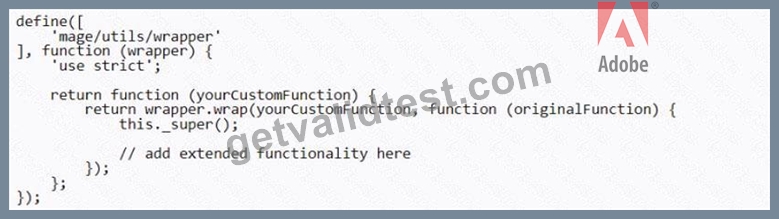
An Adobe Commerce developer was asked to customize a JavaScript component which is written as a function. How would the developer extend the native JavaScript function?
- A.
- B.

- C.

Answer: B
Explanation:
Explanation
To customize a JavaScript component that is written as a function, the developer can use option A. This option will use the prototype property of the function to extend its functionality and add new methods or properties.
For example:
function Component() { // Component logic }
Component.prototype.customMethod = function() { // Custom method logic }; This will create a new method called customMethod on the prototype of the Component function, which can be accessed by any instance of the Component object. The developer can also override existing methods or properties on the prototype by reassigning them with new values.
Option B is not correct because it will not extend the native JavaScript function, but create a new function that wraps the original function. This will not allow the developer to access or modify the properties or methods of the original function. Option C is not correct because it will not extend the native JavaScript function, but create a new object that inherits from the original function. This will not allow the developer to customize the original function itself, but only its instances.
NEW QUESTION # 50
......
Exam Materials for You to Prepare & Pass AD0-E720 Exam: https://www.getvalidtest.com/AD0-E720-exam.html
Pass Your AD0-E720 Exam at the First Try with 100% Real Exam: https://drive.google.com/open?id=1KFn4Ab-XOUz21CUIGnfkoajaQZZPkQz1