


Huawei H12-821_V1.0 Exam Prep Guide: Prep guide for the H12-821_V1.0 Exam
2026 New Preparation Guide of Huawei H12-821_V1.0 Exam
NEW QUESTION # 648
The Next_Hop attribute in BGP records the next hop of a route. Similar to the next hop in an IGP, the Next_Hop attribute in BGP must be the IP address of a peer interface.
- A. FALSE
- B. TRUE
Answer: A
Explanation:
BGP Next_Hop Attribute
Unlike IGP, the Next_Hop attribute in BGP does not necessarily have to be the IP address of a peer interface.
For example, in multi-hop BGP configurations, the Next_Hop can point to a different router or interface within the network.
HCIP-Datacom-Core Reference
Details of the Next_Hop attribute and its behavior are outlined in BGP path selection principles.
NEW QUESTION # 649
During routine O&M, an engineer finds that theHold Timeparameters of two devices are inconsistent. In this case, which of the following situations occurs?
- A. A peer relationship can be established, and the larger Hold Time is selected after negotiation.
- B. A peer relationship can be established, and the smaller Hold Time is selected after negotiation.
- C. A peer relationship can be established, and the devices use their own parameter values to send messages.
- D. No peer relationship can be established.
Answer: B
Explanation:
In BGP and other TCP-based protocols like OSPF and IS-IS, when devices havedifferent Hold Times, thesmaller value is chosenafter negotiation. This ensuresfaster detectionof communication loss.
The Keepalive and Hold Timers are negotiated during the establishment of a BGP session.
The smaller Hold Timeis used to maintain symmetry and prevent timeouts.
Reference from Huawei HCIP-Datacom-Core Technology Study Guide:
"When negotiating Hold Time, both ends agree to use the smaller of the two values. This value is used to detect failures faster." (Chapter: BGP Fundamentals - Section: BGP Session Establishment)
NEW QUESTION # 650
Which of the following statements about the concept of multicast is wrong?
- A. Multicast router: A router or a Layer 3 switch that supports Layer 3 multicast function
- B. The group refers to the source, the sender of the information, and needs to join the multicast group to provide the forwarding of the group refers to the group message
- C. Multicast group members, multicast group members can be widely distributed anywhere in the network
- D. Multicast group: A collection identified by an IP multicast address
Answer: B
NEW QUESTION # 651
See the network shown in the following figure.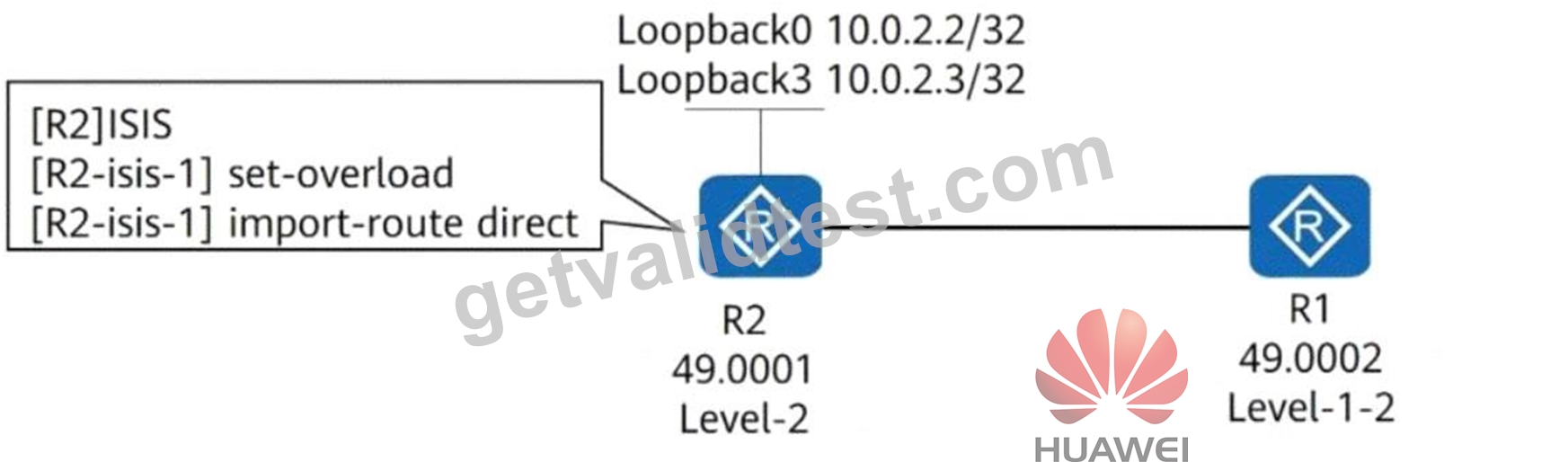
R1 and R2 run IS-IS and establish an adjacency. IS-IS is enabled on Loopback0 of R2 but disabled on Loopback3 of R2. The configurations shown in the figure are performed in the IS-IS process of R2. Which of the following statements are true?
- A. The routing table of R1 contains the route 10.0.2.2/32.
- B. The routing table of R1 does not contain the route 10.0.2.3/32.
- C. The routing table of R1 does not contain the routes 10.0.2.2/32 and 10.0.2.3/32.
- D. The routing table of R1 contains the route 10.0.2.3/32.
Answer: A,B
Explanation:
In the provided configuration, IS-IS is enabled on Loopback0 but not on Loopback3 of R2. As a result, R2 will advertise the route 10.0.2.2/32 (from Loopback0) to R1 through IS-IS. However, the route 10.0.2.3/32 will not be advertised because IS-IS is not enabled on that loopback interface. The import-route direct command does not override this behavior .
NEW QUESTION # 652
When using routing policy for routing filtering, which routing prefixes in the following options will be denied when matching the following IP-Prefix? (Multiple choice)
[HUAWEI] ip ip-prefix aa index 10 deny 0.0.0.0 24 less-equal 32 [HUAWEI] ip ip-prefix aa index 20 permit 0.0.0.0 0 less-equal 32
- A. 1.1.1.1/32
- B. 1.1.1.1/26
- C. 1.1.1.2/16
- D. 1.1.1.1/24
Answer: A,B,D
NEW QUESTION # 653
A large number of routes typically exist in a BGP routing table, and transmitting such extensive routing information brings a heavy burden to a device. In order to address this problem, it is necessary to filter those routes to be advertised. You can configure a device to advertise only necessary routes or those that its peers require.
- A. TRUE
- B. FALSE
Answer: A
Explanation:
BGP Route Filtering:
BGP provides flexible policies for route filtering to optimize routing table size and reduce network resource usage.
By configuring route filters, a device can advertise only required routes to peers, thereby improving efficiency.
Purpose of Filtering:
Reduces the routing table size.
Decreases CPU and memory usage on routers.
Limits unnecessary route propagation.
NEW QUESTION # 654
On an OSPF network, LSDBs are used to store LSAs. Common LSAs include router LSAs and network LSAs. Which of the following items is not included in the 3-tuple that is used to uniquely identify an LSA?
- A. Advertising Router
- B. LS Sequence Number
- C. LSType
- D. Link State ID
Answer: B
Explanation:
Comprehensive and Detailed in-depth Step-by-Step Explanation:In OSPF, Link State Advertisements (LSAs) are used to exchange routing and topology information. Each LSA in the OSPF network is uniquely identified using a 3-tuple identifier, which consists of:
* Link State ID:
* The Link State ID uniquely identifies the LSA within the OSPF area. Its value depends on the LSA type. For example, for a Router LSA, the Link State ID is the originating router's Router ID.
* Advertising Router:
* This is the Router ID of the router that generated the LSA. It identifies which router is responsible for creating and advertising this LSA.
* LSType:
* This field identifies the type of LSA (e.g., Router LSA, Network LSA, Summary LSA, AS- External LSA, etc.). It is crucial for interpreting the purpose and content of the LSA.
The LS Sequence Number is not part of the 3-tuple that uniquely identifies the LSA. Instead, it is used to determine the most recent version of the LSA in case there are multiple instances of the same LSA.
References:
* Huawei HCIA-Datacom Study Guide, Chapter on "OSPF LSAs and LSDBs".
* RFC 2328 - OSPF Version 2 (Section 12.1.6).
NEW QUESTION # 655
Which of the following statements about the address used by AC to establish a CAPWAP tunnel in VRRP hot backup is correct?
- A. VRRP virtual addresses of the active and standby ACs
- B. The physical address of the primary AC
- C. The physical address of the standby MC
- D. Any address configured in the AC is fine
Answer: A
NEW QUESTION # 656
Stateful inspection firewalls use session tables to track active TCP sessions and UDP sessions, and the firewall security policy determines which sessions are established, and packets will only be forwarded if they are associated with a session.
- A. TRUE
- B. FALSE
Answer: A
NEW QUESTION # 657
Which of the following descriptions about setting Community through routing policies to affect routing selection is wrong?
- A. After the router receives the routing update whose Commmity attribute is No_ Advertise, it will not advertise it outside the local AS.
- B. It can be affected indirectly. By setting the Community attribute of the route, the route can be classified, and then different attributes related to route selection can be set according to the category.
These attributes only include Loacal_Pre and MED, so as to achieve the purpose of affecting route selection - C. It can be indirectly affected. By setting the Community attribute of the route, the route can be classified, and then set different route selection-related attributes according to the category, such as Local_Pre, MED, etc., to achieve the purpose of affecting route selection
- D. It cannot be affected, because the Community attribute of the route is a non-transitional attribute and cannot be passed between routers
Answer: C
NEW QUESTION # 658
Which of the following descriptions about BGP route optimization is correct?
- A. When BGP selects a route, if it cannot be optimized according to the conditions, it will automatically carry out load sharing
- B. When BGP receives multiple routes to the same destination, it will select the optimal route according to the routing rules, and then deliver the optimal route to the IP routing table to guide data traffic forwarding
- C. When there are multiple effective routes in BGP, BGP Speaker only advertises the optimal route to the peer
- D. BGP compares the originality of routes strictly according to the sequence when selecting routes. If the optimal route can be selected through the previous attributes, the latter comparison cannot be judged.
Answer: C
NEW QUESTION # 659
In the VRP, by default, the routes imported by BGP will be automatically summarized.
- A. FALSE
- B. TRUE
Answer: A
Explanation:
By default, BGP does not automatically summarize imported routes. Route summarization must be explicitly configured using the summary or similar commands .
NEW QUESTION # 660
On an RSTP network, port priorities may be compared during root port or designated port election. Which of the following values is the default priority of a port on a Huawei switch?
- A. 0
- B. 1
- C. 2
- D. 3
Answer: A
Explanation:
Comprehensive and Detailed Step-by-Step Explanation:
1. Port Priority in RSTP:
RSTP (Rapid Spanning Tree Protocol) elects root and designated ports based on port priority and port ID.
Port priority is a configurable value that helps determine which port becomes the root or designated port when multiple ports are eligible.
The port ID consists of the port priority and port number. When priorities are equal, the port number is used as a tiebreaker.
2. Default Port Priority on Huawei Switches:
On Huawei switches, the default port priority is128.
This value can be adjusted in increments of 16 using the command stp port priority.
3. Analysis of Options:
Option A: 1
Incorrect. This is not the default port priority value.
Option B: 128
Correct. This is the default port priority value on Huawei switches.
Option C: 4096
Incorrect. This is not a valid default port priority value.
Option D: 32768
Incorrect. This is the default bridge priority, not the port priority.
4. Summary:
The default port priority on Huawei switches is128.
Huawei HCIA-Datacom Study Guide, Chapter "RSTP Port Role Election."
IEEE 802.1D-2004: Rapid Spanning Tree Protocol (RSTP).
NEW QUESTION # 661
Regarding the description of the firewall security zone, which of the following statements is correct:
- A. Different interfaces of the firewall can belong to the same security zone
- B. The same interface of the firewall can belong to different security zones
- C. The firewall's built-in security zone can be deleted
- D. Different security zones of the firewall can have the same priority.
Answer: A
NEW QUESTION # 662
PBR is a mechanism for selecting routes based on user-defined policies. There are two types of PBR:
interface-based PBR and local PBR. Which of the following statements is false about these two types of PBR?
- A. Interface-based PBR is configured on an interface and takes effect only for incoming packets on the interface.
- B. Interface-based PBR takes effect only for forwarded packets.
- C. Local PBR is configured in the protocol view.
- D. Local PBR takes effect only for locally originated packets.
Answer: C
Explanation:
Comprehensive and Detailed Step-by-Step Explanation:
1. Overview of PBR (Policy-Based Routing):
Policy-Based Routing (PBR) allows you to override traditional routing decisions by defining user-specific policies.
* Interface-Based PBR: Applied to packets arriving at a specific interface and affects traffic being forwarded through the device.
* Local PBR: Applied to traffic generated by the local router itself (e.g., locally originated packets such as management traffic).
2. Analysis of Each Statement:
Option A: Interface-based PBR takes effect only for forwarded packets.
* Correct (True Statement).
* Interface-based PBR applies only to packets arriving at a specific interface and being forwarded through the router. It does not affect locally originated traffic.
Option B: Local PBR takes effect only for locally originated packets.
* Correct (True Statement).
* Local PBR specifically applies to traffic generated by the router itself, such as pings, SNMP requests, or routing protocol updates.
Option C: Interface-based PBR is configured on an interface and takes effect only for incoming packets on the interface.
* Correct (True Statement).
* Interface-based PBR is applied directly on the interface using commands like policy-based-route. It only affects traffic entering the specified interface.
Option D: Local PBR is configured in the protocol view.
* Incorrect (False Statement).
* Local PBR is not configured in the protocol view. It is typically configured using the command local- policy in the system view to handle traffic generated by the router.
3. Summary:
* Correct answer: D (Local PBR is NOT configured in the protocol view).
NEW QUESTION # 663
The following is part of the configuration information of the router Huawei.
[HUAWEI]ip as-path-filter 2 permit 200_300
[HUAWEI]route-policy test permit node 10
[HUAWE-route-policy] if-match as-path-filter 2
Which of the description of the configuration information is wrong?
- A. The Route-Policy can only be called in the OSPF process
- B. Node 10 of the Route-Policy references AS path filter 2 and defines an if-match clause
- C. Define a Route-Policy named test, the node serial number is 10
- D. Set the AS path filter with sequence number 2, allowing routing information to include AS200 and AS300
Answer: A
NEW QUESTION # 664
Which of the following descriptions of the Preferred-Value attribute in BGP are correct? (Multiple choice)
- A. This attribute will be passed to IBGP peers
- B. This attribute is unique to Huawei devices.
- C. The smaller the value of this attribute, the better the route.
- D. This attribute value only affects the routing preference of this device.
Answer: B,D
NEW QUESTION # 665
Multiple BGP processes cannot be configured on one router.
- A. TRUE
- B. FALSE
Answer: A
NEW QUESTION # 666
Which of the following statement regarding the display ospf peer command output is true?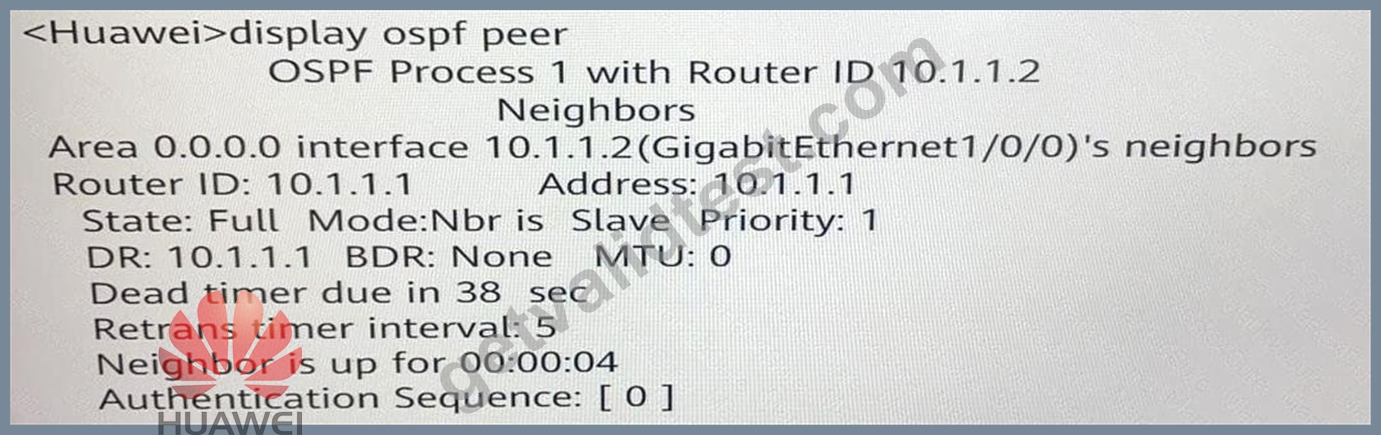
- A. The DR address is 10.1.1.1
- B. Through negotiation during DD packet exchange, the local end becomes the slave.
- C. Router ID indicates that the local router ID Is 10.1.1.1.
- D. Address: 10.1,1.1 Indicates that the local interface address is 10.1.1.1.
Answer: B
Explanation:
The command output indicates that the OSPF neighbor state is Full and that the neighbor relationship has been established. The statement confirms that the negotiation process during the exchange of DD (Database Description) packets has determined the role of the router, with the local device becoming the slave in the Master-Slave relationship, which is critical for LSA synchronization. The other options do not align with the output or OSPF principles
NEW QUESTION # 667
Which of the following statements regarding the LSA age field are true?
- A. If the LS age of a LSA has reached the LSRefreshTime (30 minutes), the originator of this LSA needs to regenerate an instance of this LSA again.
- B. The unit of this field is seconds. In a LSDB, the LS age of a LSA increases with time.
- C. The unit of this field is seconds. In a LSDB, the LS age of a LSA decreases with time.
- D. If the LS age of a LSA has reached the LSRefreshTime (30 minutes), any router can regenerate an instance of this LSA again.
Answer: A,B
Explanation:
The LS age field in OSPF LSAs (Link State Advertisements) is measured in seconds and increments over time in the Link State Database (LSDB). If the LS age reaches the LSRefreshTime (30 minutes), the router that originated the LSA must regenerate it to keep the LSA valid in the network.
NEW QUESTION # 668
GRE is a VPN technology that can implement packet transmission over heterogeneous networks. Which of the following statements are true about GRE?
- A. GRE tunnels can work with IPsec to ensure the security of multicast services such as voice and video.
- B. GRE enables encapsulated data packets to be transmitted over another network layer protocol, but cannot encapsulate multicast data.
- C. GRE tunnels can extend the working range of network protocols with hop limits.
- D. GRE is a Layer 2 VPN encapsulation technology.
Answer: A,C
Explanation:
Comprehensive and Detailed Step-by-Step Explanation:
1. What is GRE (Generic Routing Encapsulation)?
* GRE is a tunneling protocol that allows the encapsulation of various types of packets (e.g., IPv4, IPv6, multicast, etc.) to be transmitted over another protocol (e.g., IP).
* GRE is used to create point-to-point connections over heterogeneous networks.
2. Analysis of Each Option:
Option A: GRE is a Layer 2 VPN encapsulation technology.
* Incorrect.
* GRE operates at Layer 3 (Network Layer) and encapsulates Layer 3 packets. It is not a Layer 2 VPN encapsulation technology like MPLS or Ethernet-over-IP.
Option B: GRE enables encapsulated data packets to be transmitted over another network layer protocol, but cannot encapsulate multicast data.
* Incorrect.
* GRE supports the encapsulation and transmission of multicast data packets. This is one of its key features, making it suitable for protocols like OSPF and multicast applications.
Option C: GRE tunnels can work with IPsec to ensure the security of multicast services such as voice and video.
* Correct.
* GRE by itself does not provide encryption or security. However, GRE can work with IPsec to secure the encapsulated traffic, including multicast data, for services like voice and video.
Option D: GRE tunnels can extend the working range of network protocols with hop limits.
* Correct.
* GRE encapsulates packets, effectively resetting their hop limits and allowing protocols with limited hop counts (e.g., RIP) to work over larger networks.
3. Summary:
* The correct options are C and D.
NEW QUESTION # 669
......
Latest Questions H12-821_V1.0 Guide to Prepare Free Practice Tests: https://www.getvalidtest.com/H12-821_V1.0-exam.html
H12-821_V1.0 Practice Exam - 1265 Unique Questions: https://drive.google.com/open?id=14f-2ocDsqJkJBL2_llXKkNcRMDCQ_xaj