


Use Real Professional-Cloud-Architect Dumps - Google Correct Answers updated on 2021
Google Cloud Certified Professional-Cloud-Architect Exam Practice Dumps
NEW QUESTION 17
The TerramEarth development team wants to create an API to meet the company's business
requirements. You want the development team to focus their development effort on business value versus
creating a custom framework.
Which method should they use?
- A. Use Google Container Engine with a Tomcat container with the Swagger (Open API Specification)
framework. Focus on an API for dealers and partners - B. Use Google App Engine with the Swagger (Open API Specification) framework. Focus on an API for
the public - C. Use Google App Engine with Google Cloud Endpoints. Focus on an API for dealers and partners
- D. Use Google Container Engine with a Django Python container. Focus on an API for the public
- E. Use Google App Engine with a JAX-RS Jersey Java-based framework. Focus on an API for the public
Answer: C
Explanation:
Explanation/Reference:
Explanation:
Develop, deploy, protect and monitor your APIs with Google Cloud Endpoints. Using an Open API
Specification or one of our API frameworks, Cloud Endpoints gives you the tools you need for every phase
of API development.
From scenario:
Business Requirements
Decrease unplanned vehicle downtime to less than 1 week, without increasing the cost of carrying surplus
inventory
Support the dealer network with more data on how their customers use their equipment to better position
new products and services
Have the ability to partner with different companies - especially with seed and fertilizer suppliers in the
fast-growing agricultural business - to create compelling joint offerings for their customers.
Reference: https://cloud.google.com/certification/guides/cloud-architect/casestudy-terramearth
NEW QUESTION 18
You want to make a copy of a production Linux virtual machine in the US-Central region. You want to manage and replace the copy easily if there are changes on the production virtual machine. You will deploy the copy as a new instance in a different project in the US-East region.
What steps must you take?
- A. Create a snapshot of the root disk and select the snapshot as the root disk when you create a new virtual machine instance in the US-East region.
- B. Create a snapshot of the root disk, create an image file in Google Cloud Storage from the snapshot, and create a new virtual machine instance in the US-East region using the image file for the root disk.
- C. Use the Linux dd and netcat commands to copy and stream the root disk contents to a new virtual machine instance in the US-East region.
- D. Create an image file from the root disk with Linux dd command, create a new disk from the image file, and use it to create a new virtual machine instance in the US-East region.
Answer: B
Explanation:
A) This approach affects performance of the existing machine and incurs significant network costs.
B) This approach does not allow you to create the VM in the new project since snapshots are limited to the project in which they are taken.
C) dd will not work correctly on a mounted disk.
D) (Correct Answer) - This approach meets all of the requirements, it is easy to do and works cross project and cross region.
Reference Resources:
https://cloud.google.com/compute/docs/images/sharing-images-across-projects
NEW QUESTION 19
Your company is running its application workloads on Compute Engine. The applications have been deployed in production, acceptance, and development environments. The production environment is business-critical and is used 24/7, while the acceptance and development environments are only critical during office hours. Your CFO has asked you to optimize these environments to achieve cost savings during idle times. What should you do?
- A. Use Cloud Scheduler to trigger a Cloud Function that will stop the development and acceptance environments after office hours and start them just before office hours.
- B. Create a shell script that uses the gcloud command to change the machine type of the development and acceptance instances to a smaller machine type outside of office hours. Schedule the shell script on one of the production instances to automate the task.
- C. Deploy the development and acceptance applications on a managed instance group and enable autoscaling.
- D. Use regular Compute Engine instances for the production environment, and use preemptible VMs for the acceptance and development environments.
Answer: A
NEW QUESTION 20
For this question, refer to the EHR Healthcare case study. In the past, configuration errors put public IP addresses on backend servers that should not have been accessible from the Internet. You need to ensure that no one can put external IP addresses on backend Compute Engine instances and that external IP addresses can only be configured on frontend Compute Engine instances. What should you do?
- A. Revoke the compute.networkAdmin role from all users in the project with front end instances.
- B. Create an Identity and Access Management (IAM) policy that maps the IT staff to the compute.networkAdmin role for the organization.
- C. Create an Organizational Policy with a constraint to allow external IP addresses only on the frontend Compute Engine instances.
- D. Create a custom Identity and Access Management (IAM) role named GCE_FRONTEND with the compute.addresses.create permission.
Answer: C
NEW QUESTION 21
Your customer wants to do resilience testing of their authentication layer. This consists of a regional managed instance group serving a public REST API that reads from and writes to a Cloud SQL instance.
What should you do?
- A. Schedule a disaster simulation exercise during which you can shut off all VMs in a zone to see how your application behaves.
- B. Deploy intrusion detection software to your virtual machines to detect and log unauthorized access.
- C. Configure a read replica for your Cloud SQL instance in a different zone than the master, and then manually trigger a failover while monitoring KPIs for our REST API.
- D. Engage with a security company to run web scrapers that look your users' authentication data om malicious websites and notify you if any if found.
Answer: B
NEW QUESTION 22
Dress4Win would like to become familiar with deploying applications to the cloud by successfully deploying some applications quickly, as is. They have asked for your recommendation.
What should you advise?
- A. Identify self-contained applications with external dependencies as a first move to the cloud.
- B. Recommend moving their message queuing servers to the cloud and continue handling requests to on- premise applications.
- C. Suggest moving their in-house databases to the cloud and continue serving requests to on-premise applications.
- D. Identify enterprise applications with internal dependencies and recommend these as a first move to the cloud.
Answer: C
NEW QUESTION 23
Your architecture calls for the centralized collection of all admin activity and VM system logs within your
project.
How should you collect these logs from both VMs and services?
- A. All admin and VM system logs are automatically collected by Stackdriver.
- B. Stackdriver automatically collects admin activity logs for most services. The Stackdriver Logging agent
must be installed on each instance to collect system logs. - C. Launch a custom syslogd compute instance and configure your GCP project and VMs to forward all
logs to it. - D. Install the Stackdriver Logging agent on a single compute instance and let it collect all audit and access
logs for your environment.
Answer: D
Explanation:
Explanation/Reference:
Reference https://cloud.google.com/logging/docs/agent/
NEW QUESTION 24
Your architecture calls for the centralized collection of all admin activity and VM system logs within your project.
How should you collect these logs from both VMs and services?
- A. All admin and VM system logs are automatically collected by Stackdriver.
- B. Install the Stackdriver Logging agent on a single compute instance and let it collect all audit and access logs for your environment.
- C. Stackdriver automatically collects admin activity logs for most services. The Stackdriver Logging agent must be installed on each instance to collect system logs.
- D. Launch a custom syslogd compute instance and configure your GCP project and VMs to forward all logs to it.
Answer: B
Explanation:
Explanation/Reference: https://cloud.google.com/logging/docs/agent/
NEW QUESTION 25
You are running a cluster on Kubernetes Engine (GKE) to serve a web application. Users are reporting that a specific part of the application is not responding anymore. You notice that all pods of your deployment keep restarting after 2 seconds. The application writes logs to standard output. You want to inspect the logs to find the cause of the issue. Which approach can you take?
- A. Review the Serial Port logs for each Compute Engine instance that is serving as a node in the cluster.
- B. Review the Stackdriver logs for each Compute Engine instance that is serving as a node in the cluster.
- C. Review the Stackdriver logs for the specific GKE container that is serving the unresponsive part of the application.
- D. Connect to the cluster using gcloud credentials and connect to a container in one of the pods to read the logs.
Answer: D
NEW QUESTION 26
An application development team believes their current logging tool will not meet their needs for their new cloud-based product. They want a better tool to capture errors and help them analyze their historical log data.
You want to help them find a solution that meets their needs.
What should you do?
- A. Direct them to download and install the Google StackDriver logging agent
- B. Help them define their requirements and assess viable logging tools
- C. Send them a list of online resources about logging best practices
- D. Help them upgrade their current tool to take advantage of any new features
Answer: A
Explanation:
The Stackdriver Logging agent streams logs from your VM instances and from selected third party software packages to Stackdriver Logging. Using the agent is optional but we recommend it. The agent runs under both Linux and Microsoft Windows.
Note: Stackdriver Logging allows you to store, search, analyze, monitor, and alert on log data and events from Google Cloud Platform and Amazon Web Services (AWS). Our API also allows ingestion of any custom log data from any source. Stackdriver Logging is a fully managed service that performs at scale and can ingest application and system log data from thousands of VMs. Even better, you can analyze all that log data in real time.
References: https://cloud.google.com/logging/docs/agent/installation
https://medium.com/google-cloud/hidden-super-powers-of-stackdriver-logging-ca110dae7e74
NEW QUESTION 27
You deploy your custom Java application to Google App Engine. It fails to deploy and gives you the following stack trace.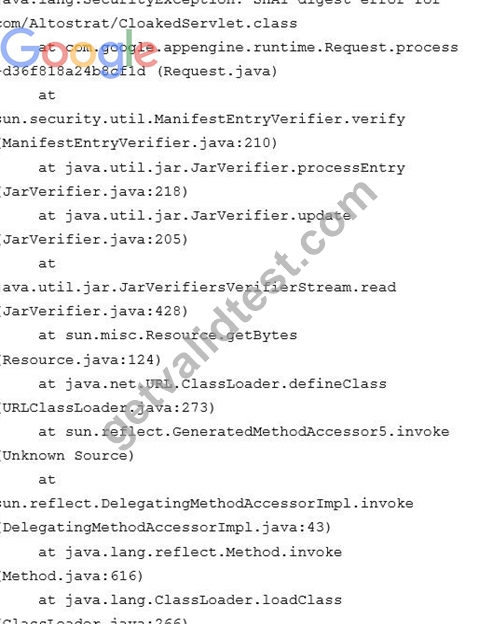
What should you do?
- A. Upload missing JAR files and redeploy your application.
- B. Recompile the CLoakedServlet class using and MD5 hash instead of SHA1
- C. Digitally sign all of your JAR files and redeploy your application
Answer: C
NEW QUESTION 28
You write a Python script to connect to Google BigQuery from a Google Compute Engine virtual machine. The script is printing errors that it cannot connect to BigQuery. What should you do to fix the script?
- A. Install the latest BigQuery API client library for Python
- B. Run your script on a new virtual machine with the BigQuery access scope enabled
- C. Install the bq component for gccloud with the command gcloud components install bq.
- D. Create a new service account with BigQuery access and execute your script with that user
Answer: B
Explanation:
Reference:
The error is most like caused by the access scope issue. When create new instance, you have the default Compute engine default service account but most serves access including BigQuery is not enable. Create an instance Most access are not enabled by default You have default service account but don't have the permission (scope) you can stop the instance, edit, change scope and restart it to enable the scope access. Of course, if you Run your script on a new virtual machine with the BigQuery access scope enabled, it also works
https://cloud.google.com/compute/docs/access/service-accounts
NEW QUESTION 29
You need to design a solution for global load balancing based on the URL path being requested. You need to ensure operations reliability and end-to-end in-transit encryption based on Google best practices.
What should you do?
- A. Create an HTTPS load balancer with URL maps.
- B. Create appropriate instance groups and instances. Configure SSL proxy load balancing.
- C. Create a global forwarding rule. Configure SSL proxy balancing.
- D. Create a cross-region load balancer with URL Maps.
Answer: A
Explanation:
Reference:
Reference https://cloud.google.com/load-balancing/docs/https/url-map
NEW QUESTION 30
You analyzed TerramEarth's business requirement to reduce downtime, and found that they can achieve a majority of time saving by reducing customer's wait time for parts. You decided to focus on reduction of the 3 weeks aggregate reporting time.
Which modifications to the company's processes should you recommend?
- A. Increase fleet cellular connectivity to 80%, migrate from FTP to streaming transport, and develop machine learning analysis of metrics
- B. Migrate from FTP to SFTP transport, develop machine learning analysis of metrics, and increase dealer local inventory by a fixed factor
- C. Migrate from FTP to streaming transport, migrate from CSV to binary format, and develop machine learning analysis of metrics
- D. Migrate from CSV to binary format, migrate from FTP to SFTP transport, and develop machine learning analysis of metrics
Answer: A
Explanation:
The Avro binary format is the preferred format for loading compressed data. Avro data is faster to load because the data can be read in parallel, even when the data blocks are compressed.
Cloud Storage supports streaming transfers with the gsutil tool or boto library, based on HTTP chunked transfer encoding. Streaming data lets you stream data to and from your Cloud Storage account as soon as it becomes available without requiring that the data be first saved to a separate file. Streaming transfers are useful if you have a process that generates data and you do not want to buffer it locally before uploading it, or if you want to send the result from a computational pipeline directly into Cloud Storage.
Reference: https://cloud.google.com/storage/docs/streaming
https://cloud.google.com/bigquery/docs/loading-data
NEW QUESTION 31
Your company has successfully migrated to the cloud and wants to analyze their data stream to optimize operations. They do not have any existing code for this analysis, so they are exploring all their options. These options include a mix of batch and stream processing, as they are running some hourly jobs and live-processing some data as it comes in. Which technology should they use for this?
- A. Google Compute Engine with Google BigQuery
- B. Google Container Engine with Bigtable
- C. Google Cloud Dataproc
- D. Google Cloud Dataflow
Answer: D
NEW QUESTION 32
Your customer runs a web service used by e-commerce sites to offer product recommendations to users. The company has begun experimenting with a machine learning model on Google Cloud Platform to improve the quality of results.
What should the customer do to improve their model's results over time?
- A. Build a roadmap to move the machine learning model training from Cloud GPUs to Cloud TPUs, which offer better results.
- B. Export Cloud Machine Learning Engine performance metrics from Stackdriver to BigQuery, to be used to analyze the efficiency of the model.
- C. Monitor Compute Engine announcements for availability of newer CPU architectures, and deploy the model to them as soon as they are available for additional performance.
- D. Save a history of recommendations and results of the recommendations in BigQuery, to be used as training data.
Answer: D
Explanation:
Reference:
https://cloud.google.com/solutions/building-a-serverless-ml-model
NEW QUESTION 33
To reduce costs, the Director of Engineering has required all developers to move their development infrastructure resources from on-premises virtual machines (VMs) to Google Cloud Platform. These resources go through multiple start/stop events during the day and require state to persist. You have been asked to design the process of running a development environment in Google Cloud while providing cost visibility to the finance department.
Which two steps should you take? Choose 2 answers.
- A. Use the - -auto-delete flag on all persistent disks and terminate the VM
- B. Store all state into local SSD, snapshot the persistent disks, and terminate the VM
- C. Store all state in Google Cloud Storage, snapshot the persistent disks, and terminate the VM
- D. Use Google BigQuery billing export and labels to associate cost to groups
- E. Use the - -no-auto-delete flag on all persistent disks and stop the VM
- F. Apply VM CPU utilization label and include it in the BigQuery billing export
Answer: B,F
Explanation:
C: Billing export to BigQuery enables you to export your daily usage and cost estimates automatically throughout the day to a BigQuery dataset you specify.
Labels applied to resources that generate usage metrics are forwarded to the billing system so that you can break down your billing charges based upon label criteria. For example, the Compute Engine service reports metrics on VM instances. If you deploy a project with 2,000 VMs, each of which is labeled distinctly, then only the first 1,000 label maps seen within the 1 hour window will be preserved.
E: You cannot stop an instance that has a local SSD attached. Instead, you must migrate your critical data off of the local SSD to a persistent disk or to another instance before you delete the instance completely.
You can stop an instance temporarily so you can come back to it at a later time. A stopped instance does not incur charges, but all of the resources that are attached to the instance will still be charged. Alternatively, if you are done using an instance, delete the instance and its resources to stop incurring charges.
References:
https://cloud.google.com/billing/docs/how-to/export-data-bigquery
https://cloud.google.com/compute/docs/instances/stopping-or-deleting-an-instance
NEW QUESTION 34
Your company has announced that they will be outsourcing operations functions. You want to allow developers to easily stage new versions of a cloud-based application in the production environment and allow the outsourced operations team to autonomously promote staged versions to production. You want to minimize the operational overhead of the solution. Which Google Cloud product should you migrate to?
- A. Compute Engine
- B. App Engine
- C. GKE On-Prem
- D. Google Kubernetes Engine
Answer: D
Explanation:
Reference: https://cloud.google.com/security/compliance/eba-outsourcing-mapping-gcp
NEW QUESTION 35
Case Study: 3 - JencoMart Case Study
Company Overview
JencoMart is a global retailer with over 10,000 stores in 16 countries. The stores carry a range of goods, such as groceries, tires, and jewelry. One of the company's core values is excellent customer service. In addition, they recently introduced an environmental policy to reduce their carbon output by 50% over the next 5 years.
Company Background
JencoMart started as a general store in 1931, and has grown into one of the world's leading brands known for great value and customer service. Over time, the company transitioned from only physical stores to a stores and online hybrid model, with 25% of sales online. Currently, JencoMart has little presence in Asia, but considers that market key for future growth.
Solution Concept
JencoMart wants to migrate several critical applications to the cloud but has not completed a technical review to determine their suitability for the cloud and the engineering required for migration. They currently host all of these applications on infrastructure that is at its end of life and is no longer supported.
Existing Technical Environment
JencoMart hosts all of its applications in 4 data centers: 3 in North American and 1 in Europe, most applications are dual-homed.
JencoMart understands the dependencies and resource usage metrics of their on-premises architecture.
Application Customer loyalty portal
LAMP (Linux, Apache, MySQL and PHP) application served from the two JencoMart-owned U.S.
data centers.
Database
* Oracle Database stores user profiles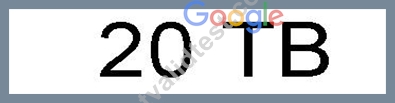



* PostgreSQL database stores user credentials
-homed in US West



Authenticates all users
Compute
* 30 machines in US West Coast, each machine has:


* 20 machines in US East Coast, each machine has:
-core CPU

RAID 1)
Storage
* Access to shared 100 TB SAN in each location
* Tape backup every week
Business Requirements
* Optimize for capacity during peak periods and value during off-peak periods
* Guarantee service availably and support
* Reduce on-premises footprint and associated financial and environmental impact.
* Move to outsourcing model to avoid large upfront costs associated with infrastructure purchase
* Expand services into Asia.
Technical Requirements
* Assess key application for cloud suitability.
* Modify application for the cloud.
* Move applications to a new infrastructure.
* Leverage managed services wherever feasible
* Sunset 20% of capacity in existing data centers
* Decrease latency in Asia
CEO Statement
JencoMart will continue to develop personal relationships with our customers as more people access the web. The future of our retail business is in the global market and the connection between online and in-store experiences. As a large global company, we also have a responsibility to the environment through 'green' initiatives and polices.
CTO Statement
The challenges of operating data centers prevents focus on key technologies critical to our long- term success. Migrating our data services to a public cloud infrastructure will allow us to focus on big data and machine learning to improve our service customers.
CFO Statement
Since its founding JencoMart has invested heavily in our data services infrastructure. However, because of changing market trends, we need to outsource our infrastructure to ensure our long- term success. This model will allow us to respond to increasing customer demand during peak and reduce costs.
For this question, refer to the JencoMart case study.
The migration of JencoMart's application to Google Cloud Platform (GCP) is progressing too slowly. The infrastructure is shown in the diagram.
You want to maximize throughput.
What are three potential bottlenecks? (Choose 3 answers.)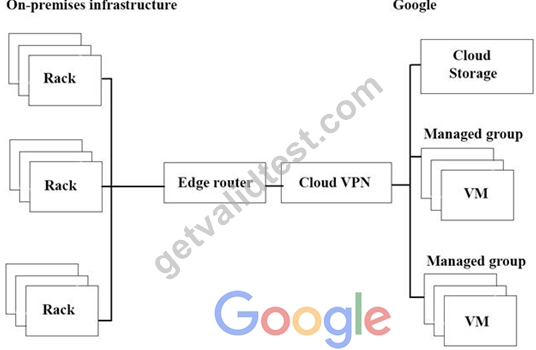
- A. A copy command that is not suited to operate over long distances
- B. Fewer virtual machines (VMs) in GCP than on-premises machines
- C. Complicated internet connectivity between the on-premises infrastructure and GCP
- D. A tier of Google Cloud Storage that is not suited for this task
- E. A single VPN tunnel, which limits throughput
- F. A separate storage layer outside the VMs, which is not suited for this task
Answer: A,E,F
NEW QUESTION 36
To speed up data retrieval, more vehicles will be upgraded to cellular connections and be able to transmit data to the ETL process. The current FTP process is error-prone and restarts the data transfer from the start of the file when connections fail, which happens often. You want to improve the reliability of the solution and minimize data transfer time on the cellular connections.
What should you do?
- A. Directly transfer the files to different Google Cloud Multi-Regional Storage bucket locations in US, EU, and Asia using Google APIs over HTTP(S). Run the ETL process using the data in the bucket
- B. Directly transfer the files to a different Google Cloud Regional Storage bucket location in US, EU, and Asia using Google APIs over HTTP(S). Run the ETL process to retrieve the data from each Regional bucket
- C. Use one Google Container Engine cluster of FTP servers. Save the data to a Multi-Regional bucket. Run the ETL process using data in the bucket
- D. Use multiple Google Container Engine clusters running FTP servers located in different regions. Save the data to Multi-Regional buckets in US, EU, and Asia. Run the ETL process using the data in the bucket
Answer: B
NEW QUESTION 37
Your company operates nationally and plans to use GCP for multiple batch workloads, including some that are not time-critical. You also need to use GCP services that are HIPAA-certified and manage service costs.
How should you design to meet Google best practices?
- A. Provisioning preemptible VMs to reduce cost. Disable and then discontinue use of all GCP and APIs that are not HIPAA-compliant.
- B. Provision standard VMs in the same region to reduce cost. Discontinue use of all GCP services and APIs that are not HIPAA-compliant.
- C. Provisioning preemptible VMs to reduce cost. Discontinue use of all GCP services and APIs that are not HIPAA-compliant.
- D. Provision standard VMs to the same region to reduce cost. Disable and then discontinue use of all GCP services and APIs that are not HIPAA-compliant.
Answer: A
NEW QUESTION 38
You are working in a highly secured environment where public Internet access from the Compute Engine
VMs is not allowed. You do not yet have a VPN connection to access an on-premises file server. You need
to install specific software on a Compute Engine instance. How should you install the software?
- A. Upload the required installation files to Cloud Storage and use firewall rules to block all traffic except
the IP address range for Cloud Storage. Download the files to the VM using gsutil. - B. Upload the required installation files to Cloud Storage. Configure the VM on a subnet with a Private
Google Access subnet. Assign only an internal IP address to the VM. Download the installation files to
the VM using gsutil. - C. Upload the required installation files to Cloud Source Repositories. Configure the VM on a subnet with
a Private Google Access subnet. Assign only an internal IP address to the VM. Download the
installation files to the VM using gcloud. - D. Upload the required installation files to Cloud Source Repositories and use firewall rules to block all
traffic except the IP address range for Cloud Source Repositories. Download the files to the VM using
gsutil.
Answer: A
NEW QUESTION 39
You are developing a globally scaled frontend for a legacy streaming backend data API. This API expects events in strict chronological order with no repeat data for proper processing.
Which products should you deploy to ensure guaranteed-once FIFO (first-in, first-out) delivery of data?
- A. Cloud Pub/Sub to Cloud DataFlow
- B. Cloud Pub/Sub to Stackdriver
- C. Cloud Pub/Sub alone
- D. Cloud Pub/Sub to Cloud SQL
Answer: D
Explanation:
https://cloud.google.com/pubsub/docs/ordering
NEW QUESTION 40
......
Get ready to pass the Professional-Cloud-Architect Exam right now using our Google Cloud Certified Exam Package: https://www.getvalidtest.com/Professional-Cloud-Architect-exam.html
Professional-Cloud-Architect Premium Files Test pdf - Free Dumps Collection: https://drive.google.com/open?id=1DA-C390X1O9RL0C_TvCSOGcMl2zKTR28