


[Sep-2024] Juniper JN0-664 DUMPS WITH REAL EXAM QUESTIONS
2024 New GetValidTest JN0-664 PDF Recently Updated Questions
Juniper JN0-664 certification exam covers a broad range of topics related to service provider routing and switching technologies. These include OSPF, BGP, IS-IS, MPLS, Layer 2 VPNs, Layer 3 VPNs, multicast, and class of service. JN0-664 exam also tests an individual's knowledge of Junos OS troubleshooting tools and techniques, as well as their ability to configure and troubleshoot Junos devices in a service provider environment.
Juniper JN0-664: Service Provider, Professional (JNCIP-SP) exam is a certification exam that is designed for professionals who are looking to enhance their skills in the field of service provider networking. Service Provider, Professional (JNCIP-SP) certification exam is conducted by Juniper Networks, which is one of the leading networking equipment providers in the world.
NEW QUESTION # 56
You are configuring a BGP signaled Layer 2 VPN across your MPLS enabled core network. Your PE-2 device connects to two sites within the same VPN.
In this scenario, which statement is correct?
- A. You must use separate physical interfaces to connect PE-2 to each site.
- B. By default on PE-2, the remote site IDs are automatically assigned based on the order that you add the interfaces to the site configuration.
- C. By default on PE-2, the site's local ID is automatically assigned a value of 0 and must be configured to match the total number of attached sites.
- D. You must create a unique Layer 2 VPN routing instance for each site on the PE-2 device.
Answer: B
NEW QUESTION # 57
You are responding to an RFP for a new MPLS VPN implementation. The solution must use LDP for signaling and support Layer 2 connectivity without using BGP. The solution must be scalable and support multiple VPN connections over a single MPLS LSP. The customer wants to maintain all routing for their private network.
In this scenario, which solution do you propose?
- A. translational cross-connect
- B. circuit cross-connect
- C. BGP Layer 2 VPN
- D. LDP Layer 2 circuit
Answer: D
NEW QUESTION # 58
Exhibit.
Referring to the exhibit; the 10.0.0.0/24 EBGP route is received on R5; however, the route is being hidden.
What are two solutions that will solve this problem? (Choose two.)
- A. On R4, create a policy to change the BGP next hop to 172.16.1.1 and apply it to IBGP as an export policy
- B. Add the external interface prefix to the IGP routing tables
- C. Add the internal interface prefix to the BGP routing tables.
- D. On R4, create a policy to change the BGP next hop to itself and apply it to IBGP as an export policy
Answer: B,D
Explanation:
the default behavior for iBGP is to propagate EBGP-learned prefixes without changing the next-hop. This can cause issues if the next-hop is not reachable via the IGP. One solution is to use the next-hop self command on R4, which will change the next-hop attribute to its own loopback address. This way, R5 can reach the next-hop via the IGP and install the route in its routing table.
Another solution is to add the external interface prefix (120.0.4.16/30) to the IGP routing tables of R4 and R5.
This will also make the next-hop reachable via the IGP and allow R5 to use the route. According to 2, this is a possible workaround for a pure IP network, but it may not work well for an MPLS network.
The reason why the route is being hidden is that R5 cannot reach the BGP next hop 10.0.0.1, which is the address of R1. R5 does not have a route to 10.0.0.0/24 in its routing table, and neither does R4. Therefore, R5 cannot resolve the BGP next hop and marks the route as hidden.
There are two solutions that will solve this problem:
Option A: On R4, create a policy to change the BGP next hop to itself and apply it to IBGP as an export policy. This way, R5 will receive the route with a next hop of 172.16.1.2, which is reachable via the IGP. This solution is also known as next-hop-self1.
Option B: Add the external interface prefix to the IGP routing tables. This way, R4 and R5 will learn a route to 10.0.0.0/24 via the IGP and be able to resolve the BGP next hop. This solution is also known as recursive lookup2.
Option C is not correct because adding the internal interface prefix to the BGP routing tables will not help R5 reach the BGP next hop 10.0.0.1.
Option D is not correct because changing the BGP next hop to 172.16.1.1 on R4 will not help R5 either, since R5 does not have a route to 172.16.1.1 in its routing table.
References: 1: Configuring Next-Hop-Self for IBGP Peers 2: Understanding Recursive Lookup
NEW QUESTION # 59
A packet is received on an interface configured with transmission scheduling. One of the configured queues In this scenario, which two actions will be taken by default on a Junos device? (Choose two.)
- A. The exceeding queue will be considered to have negative bandwidth credit.
- B. The excess traffic will use bandwidth available from other queueses
- C. The excess traffic will be discarded
- D. The exceeding queue will be considered to have positive bandwidth credit
Answer: A,C
Explanation:
https://www.juniper.net/documentation/us/en/software/junos/cos-security-devices/topics/concept/cos-transmissio
NEW QUESTION # 60
When building an interprovider VPN, you notice on the PE router that you have hidden routes which are received from your BGP peer with family inet labeled-unica3t configured.
Which parameter must you configure to solve this problem?
- A. Under the family inet labeled-unicast hierarchy, add the resolve-vpn parameter.
- B. Under the family inet labeled-unicast hierarchy, add the explicit null parameter.
- C. Under the protocols ospf hierarchy, add the traffic-engineering parameter.
- D. Under the protocols mpls hierarchy, add the traffic-engineering parameter
Answer: A
Explanation:
Explanation
The resolve-vpn parameter is a BGP option that allows a router to resolve labeled VPN-IPv4 routes using unlabeled IPv4 routes received from another BGP peer with family inet labeled-unicast configured. This option enables interprovider VPNs without requiring MPLS labels between ASBRs or using VRF tables on ASBRs. In this scenario, you need to configure the resolve-vpn parameter under [edit protocols bgp group external family inet labeled-unicast] hierarchy level on both ASBRs.
NEW QUESTION # 61
PE-1 and PE-2 are configured with LDP-signaled pseudowires to provide connectivity between CE-1 and CE-2. You notice no connectivity exists between CE-1 and CE-2.
Referring to the exhibit, which two statements describe potential causes for this fault? (Choose two.)
- A. There is no LSP configured from PE-1 to PE-2.
- B. The VC IDs are mismatched.
- C. Interface ge-0/0/0 on PE-1 is down.
- D. There is no LSP configured from PE-2 to PE-1.
Answer: A,D
NEW QUESTION # 62
Which two statements are correct about VPLS tunnels? (Choose two.)
- A. BGP-signaled VPLS tunnels require manual provisioning of sites.
- B. LDP-signaled VPLS tunnels use auto-discovery to provision sites
- C. LDP-signaled VPLS tunnels only support control bit 0.
- D. BGP-signaled VPLS tunnels can use either RSVP or LDP between the PE routers.
Answer: B,D
Explanation:
Explanation
VPLS is a Layer 2 VPN technology that allows multiple sites to connect over a shared IP/MPLS network as if they were on the same LAN. VPLS tunnels can be signaled using either Label Distribution Protocol (LDP) or Border Gateway Protocol (BGP). LDP-signaled VPLS tunnels use auto-discovery to provision sites, meaning that PE routers can automatically discover other PE routers that belong to the same VPLS instance
NEW QUESTION # 63
You are a network architect for a service provider and want to offer Layer 2 services to your customers You want to use EVPN for Layer 2 services in your existing MPLS network.
Which two statements are correct in this scenario? (Choose two.)
- A. EVPN uses Type 3 routes to join a multicast tree to flood traffic.
- B. Segment routing must be configured on all PE routers.
- C. VXLAN must be configured on all PE routers.
- D. EVPN uses Type 2 routes to advertise MAC address and IP address pairs learned using ARP snooping
Answer: A,D
Explanation:
EVPN is a technology that connects L2 network segments separated by an L3 network using a virtual Layer 2 network overlay over the Layer 3 network. EVPN uses BGP as its control protocol to exchange different types of routes for different purposes. Type 2 routes are used to advertise MAC address and IP address pairs learned using ARP snooping from the local CE devices. Type 3 routes are used to join a multicast tree to flood traffic such as broadcast, unknown unicast, and multicast (BUM) traffic.
NEW QUESTION # 64
Which two statements are correct about the customer interface in an LDP-signaled pseudowire? (Choose two)
- A. When the encapsulation is vLan-ccc or extended-vlan-ccc, the configured VLAN tag is included in the control plane LDP advertisement
- B. When the encapsulation is ethemet-ccc, tagged and untagged frames are both accepted in the data plane.
- C. When the encapsulation is vlan-ccc or extended-vlan-ccc, the configured VLAN tag is not included in the control plane LDP advertisement
- D. When the encapsulation is ethernet-ccc, only frames without a VLAN tag are accepted in the data plane
Answer: A,B
Explanation:
Explanation
The customer interface in an LDP-signaled pseudowire is the interface on the PE router that connects to the CE device. An LDP-signaled pseudowire is a type of Layer 2 circuit that uses LDP to establish a point-to-point connection between two PE routers over an MPLS network. The customer interface can have different encapsulation types depending on the type of traffic that is carried over the pseudowire. The encapsulation types are ethernet-ccc, vlan-ccc, extended-vlan-ccc, atm-ccc, frame-relay-ccc, ppp-ccc, cisco-hdlc-ccc, and tcc-ccc. Depending on the encapsulation type, the customer interface can accept or reject tagged or untagged frames in the data plane, and include or exclude VLAN tags in the control plane LDP advertisement. The following table summarizes the behavior of different encapsulation types:
NEW QUESTION # 65
Which two statements are correct about the class-of-service configuration shown in the exhibit?
(Choose two.)
- A. The best-effort queue can never transmit more than 40% of the total bandwidth on the ge-0/0/0 interface, even if that bandwidth is available.
- B. Incoming traffic will be classified using the default classifier.
- C. The best-effort queue can transmit more than 40% of the total bandwidth on the ge-0/0/0 interface, if no other queue is using that bandwidth.
- D. Incoming traffic will not be classified because no classifier exists in the configuration.
Answer: B,C
NEW QUESTION # 66
Which three mechanisms are used by Junos platforms to evaluate incoming traffic for CoS purposes? (Choose three )
- A. traffic shapers
- B. rewrite rules
- C. behavior aggregate classifiers
- D. fixed classifiers
- E. multifield classifiers
Answer: C,D,E
Explanation:
Junos platforms use different mechanisms to evaluate incoming traffic for CoS purposes, such as:
Behavior aggregate classifiers: These classifiers use a single field in a packet header to classify traffic into different forwarding classes and loss priorities based on predefined or user-defined values.
Fixed classifiers: These classifiers use a fixed field in a packet header to classify traffic into different forwarding classes and loss priorities based on predefined values.
Multifield classifiers: These classifiers use multiple fields in a packet header to classify traffic into different forwarding classes and loss priorities based on user-defined values and filters.
Rewrite rules and traffic shapers are not used to evaluate incoming traffic for CoS purposes, but rather to modify or shape outgoing traffic based on CoS policies.
NEW QUESTION # 67
Exhibit
You must ensure that the VPN backbone is preferred over the back door intra-area link as long as the VPN is available. Referring to the exhibit, which action will accomplish this task?
- A. Enable OSPF traffic-engineering.
- B. Configure the OSPF metric on the backup intra-area link that is higher than the L3VPN link.
- C. Create an OSPF sham link between the PE routers.
- D. Configure an import routing policy on the CE routers that rejects OSPF routes learned on the backup intra-area link.
Answer: C
Explanation:
A sham link is a logical link between two PE routers that belong to the same OSPF area but are connected through an L3VPN. A sham link makes the PE routers appear as if they are directly connected, and prevents OSPF from preferring an intra-area back door link over the VPN backbone. To create a sham link, you need to configure the local and remote addresses of the PE routers under the [edit protocols ospf area area-id] hierarchy level1.
NEW QUESTION # 68
What is the correct order of packet flow through configurable components in the Junos OS CoS features?
- A. Behavior Aggregate Classifier -> Multifield Classifier -> Input Policer -> Forwarding Policy Options
-> Fabric Scheduler -> Scheduler/Shaper/RED -> Output Policer -> Rewrite Marker - B. Behavior Aggregate Classifier -> Input Policer -> Multifield Classifier -> Forwarding Policy Options
-> Fabric Scheduler -> Output Policer -> Scheduler/Shaper/RED -> Rewrite Marker - C. Multifield Classifier -> Behavior Aggregate Classifier -> Input Policer -> Forwarding Policy Options
-> Fabric Scheduler -> Output Policer -> Rewrite Marker -> Scheduler/Shaper/RED - D. Behavior Aggregate Classifier -> Multifield Classifier -> Input Policer -> Forwarding Policy Options
-> Fabric Scheduler -> Output Policer -> Scheduler/Shaper/RED -> Rewrite Marker
Answer: D
Explanation:
https://www.juniper.net/documentation/us/en/software/junos/cos/topics/concept/packet-flow-cos- process-cos-config-guide.html
NEW QUESTION # 69
You are configuring a BGP signaled Layer 2 VPN across your MPLS enabled core network.
In this scenario, which statement is correct?
- A. You must assign a unique site number to each attached site's configuration.
- B. You must use the same route-distinguisher value on both PE devices.
- C. This type of VPN requires the support of the inet-vpn NLRI on all core BGP devices.
- D. This type of VPN only supports Ethernet interfaces when connecting to CE devices.
Answer: A
NEW QUESTION # 70
Exhibit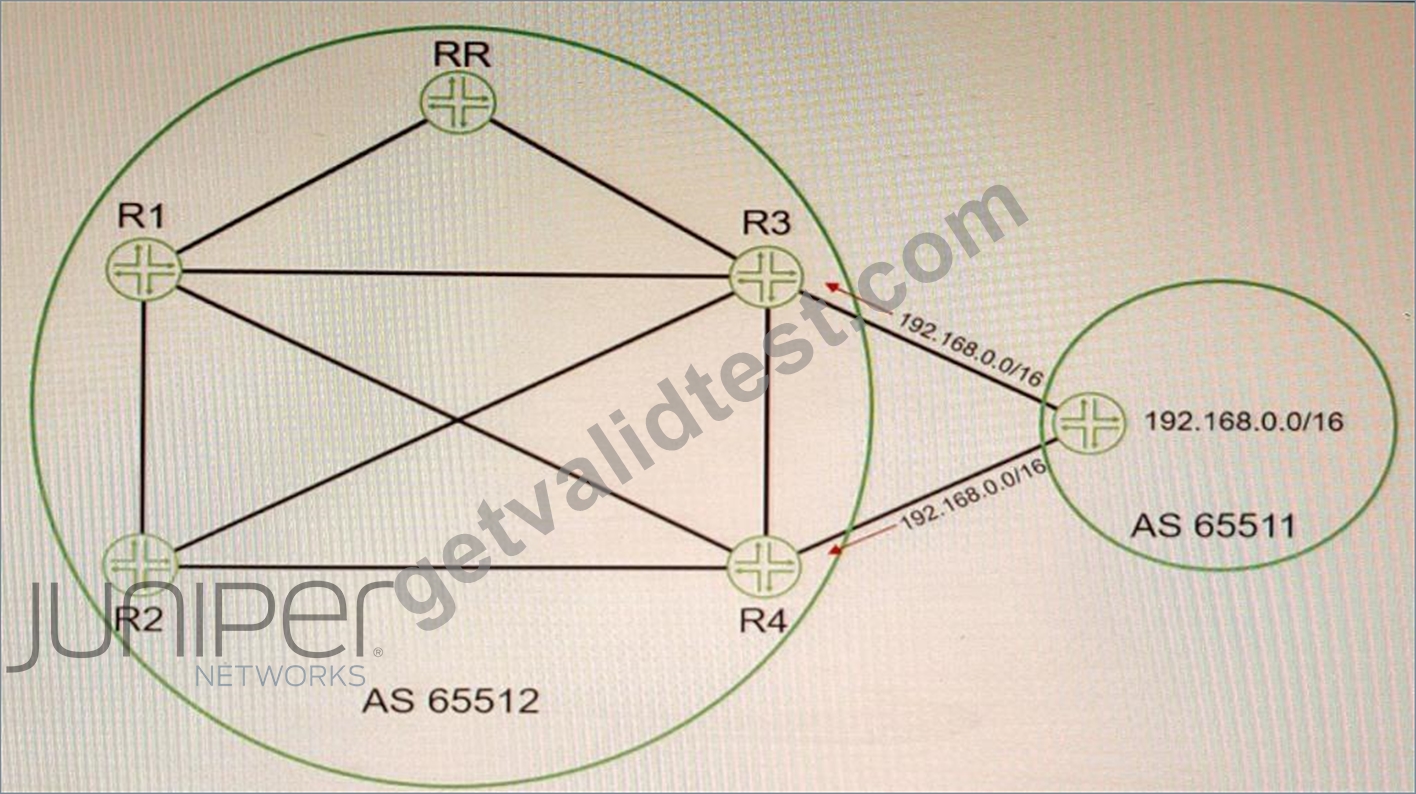
Referring to the exhibit, you are receiving the 192.168 0 0/16 route on both R3 and R4 from your EBGP neighbor You must ensure that R1 and R2 receive both BGP routes from the route reflector In this scenario, which BGP feature should you configure to accomplish this behavior?
- A. route-target
- B. multipath
- C. multihop
- D. add-path
Answer: D
Explanation:
Explanation
BGP add-path is a feature that allows the advertisement of multiple paths through the same peering session for the same prefix without the new paths implicitly replacing any previous paths. This behavior promotes path diversity and reduces multi-exit discriminator (MED) oscillations. BGP add-path is implemented by adding a path identifier to each path in the NLRI. The path identifier can be considered as something similar to a route distinguisher in VPNs, except that a path ID can apply to any address family. Path IDs are unique to a peering session and are generated for each network3. In this question, we have a route reflector (RR) that receives two routes for the same prefix (192.168.0.0/16) from an EBGP neighbor. By default, the RR will only advertise its best path to its clients (R1 and R2). However, we want R1 and R2 to receive both routes from the RR. To achieve this, we need to configure BGP add-path on the RR and enable it to send multiple paths for the same prefix to its clients.
NEW QUESTION # 71
In which two ways does OSPF prevent routing loops in multi-area networks? (Choose two.)
- A. The SPF algorithm prunes looped paths within an area.
- B. All areas are required to connect to area 0.
- C. All areas are required to connect as a full mesh.
- D. The LFA algorithm prunes all looped paths within an area.
Answer: A,B
Explanation:
Explanation
OSPF is an interior gateway protocol that uses link-state routing to exchange routing information among routers within a single autonomous system. OSPF prevents routing loops in multi-area networks by using two methods: area hierarchy and SPF algorithm. Area hierarchy is the concept of dividing a large OSPF network into smaller areas that are connected to a backbone area (area 0). This reduces the amount of routing information that each router has to store and process, and also limits the scope of link-state updates within each area. All areas are required to connect to area 0 either directly or through virtual links2. SPF algorithm is the method that OSPF uses to calculate the shortest path to each destination in the network based on link-state information. The SPF algorithm runs on each router and builds a shortest-path tree that represents the topology of the network from the router's perspective. The SPF algorithm prunes looped paths within an area by choosing only one best path for each destination3.
References: 2:
https://www.juniper.net/documentation/us/en/software/junos/ospf/topics/concept/ospf-area-overview.html 3:
https://www.juniper.net/documentation/us/en/software/junos/ospf/topics/concept/ospf-spf-algorithm-overview.ht
NEW QUESTION # 72
An interface is configured with a behavior aggregate classifier and a multifield classifier How will the packet be processed when received on this interface?
- A. The packet will be processed by the MF classifier first, then the BA classifier.
- B. The packet will be forwarded with no classification changes.
- C. The packet will be processed by the BA classifier first, then the MF classifier.
- D. The packet will be discarded.
Answer: B
Explanation:
behavior aggregate (BA) classifiers and multifield (MF) classifiers are two types of classifiers that are used to assign packets to a forwarding class and a loss priority based on different criteria. The forwarding class determines the output queue for a packet. The loss priority is used by a scheduler to control packet discard during periods of congestion.
A BA classifier maps packets to a forwarding class and a loss priority based on a fixed-length field in the packet header, such as DSCP, IP precedence, MPLS EXP, or IEEE 802.1p CoS bits. A BA classifier is computationally efficient and suitable for core devices that handle high traffic volumes. A BA classifier is useful if the traffic comes from a trusted source and the CoS value in the packet header is trusted.
An MF classifier maps packets to a forwarding class and a loss priority based on multiple fields in the packet header, such as source address, destination address, protocol type, port number, or VLAN ID. An MF classifier is more flexible and granular than a BA classifier and can match packets based on complex filter rules. An MF classifier is suitable for edge devices that need to classify traffic from untrusted sources or rewrite packet headers.
You can configure both a BA classifier and an MF classifier on an interface. If you do this, the BA classification is performed first and then the MF classification. If the two classification results conflict, the MF classification result overrides the BA classification result.
Based on this information, we can infer the following statements:
The packet will be discarded. This is not correct because the packet will not be discarded by the classifiers unless it matches a filter rule that specifies discard as an action. The classifiers only assign packets to a forwarding class and a loss priority based on their match criteria.
The packet will be processed by the BA classifier first, then the MF classifier. This is correct because if both a BA classifier and an MF classifier are configured on an interface, the BA classification is performed first and then the MF classification. If they conflict, the MF classification result overrides the BA classification result.
The packet will be forwarded with no classification changes. This is not correct because the packet will be classified by both the BA classifier and the MF classifier if they are configured on an interface. The final classification result will determine which output queue and which discard policy will be applied to the packet.
The packet will be processed by the MF classifier first, then the BA classifier. This is not correct because if both a BA classifier and an MF classifier are configured on an interface, the BA classification is performed first and then the MF classification. If they conflict, the MF classification result overrides the BA classification result.
NEW QUESTION # 73
R1 and R8 are not receiving each other's routes.
Referring to the exhibit, what are three configuration commands that would solve this problem?
(Choose three.)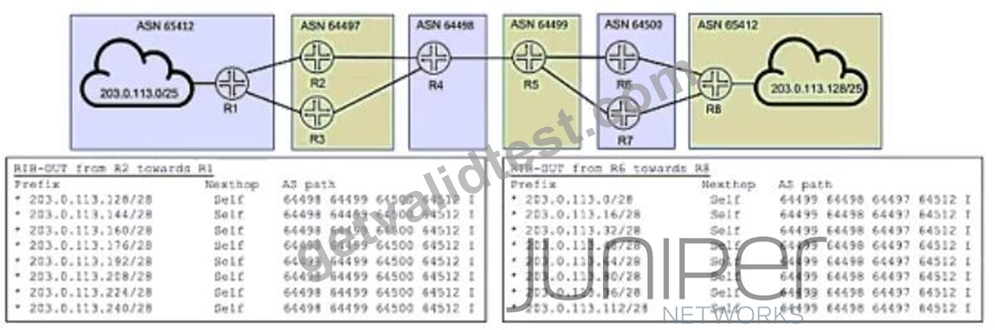
- A. Configure remove-private on advertisements from AS 64497 toward AS 64498.
- B. Configure as-override on advertisement from AS 64500 toward AS 64512.
- C. Configure loops and advertise-peer-as on routers in AS 64497 and AS 64450.
- D. Configure remove-private on advertisements from AS 64500 toward AS 64499.
- E. Configure loops on routers in AS 65412 and advertise-peer-as on routers in AS 64498.
Answer: A,B,C
NEW QUESTION # 74
Which two statements are correct regarding the PIM DR in a PIM-SM domain? (Choose two.)
- A. The source DR sends PIM register messages from the source network to the RP.
- B. If the DR priorities match, the router with the lowest IP address is selected as the DR.
- C. By default. PIM DR election is performed on point-to-point links.
- D. The receiver DR sends PIM join and PIM prune messages from the receiver network toward the RP.
Answer: A,D
NEW QUESTION # 75
You are asked to exchange routes between R1 and R4 as shown in the exhibit. These two routers use the same AS number.
Which two steps will accomplish this task? (Choose two.)
- A. Configure the BGP group with the as-override parameter on R1 and R4.
- B. Configure the BGP group with the advertise-peer-as parameter on R1 and R4.
- C. Configure the BGP group with the advertise-peer-as parameter on R2 and R3.
- D. Configure the BGP group with the as-override parameter on R2 and R3.
Answer: C,D
Explanation:
https://www.juniper.net/documentation/us/en/software/junos/routing-
policy/bgp/topics/example/bgp-advertise-peer-as.html
Both advertise-peer-as and as-override are BGP settings applied on the PE, not the CE.
NEW QUESTION # 76
Which two statements are correct about the class-of-service configuration shown in the exhibit?
(Choose two.)
- A. The drop probability gradually increases from 20% to 60% as the queue level increases from 50% full to 75% full.
- B. The drop probability jumps immediately from 20% to 60% when the queue level reaches 75% full.
- C. To use this drop profile, you apply it directly to an interface.
- D. To use this drop profile, you reference it in a scheduler.
Answer: A,D
NEW QUESTION # 77
Which two statements are correct about the customer interface in an LDP-signaled pseudowire?
(Choose two.)
- A. When the encapsulation is ethernet-ccc, only frames without a VLAN tag are accepted in the data plane.
- B. When the encapsulation is vlan-ccc or extended-vlan-ccc, the configured VLAN tag is included in the control plane LDP advertisement.
- C. When the encapsulation is ethernet-ccc, tagged and untagged frames are both accepted in the data plane.
- D. When the encapsulation is vlan-ccc or extended-vlan-ccc, the configured VLAN tag is not included in the control plane LDP advertisement.
Answer: B,C
NEW QUESTION # 78
Referring to the exhibit, which two statements are true? (Choose two.)
- A. This route is learned through EBGP.
- B. The device advertising this route into EVPN is 192.168.101.5.
- C. The devices advertising this route into EVPN are 10.0.2.12 and 10.0.2.22.
- D. This is an EVPN Type-2 route.
Answer: B,D
NEW QUESTION # 79
Exhibit.
Referring to the exhib.t, what must be changed to establish a Level 1 adjacency between routers R1 and R2?
- A. Add IP addresses to the interface ge-l/2/3 unit 0 family iso hierarchy on both R1 and R2.
- B. Remove the level i disable parameter under the R2 protocols isis interface loo . 0 configuration hierarchy.
- C. Change the level l disable parameter under the R1 protocols isis interface lo0.0 hierarchy to the level 2 disable parameter.
- D. Change the level 1 disable parameter under the R2 protocols isis interface ge-1/2/3 .0 hierarchy to the level 2 disable parameter
Answer: B
Explanation:
IS-IS routers can form Level 1 or Level 2 adjacencies depending on their configuration and network topology.
Level 1 routers are intra-area routers that share the same area address with their neighbors. Level 2 routers are inter-area routers that can connect different areas. Level 1-2 routers are both intra-area and inter-area routers that can form adjacencies with any other router.
In the exhibit, R1 and R2 are in different areas (49.0001 and 49.0002), so they cannot form a Level 1 adjacency. However, they can form a Level 2 adjacency if they are both configured as Level 1-2 routers. R1 is already configured as a Level 1-2 router, but R2 is configured as a Level 1 router only, because of the level 1 disable command under the lo0.0 interface. This command disables Level 2 routing on the loopback interface, which is used as the router ID for IS-IS.
Therefore, to establish a Level 1 adjacency between R1 and R2, the level 1 disable command under the R2 protocols isis interface lo0.0 hierarchy must be removed. This will enable Level 2 routing on R2 and allow it to form a Level 2 adjacency with R1.
NEW QUESTION # 80
A network designer would like to advertise a single summary route from R4 to IS-IS level 2 neighbors as shown in the exhibit, but the configuration is not working.
Which three configuration changes will accomplish this task? (Choose three.)
- A. set policy-options policy-statement summary-v6 term suppress then reject
- B. delete policy-options policy-statement summary-v6 term DC-routes from route-filter
2001:db5:a:fa00::/61 longer - C. set protocols isis import summary-v6
- D. set policy-options policy-statement summary-v6 term DC-routes from route-filter
2001:dbS:a:fa00::/6l exact - E. delete protocols isis export summary-v6
Answer: A,B,D
NEW QUESTION # 81
......
Latest JN0-664 Pass Guaranteed Exam Dumps Certification Sample Questions: https://www.getvalidtest.com/JN0-664-exam.html
JN0-664 Exam with Guarantee Updated 99 Questions: https://drive.google.com/open?id=1cyrQR8yPouBoXN8Lg1goJNk2MrVCr-9c