


[Sep-2025] Get 100% Real PCNSE Exam Questions, Accurate & Verified GetValidTest Dumps in the Real Exam!
Pass Your PCNSE PAN-OS Exams Fast. All Top PCNSE Exam Questions Are Covered.
The PCNSE exam is a comprehensive and challenging test that covers a wide range of topics, including firewall configuration, network security, virtualization, and cloud computing. PCNSE exam is based on the latest version of the Palo Alto Networks’ operating system, PAN-OS 10.0, which includes advanced security features such as machine learning, threat intelligence, and multi-cloud security. The PCNSE certification is recognized globally and is highly valued by employers, making it a valuable credential for security professionals looking to advance their careers in the cybersecurity industry.
NEW QUESTION # 223
Which DoS Protection Profile detects and prevents session exhaustion attacks against specific destinations?
- A. Packet Buffer Protection
- B. Resource Protection
- C. TCP Port Scan Protection
- D. Packet Based Attack Protection
Answer: B
Explanation:
IP flood thresholds, you can also use DoS Protection profiles to detect and prevent session exhaustion attacks in which a large number of hosts (bots) establish as many sessions as possible to consume a target's resources. On the profile's Resources Protection tab, you can set the maximum number of concurrent sessions that the device(s) defined in the DoS Protection policy rule to which you apply the profile can receive. When the number of concurrent sessions reaches its maximum limit, new sessions are dropped. https://docs.paloaltonetworks.com/pan-os/10-1/pan-os-admin/zone-protection-and-dos-protection/zone-defense/dos-protection-profiles-and-policy-rules/dos-protection-profiles.html
https://docs.paloaltonetworks.com/pan-os/10-2/pan-os-admin/zone-protection-and-dos-protection/zone-defense/dos-protection-profiles-and-policy-rules/dos-protection-profiles#ida42d52fa-3366-4695-bb4a-d39ebf3b6a5f
NEW QUESTION # 224
Which PAN-OS policy must you configure to force a user to provide additional credentials before he is allowed to access an internal application that contains highly-sensitive business data?
- A. Security policy
- B. Application Override policy
- C. Authentication policy
- D. Decryption policy
Answer: C
Explanation:
Authentication policy enables you to authenticate end users before they can access services and applications. Whenever a user requests a service or application (such as by visiting a web page), the firewall evaluates Authentication policy. Based on the matching Authentication policy rule, the firewall then prompts the user to authenticate using one or more methods (factors), such as login and password, Voice, SMS, Push, or One-time Password (OTP) authentication
https://docs.paloaltonetworks.com/pan-os/9-1/pan-os-admin/authentication/authentication-policy
NEW QUESTION # 225
What are two valid deployment options for Decryption Broker? (Choose two)
- A. Layer 2 Security Chain
- B. Layer 3 Security Chain
- C. Transparent Bridge Security Chain
- D. Transparent Mirror Security Chain
Answer: B,C
Explanation:
https://docs.paloaltonetworks.com/pan-os/10-0/pan-os-admin/decryption/decryption-broker/decryption-broker-concepts
NEW QUESTION # 226
A new application server 192.168.197.40 has been deployed in the DMZ. There are no public IP addresses available, resulting in the server sharing NAT IP 198.51.100.88 with another DMZ serve that uses IP address 192.168.197.60. Firewall security and NAT rules have been configured. The application team has confirmed that the new server is able to establish a secure connection to an external database with IP address 203.0.113.40.
The database team reports that they are unable to establish a secure connection to
198.51.100.88 from 203.0.113.40. However, it confirms a successful ping test to 198.51.100.88.
Referring to the NAT configuration and traffic logs provided how can the firewall engineer resolve the situation and ensure inbound and outbound connections work concurrently for both DMZ servers?
- A. Configure separate source NAT and destination NAT rules for the two DMZ servers without using the bidirectional option.
- B. Sharing a single NAT IP is possible for outbound connectivity not for inbound therefore a new public IP address must be obtained for the new DMZ server and used in the NAT rule 6 DMZ server 2.
- C. Move the NAT rule 6 DMZ server 2 above NAT rule 5 DMZ server 1.
- D. Replace the two NAT rules with a single rule that has both DMZ servers as "Source Address" both external servers as "Destination Address," and Source Translation remaining as is with bidirectional option enabled.
Answer: B
NEW QUESTION # 227
A web server is hosted in the DMZ and the server is configured to listen for incoming connections on TCP port 443. A Security policies rules allowing access from the Trust zone to the DMZ zone needs to be configured to allow web-browsing access. The web server hosts its contents over HTTP(S). Traffic from Trust to DMZ is being decrypted with a Forward Proxy rule.
Which combination of service and application, and order of Security policy rules, needs to be configured to allow cleartext web- browsing traffic to this server on tcp/443.
- A. Rule #1: application: web-browsing; service: service-https; action: allow Rule #2: application: ssl; service: application-default; action: allow
- B. Rule #1: application: web-browsing; service: application-default; action: allow Rule #2:
application: ssl; service: application-default; action: allow - C. Rule # 1: application: ssl; service: application-default; action: allow Rule #2: application: web-browsing; service: application-default; action: allow
- D. Rule #1: application: web-browsing; service: service-http; action: allow Rule #2: application: ssl; service: application-default; action: allow
Answer: B
NEW QUESTION # 228
A remote administrator needs firewall access on an untrusted interface Which two components are required on the firewall to configure certificate-based administrator authentication to the web Ul? (Choose two)
- A. certificate authority (CA) certificate
- B. client certificate
- C. server certificate
- D. certificate profile
Answer: B,D
NEW QUESTION # 229
Given the following table.
Which configuration change on the firewall would cause it to use 10.66.24.88 as the next hop for the
192.168.93.0/30 network?
- A. Configuring the metric for RIP to be higher than that of OSPF Int.
- B. Configuring the administrative Distance for RIP to be higher than that of OSPF Ext.
- C. Configuring the administrative Distance for RIP to be lower than that of OSPF Int.
- D. Configuring the metric for RIP to be lower than that OSPF Ext.
Answer: C
NEW QUESTION # 230
A users traffic traversing a Palo Alto networks NGFW sometimes can reach http //www company com At other times the session times out. At other times the session times out The NGFW has been configured with a PBF rule that the user traffic matches when it goes to http://www.company.com goes to http://www company com How can the firewall be configured to automatically disable the PBF rule if the next hop goes down?
- A. Enable and configure a link monitoring profile for the external interface of the firewall
- B. Create and add a monitor profile with an action of fail over in the PBF rule in question
- C. Configure path monitoring for the next hop gateway on the default route in the virtual router
- D. Create and add a monitor profile with an action of wait recover in the PBF rule in question
Answer: B
NEW QUESTION # 231
A organizations administrator has the funds available to purchase more firewalls to increase the organization's security posture.
The partner SE recommends placing the firewalls as close as possible to the resources that they protect Is the SE's advice correct and why or why not?
- A. No Firewalls provide new defense and resilience to prevent attackers at every stage of the cyberattack lifecycle independent of placement
- B. Yes Zone Protection profiles can be tailored to the resources that they protect via the configuration of specific device types and operating systems
- C. Yes Firewalls are session based so they do not scale to millions of CPS
- D. No Placing firewalls m front of perimeter DDoS devices provides greater protection tor sensitive devices inside the network
Answer: C
Explanation:
Explanation
https://docs.paloaltonetworks.com/pan-os/10-0/pan-os-admin/zone-protection-and-dos-protection/zone-defense/f
NEW QUESTION # 232
An administrator accidentally closed the commit window/screen before the commit was finished. Which two options could the administrator use to verify the progress or success of that commit task? (Choose two.)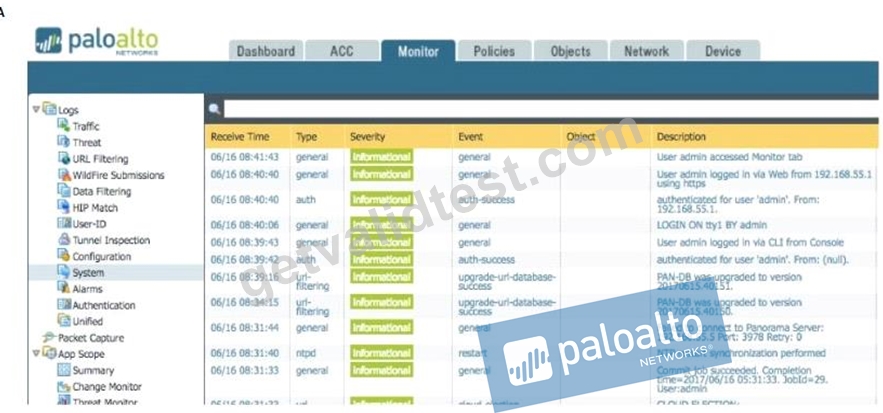


- A. Exhibit B
- B. Exhibit A
- C. Exhibit C
- D. Exhibit D
Answer: B,D
NEW QUESTION # 233
Which statement is correct given the following message from the PanGPA log on the GlobalProtect app?
Failed to connect to server at port:47 67
- A. The PanGPA process failed to connect to the PanGPS process on port 4767
- B. The PanGPS process failed to connect to the PanGPA process on port 4767
- C. The GlobalProtect app failed to connect to the GlobalProtect Gateway on port 4767
- D. The GlobalProtect app failed to connect to the GlobalProtect Portal on port 4767
Answer: D
NEW QUESTION # 234
An administrator has a requirement to export decrypted traffic from the Palo Alto Networks NGFW to a third-party, deep-level packet inspection appliance.
Which interface type and license feature are necessary to meet the requirement?
- A. Virtual Wire interface with the Decryption Port Export license
- B. Tap interface with the Decryption Port Mirror license
- C. Decryption Mirror interface with the Threat Analysis license
- D. Decryption Mirror interface with the associated Decryption Port Mirror license
Answer: D
NEW QUESTION # 235
A consultant deploys a PAN-OS 11.0 VM-Series firewall with the Web Proxy feature in Transparent Proxy mode.
Which three elements must be in place before a transparent web proxy can function? (Choose three.)
- A. Authentication Policy Rule set to default-web-form
- B. Cortex Data Lake license
- C. DNS Security license
- D. Prisma Access explicit proxy license
- E. User-ID for the proxy zone
Answer: C,D,E
Explanation:
https://docs.paloaltonetworks.com/pan-os/11-0/pan-os-new-features/networking-features/web- proxy
NEW QUESTION # 236
Which DoS Protection Profile detects and prevents session exhaustion attacks against specific destinations?
- A. Packet Buffer Protection
- B. Resource Protection
- C. TCP Port Scan Protection
- D. Packet Based Attack Protection
Answer: B
Explanation:
Explanation
IP flood thresholds, you can also use DoS Protection profiles to detect and prevent session exhaustion attacks in which a large number of hosts (bots) establish as many sessions as possible to consume a target's resources.
On the profile's Resources Protection tab, you can set the maximum number of concurrent sessions that the device(s) defined in the DoS Protection policy rule to which you apply the profile can receive. When the number of concurrent sessions reaches its maximum limit, new sessions are dropped.
https://docs.paloaltonetworks.com/pan-os/10-1/pan-os-admin/zone-protection-and-dos-protection/zone-defense/d
https://docs.paloaltonetworks.com/pan-os/10-2/pan-os-admin/zone-protection-and-dos-protection/zone-defense/d
NEW QUESTION # 237
An administrator pushes a new configuration from Panorama to a par of firewalls that are configured as an active/passive HA pair. Which NGFW receives the from Panorama?
- A. Both the active and passive firewalls which then synchronize with each other
- B. Both the active and passive firewalls independently, with no synchronization afterward
- C. The active firewall which then synchronizes to the passive firewall
- D. The passive firewall, which then synchronizes to the active firewall
Answer: B
NEW QUESTION # 238
A network administrator plans a Prisma Access deployment with three service connections, each with a BGP peering to a CPE. The administrator needs to minimize the BGP configuration and management overhead on on-prem network devices.
What should the administrator implement?
- A. hot potato routing
- B. target service connection for traffic steering
- C. summarized BGP routes before advertising
- D. default routing
Answer: A
NEW QUESTION # 239
Which option is an IPv6 routing protocol?
- A. OSPFv3
- B. BGP NG
- C. RIPv3
- D. OSPv3
Answer: A
NEW QUESTION # 240
What should an administrator consider when planning to revert Panorama to a pre-PAN-OS 8.1 version?
- A. An administrator must use the Expedition tool to adapt the configuration to the pre-PAN-OS 8.1 state.
- B. Panorama cannot be reverted to an earlier PAN-OS release if variables are used in templates or template stacks.
- C. Administrators need to manually update variable characters to those used in pre-PAN-OS 8.1.
- D. When Panorama is reverted to an earlier PAN-OS release, variables used in templates or template stacks will be removed automatically.
Answer: B
Explanation:
You are unable to downgrade from PAN-OS 8.1 to an earlier PAN-OS release if variables are used in your template or template stack configuration. Variables must be removed from the template and template stack configuration to downgrade.
https://www.paloaltonetworks.com/documentation/81/pan-os/newfeaturesguide/upgrade-to-pan- os-81/upgradedowngrade-considerations
NEW QUESTION # 241
A client is concerned about web shell attacks against their servers.
Which profile will protect the individual servers?
- A. Anti-Spyware profile
- B. Zone Protection profile
- C. DoS Protection profile
- D. Antivirus profile
Answer: A
Explanation:
Web shell attacks are part of the Spyware Signatures.
https://docs.paloaltonetworks.com/pan-os/10-1/pan-os-admin/threat-prevention/threat-signatures
NEW QUESTION # 242
A company has a policy that denies all applications it classifies as bad and permits only application it classifies as good. The firewall administrator created the following security policy on the company's firewall.
Which interface configuration will accept specific VLAN IDs?
Which two benefits are gained from having both rule 2 and rule 3 presents? (choose two)
- A. Separate Log Forwarding profiles can be applied to rules 2 and 3.
- B. Different security profiles can be applied to traffic matching rules 2 and 3.
- C. A report can be created that identifies unclassified traffic on the network.
- D. Rule 2 and 3 apply to traffic on different ports.
Answer: A,C
NEW QUESTION # 243
Refer to the exhibit.
Which will be the egress interface if the traffic's ingress interface is ethernet1/7 sourcing from 192.168.111.3 and to the destination 10.46.41.113?
- A. ethernet1/6
- B. ethernet1/7
- C. ethernet1/5
- D. ethernet1/3
Answer: C
Explanation:
In the second image, VW ports mentioned are 1/5 and 1/7. Hence it can not be a part of any other routing. So if any traffic coming as ingress from 1/7, it has to go out via 1/5.
The egress interface for the traffic with ingress interface ethernet1/7, source 192.168.111.3, and destination
10.46.41.113 will be ethernet1/5. This is because the traffic will match the virtual wire with interfaces ethernet1/5 and ethernet1/7, which is configured to allow VLAN-tagged traffic with tags 10 and 201. The traffic will also match the security policy rule that allows traffic from zone Trust to zone Untrust, which are assigned to ethernet1/7 and ethernet1/5 respectively2. Therefore, the traffic will be forwarded to the same interface from which it was received, which is ethernet1/53.
NEW QUESTION # 244
......
Palo Alto Networks Certified Security Engineer (PCNSE) certification is one of the most sought-after certifications in the IT security industry. Palo Alto Networks Certified Network Security Engineer Exam certification is designed for professionals who are responsible for deploying, configuring, and managing Palo Alto Networks Next-Generation Firewalls (NGFWs). The PCNSE certification is a testament to an individual’s expertise in implementing Palo Alto Networks' security solutions and ensuring the organization's network security.
The PCNSE certification exam covers a wide range of topics, including network security technologies, network design and implementation, firewall policies and configurations, and threat prevention and detection. PCNSE exam is designed to test the candidate's knowledge and skills in the latest security technologies and best practices, and to ensure that they are capable of designing, deploying, configuring, and troubleshooting secure networks using Palo Alto Networks products.
Penetration testers simulate PCNSE exam: https://www.getvalidtest.com/PCNSE-exam.html
Free Test Engine For Palo Alto Networks Certified Network Security Engineer Exam Certification Exams: https://drive.google.com/open?id=192X6ix-BQjjYgICl4PSmMcO4N2L70qn_