


[Sep-2026] Verified Microsoft Exam Dumps with MB-800 Exam Study Guide
Best Quality Microsoft MB-800 Exam Questions GetValidTest Realistic Practice Exams [2026]
NEW QUESTION # 33
A company uses Dynamics 365 Business Central. You are recording incoming payments from customers.
You must record a payment of $500 for customer 2030 with a posting date of November 16. 2022. The payment must be recorded against bank account No. 1010 with general ledger (G/l) account No. 10100.
You need to populate the cash receipt journal batch in Business Central to properly record the incoming payment to a bank account Which value should you use? To answer, select the appropriate options in the answer area.
NOTE: Each correct selection is worth one point.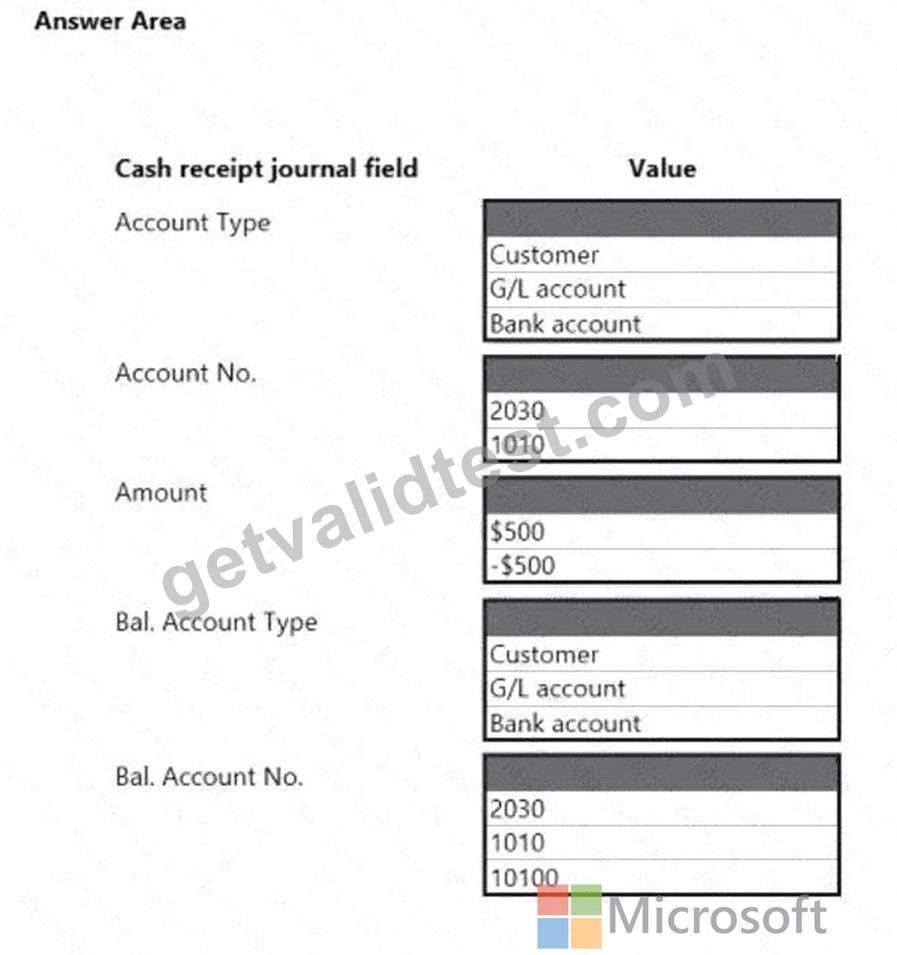
Answer:
Explanation:
Explanation:
We are recording an incoming customer payment in the Cash Receipt Journal:
* Account Type = Customer # Because we are applying the payment to a customer balance.
* Account No. = 2030 # This is the customer account number provided.
* Amount = $500 # Since it's an incoming receipt (cash inflow), the value is positive. (A negative would represent refunds or outgoing payments.)
* Bal. Account Type = Bank account # Payments received must be offset against a bank account, not a G
/L account directly.
* Bal. Account No. = 1010 # This is the specific bank account receiving the payment.
## Note: The G/L account 10100 mentioned in the scenario is the general ledger posting account associated with the bank account card (No. 1010). Users do not directly post against that G/L account in the journal; instead, the system automatically posts to it when you select the bank account.
This ensures proper double-entry posting:
* Debit Bank (G/L 10100 via Bank Account 1010)
* Credit Customer (Customer 2030).
Microsoft Learn References
* Work with General Journals in Business Central
* Apply Payments with the Cash Receipt Journal
* Bank Accounts in Business Central
NEW QUESTION # 34
You set up a new company in Dynamics 365 Business Central.
You need to demonstrate Page Inspection functionality.
Which features should you use? To answer, drag the appropriate page inspection features to the correct display requirements. Each page inspection feature may be used once, more than once, or not at all. You may need to drag the split bar between panes or scroll to view content.
NOTE: Each correct selection is worth one point.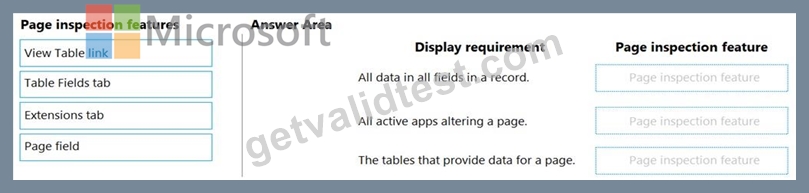
Answer:
Explanation:
Reference:
https://docs.microsoft.com/en-gb/dynamics365/business-central/dev-itpro/developer/devenv-inspecting-pages?tabs=page
NEW QUESTION # 35
A company uses Dynamics 365 Business Central.
The company performs an annual review of customer prices and determines that sales prices must rise by 10% for the coming year. You need to adjust the prices. What should you do?
- A. Manually add new lines to the Sales Lines Discount page.
- B. Use the action Suggest Sales Price on Worksheet.
- C. Manually add a sales price to the Sales Prices page.
- D. Manually add a sales price to the Sales Price Worksheet page.
Answer: B
NEW QUESTION # 36
You are setting up and testing a workflow with approval hierarchy in Dynamics 365 Business Central.
In Approval User Setup, you configure the following users:
You create and enable an approval workflow. You configure the workflow to use the approver limit type Approver Chain.
To test the workflow, User1 creates a purchase order for $1,100 and runs the Send Approval Request function.
You need to identify the actions that occur when the workflow runs.
Which set of actions occurs?
- A. User4 will receive an approval request.
Once approved, the purchase order is released. - B. User1 will receive an approval request.
Once User1 approves the request, User2 must approve the request.
Once User2 approves the request, User3 must approve the request.
Once User3 approves the request, the purchase order is released. - C. User3 receives an approval request.
Once User3 approves the request, the purchase order is released. - D. User3 will receive an approval request.
Once User3 approves the request, the request is routed to User4 for approval.
Once User4 approves the request, the purchase order is released. - E. User2 will receive an approval request.
Once User2 approves the request, User3 will receive an approval request.
Once User2 and User3 approve the request, the purchase order is released.
Answer: E
Explanation:
Reference:
https://docs.microsoft.com/en-gb/dynamics365/business-central/across-how-to-set-up-approval-users
https://dynamics.tensoft.com/approval-user-setup-in-microsoft-dynamics-365-business-central/
NEW QUESTION # 37
A company uses Dynamics 365 Business Central.
The finance manager requires a specific group of operating team users to have access only to a particular set of customer data.
You need to configure and enforce the security requirements.
Which pages should you configure? To answer, move the appropriate pages to the correct requirements. You may use each page once, more than once, or not at all. You may need to move the split bar between panes or scroll to view content.
NOTE: Each correct selection is worth one point.
Answer:
Explanation:
Explanation:
Create security rules that will grant users required access # Permission Sets Assign the predefined security rule sets to the requested users # User Card Comprehensive Detailed Explanation In Dynamics 365 Business Central, security is managed using Permission Sets and then assigned to users.
* Create security rules # Permission Sets
* A Permission Set defines which tables, reports, and pages a user can access (read, insert, modify, delete).
* To restrict access to a particular set of customer data, you would configure a Permission Set that includes only the required tables/records, possibly combined with security filters.
* Assign rules to users # User Card
* After creating or selecting predefined permission sets, you assign them to users via the User Card page.
* The User Card links Business Central users with the permissions they need to perform their job roles.
Other options not correct:
* Profiles (Roles): These control the Role Center (UI experience) but not security.
* Microsoft 365 admin center: Used for licensing and user account management but not Business Central data security.
Microsoft Learn References
* Permissions and Permission Sets
* Assign Permission Sets to Users
* Manage Users and Permissions
NEW QUESTION # 38
A company plans to verify that purchase invoices use agreed-upon prices and discounts.
The company is configuring settings on a vendor card. The company receives a validation error when creating a purchase order for the vendor.
You need to find out which setting is causing the validation error.
Which configuration option on the vendor card must you populate?
- A. Order address
- B. Vendor Posting Group
- C. Vendor Template
- D. Purchase Prices
- E. Location code
Answer: B
Explanation:
Reference:
https://usedynamics.com/business-central/purchase/creating-vendors/
NEW QUESTION # 39
A company uses Dynamics 365 Business Central. You manage customer master data for the company.
You need to create new customers.
What are three possible ways to achieve the goal? Each correct answer presents a complete solution.
NOTE: Each correct selection is worth one point.
- A. On the Contacts page, select Related Information and then select Customer
- B. On the Configuration Template Header for the customer table, select Create Instance.
- C. On the Customer card, select Apply Template.
- D. On the Contacts page, select Create as Customer.
- E. On the Customers page, select New.
Answer: B,D,E
Explanation:
There are multiple ways to create a customer in Business Central:
* From Contacts page - Create as Customer (B): You can convert a contact record into a customer.
* From Configuration Template Header - Create Instance (C): You can create new customer records via configuration templates.
* From Customers page - New (D): The most common way is directly on the Customers page by selecting New.
Other options:
* A (On the Contacts page, Related Information # Customer): No direct action exists with this name.
* E (Apply Template on Customer card): Applies template data to an already created customer; it doesn't create a new record.
References:
Register New Customers
Using Configuration Templates
NEW QUESTION # 40
A client plans to implement Dynamics 365 Business Central.
You need to configure the system.
Which value posting type should you use? To answer, select the appropriate options in the answer area.
NOTE: Each correct selection is worth one point.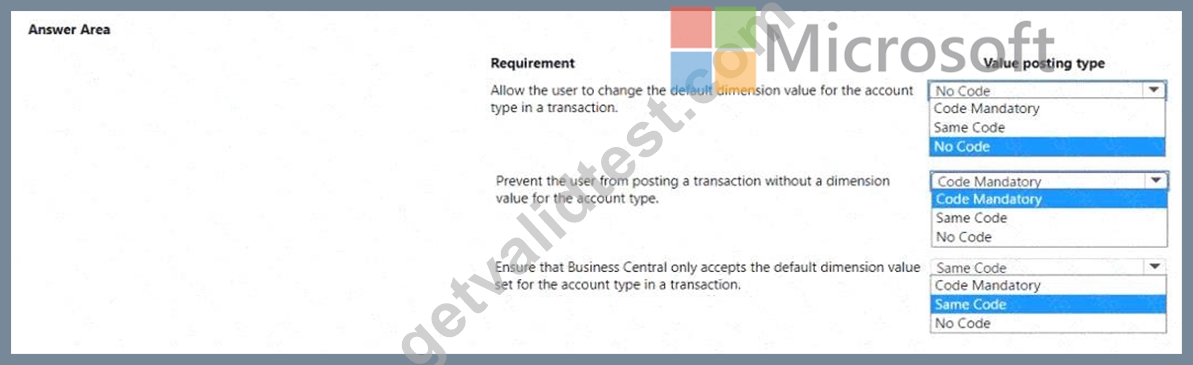
Answer:
Explanation:
Explanation:
Comprehensive Detailed Explanation
In Dynamics 365 Business Central, the Value Posting field on dimensions defines how dimensions behave during posting:
* No Code
* The dimension is optional.
* Users can change or skip the default dimension value when entering a transaction.
* Used when you want flexibility.
* Code Mandatory
* A dimension value must be entered before posting is allowed.
* Ensures the transaction always contains a dimension value, but users can pick any valid one.
* Used when dimension entry is required for reporting.
* Same Code
* The system enforces that only the default dimension value assigned to the account type can be used.
* Users cannot change the default value, ensuring strict consistency.
Microsoft Learn References
* Default Dimensions and Value Posting Types
* Set Up Dimensions
NEW QUESTION # 41
A company creates blanket purchase orders from inbound documents that are sent to Dynamics 365 Business Central by purchasing agents.
When a new blanket purchase order is created with a certain item, the system must send a procurement supervisor a request to approve the purchase order. Purchase orders must not be posted until the procurement supervisor approves the purchase order.
You need to configure the system. To answer, select the appropriate options in the answer area.
NOTE: Each correct selection is worth one point.
Answer:
Explanation: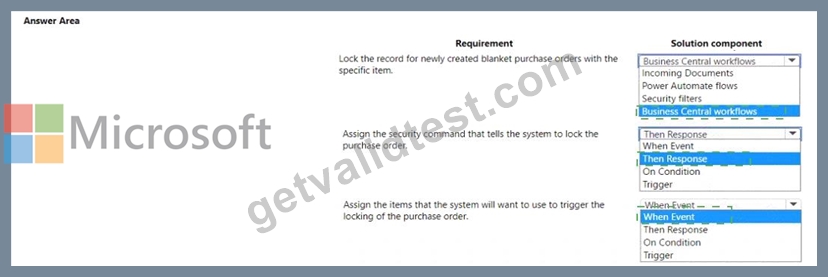
Explanation:
NEW QUESTION # 42
You need to configure the purchase order process to meet the auditor's requirements.
Which four actions should you perform in sequence? To answer, move the appropriate actions from the list of actions to the answer area and arrange them in the correct order.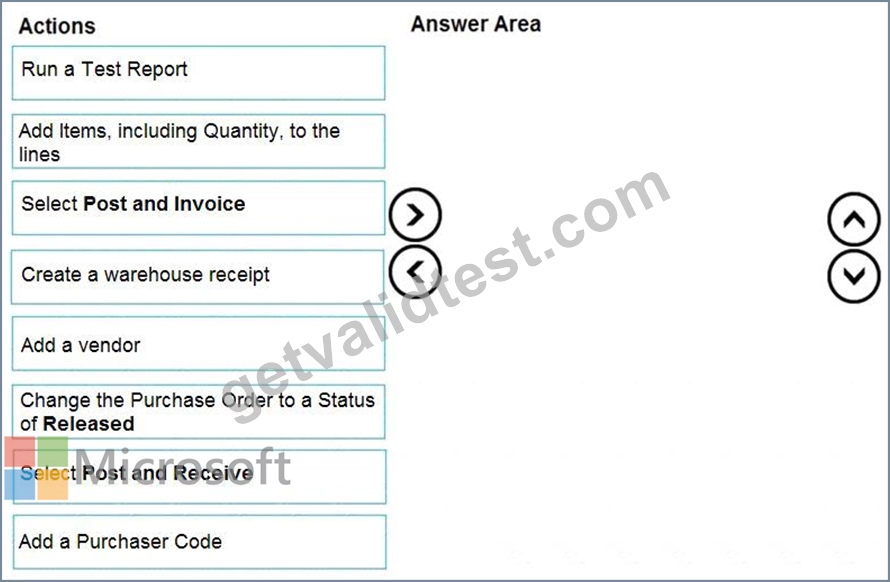
Answer:
Explanation: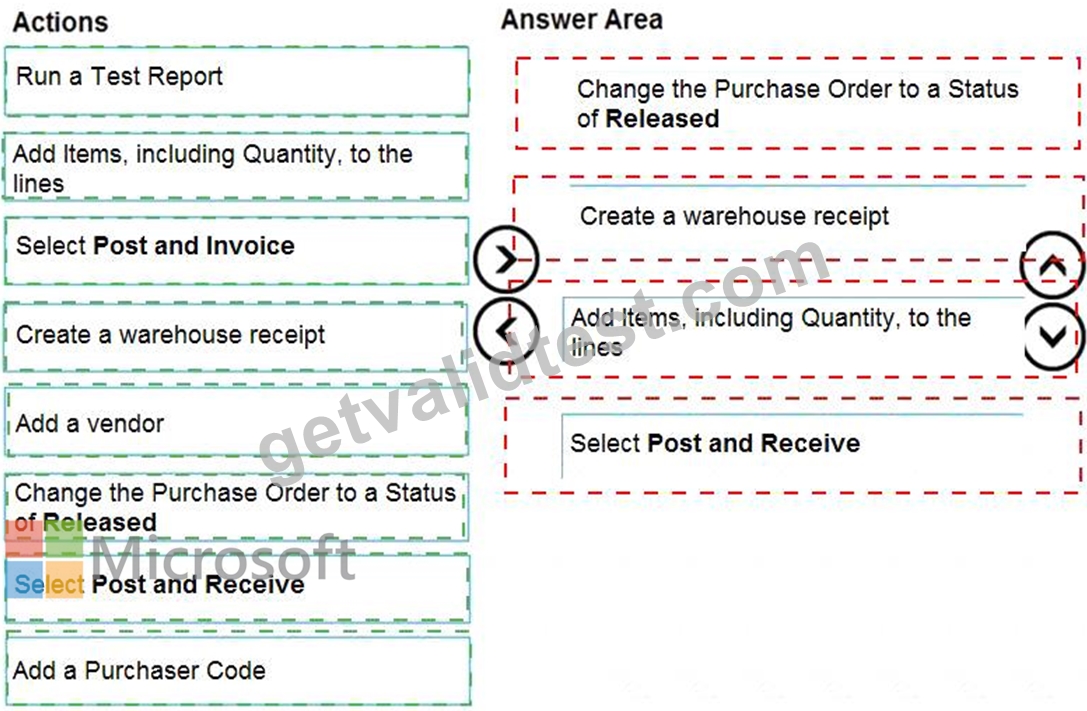
Explanation: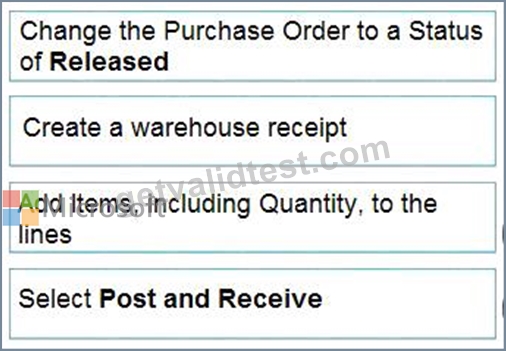
NEW QUESTION # 43
You are creating a filtered view of a Chart of Accounts page.
The page must be filtered to display Net Change values only for transactions between a specific date range.
You must save the filtered view for future use.
You need to filter on transactions occurring between January 1, 2020 and January 31, 2020.
Which three actions should you perform in sequence? To answer, move the appropriate actions from the list of actions to the answer area and arrange them in the correct order.
Answer:
Explanation: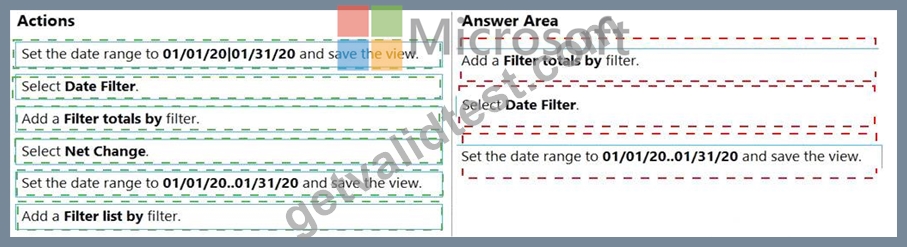
Explanation: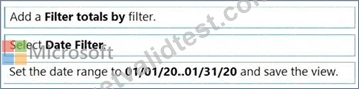
Reference:
When creating a filtered view of the Chart of Accounts (COA) in Dynamics 365 Business Central to display only Net Change values for a defined date range, the following steps apply:
Select Net Change
By default, the COA shows Balance at Date or other values.
To see activity for a specific date range, switch to Net Change, which displays only the transactions for the chosen period.
Select Date Filter
Add a Date Filter to define which transactions to include. This field filters transactions by posting date.
Set the date range to 01/01/20..01/31/20 and save the view
Enter the date filter range (01/01/20..01/31/20).
Save the filtered view for later reuse so the user doesn't need to reapply filters each time.
Why not other actions?
Add a Filter totals by filter and Filter list by filter # These are used for dimension-based filtering or list filtering, not for filtering the Net Change calculation by posting date.
Microsoft Learn References:
Work with the Chart of Accounts
Filter Data in Business Central
NEW QUESTION # 44
A company uses Dynamics 365 Business Central.
The company's funds are limited and some invoices that are due cannot be paid on time.
You need to prioritize vendors when you suggest vendor payments.
Which three actions should you perform in sequence? To answer, move the appropriate actions from the list of actions to the answer area and arrange them in the correct order.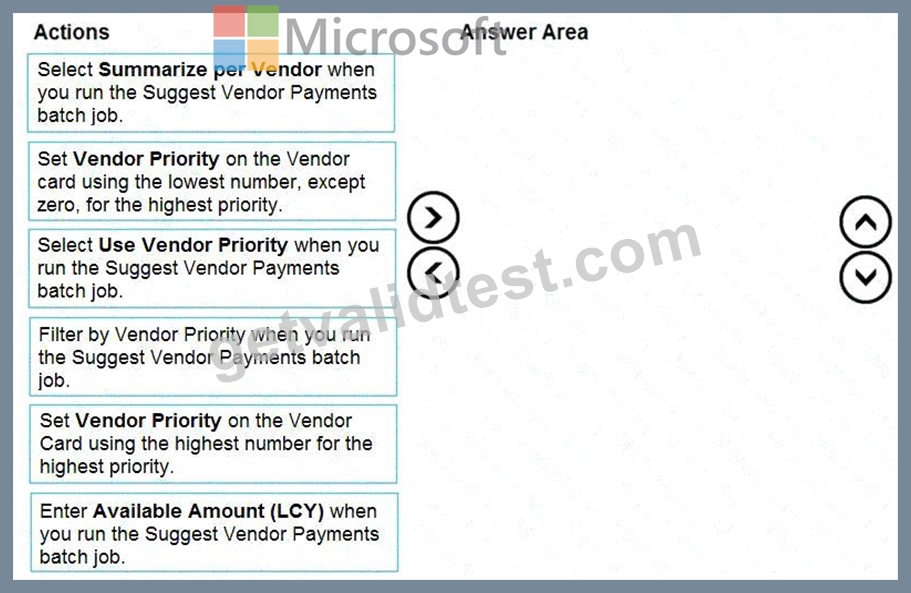
Answer:
Explanation: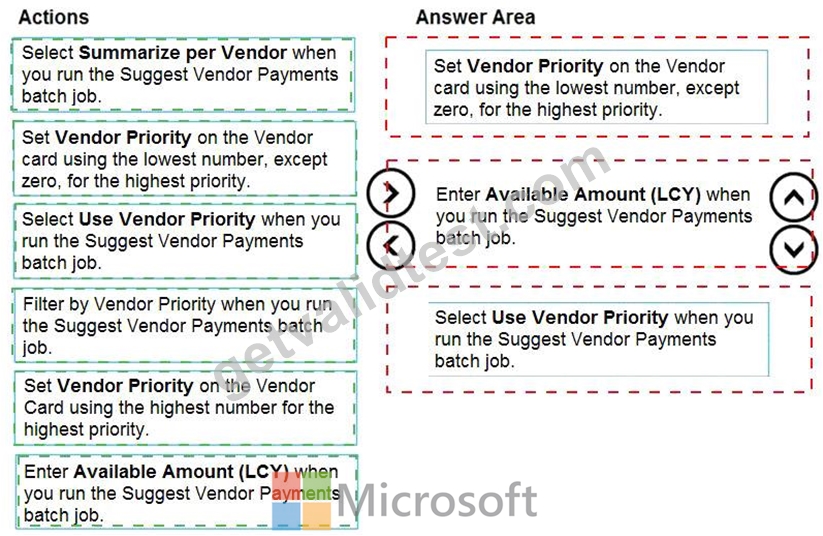
Explanation:
Reference:
https://docs.microsoft.com/en-us/learn/modules/suggest-vendor-payments-dynamics-365-business-central/2- priority
NEW QUESTION # 45
You are implementing Dynamics 365 Business Central.
The accounting manager wants to set up a complete Purchase Document Approval system with an approval hierarchy that meets the following requirements:
Sara processes all purchase orders. Any purchase orders that Sara processes must be approved.
Michelle can approve purchase orders up to $10,000.
Shawn can approve the orders up to $50,000.
Purchase orders above $50,000 must be approved by Remy.
You need to create the hierarchy.
Which hierarchy setup should be used for each limit? To answer, select the appropriate options in the answer area.
NOTE: Each correct selection is worth one point.
Answer:
Explanation: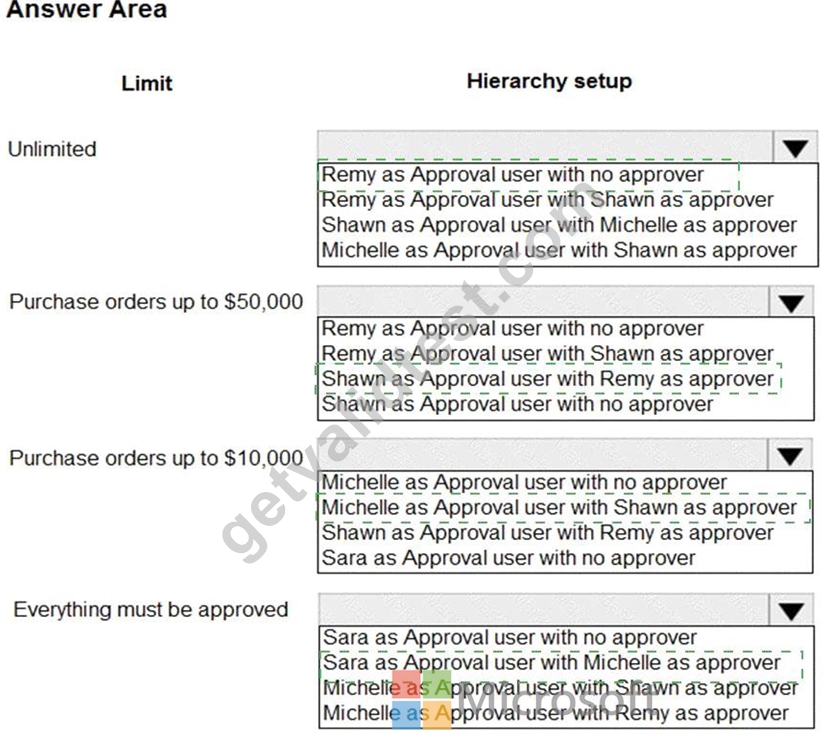
Explanation:

Comprehensive Detailed Explanation along with All References available from Microsoft Dynamics 365 Business Central Functional Consultant at end of each question below In Dynamics 365 Business Central, approval workflows are configured so that purchase orders (POs) are routed to the correct approver depending on amount thresholds and hierarchies.
The requirements:
Sara processes all POs # must always be approved
Sara is the requester (Approval user). Since all of Sara's POs require approval, she must always have an approver assigned. That approver is Michelle (the first approver level).
Michelle approves POs up to $10,000
Michelle can approve POs but has a limit of $10,000. If the order is above her threshold, it should escalate.
Therefore, Michelle must have Shawn as her approver.
Shawn approves up to $50,000
Shawn has a higher approval limit. If the PO exceeds $50,000, it escalates further. Therefore, Shawn's approver is Remy.
Remy approves above $50,000 (Unlimited)
Remy is the top approver with unlimited approval authority, meaning no one approves above him. Therefore, Remy has no approver.
Mapping to options in the Answer Area:
Unlimited # Remy as Approval user with no approver
Purchase orders up to $50,000 # Shawn as Approval user with Remy as approver Purchase orders up to $10,000 # Michelle as Approval user with Shawn as approver Everything must be approved # Sara as Approval user with Michelle as approver This setup satisfies the hierarchy and approval rules described.
Microsoft Learn References
Set up approval users
Workflow and approvals in Business Central
Approval user setup and limits
NEW QUESTION # 46
You need to configure the system to meet the requirements for received items.
What should you do?
- A. Set the value of the Automatic Cost Adjustment option to Always
- B. Turn on Automatic Cost Posting
- C. Turn on Expected Cost Posting
- D. Set the default costing method to Standard
Answer: C
Explanation:
Reference:
https://docs.microsoft.com/en-gb/dynamics365/business-central/design-details-expected-cost-posting
NEW QUESTION # 47
You manage several companies within one Dynamics 365 Business Central database. Most users work in only one of these companies, where they have a specific role.
You need to set up security according to company requirements.
Which setup should you use? To answer, drag the appropriate setups to the correct requirements. Each setup may be used once, more than once, or not at all. You may need to drag the split bar between panes or scroll to view content.
NOTE: Each correct selection is worth one point.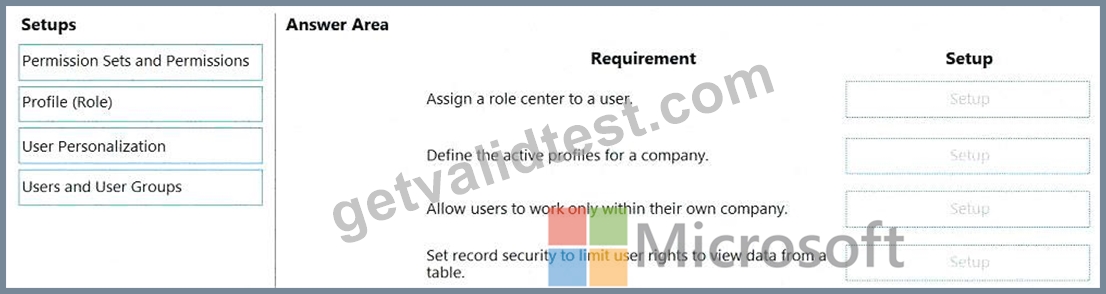
Answer:
Explanation:
Explanation:
Comprehensive Detailed Explanation
* Assign a role center to a user # User Personalization
* The User Personalization page defines the Role Center (profile) for a specific user. This controls the home page and navigation menus that appear when the user signs in.
* Define the active profiles for a company # Profile (Role)
* Profiles (Roles) are templates for Role Centers and define the functionality and pages available to users. You configure active profiles at the Profile (Role) setup level.
* Allow users to work only within their own company # Users and User Groups
* On the Users setup page, you can specify which companies a user has access to. This ensures they can only work within their assigned company.
* Set record security to limit user rights to view data from a table # Permission Sets and Permissions
* Permissions (via Permission Sets) define object-level and record-level security, controlling access to tables, reports, pages, and limiting rights like Read, Insert, Modify, and Delete.
Microsoft Learn References:
* Assign Permissions to Users and Groups in Business Central
* Manage Profiles (Roles)
* User Personalization in Business Central
* Manage Users and User Groups
NEW QUESTION # 48
......
Authentic Best resources for MB-800: https://www.getvalidtest.com/MB-800-exam.html
MB-800 Test Engine Practice Exam: https://drive.google.com/open?id=1PqACpPpJek3qGXWYwCimIk389y4PwOao