


[Dec 21, 2025] Latest Questions 300-710 Guide to Prepare Free Practice Tests
Reliable 300-710 Dumps Questions Available as Web-Based Practice Test Engine
In addition to NGFW and IPS, the Cisco 300-710 exam also covers AMP, which provides continuous analysis and protection against advanced malware and other threats. Candidates will be tested on their ability to configure and manage AMP policies, including file analysis and blocking, and endpoint protection.
Cisco 300-710 (Securing Networks with Cisco Firepower) Certification Exam is a challenging but rewarding certification for security professionals who want to validate their knowledge and skills in Cisco Firepower technology. With proper preparation and dedication, candidates can pass the exam and take their careers to the next level.
Cisco 300-710 certification exam is a valuable credential for IT professionals who want to demonstrate their expertise in securing networks with Cisco Firepower. 300-710 exam covers a range of topics related to network security, including network access control, intrusion prevention and detection, and advanced malware protection. 300-710 exam is available in English and Japanese and can be taken at any Pearson VUE testing center worldwide.
NEW QUESTION # 79
A network administrator reviews the file report for the last month and notices that all file types, except exe. show a disposition of unknown. What is the cause of this issue?
- A. Only Spero file analysis is enabled.
- B. A file policy has not been applied to the access policy.
- C. The Cisco FMC cannot reach the Internet to analyze files.
- D. The malware license has not been applied to the Cisco FTD.
Answer: A
NEW QUESTION # 80
An engineer must configure a Cisco FMC dashboard in a child domain. Which action must be taken so that the dashboard is visible to the parent domain?
- A. Add a separate widget.
- B. Create a copy of the dashboard.
- C. Add a separate tab.
- D. Adjust policy inheritance settings.
Answer: B
NEW QUESTION # 81
A security engineer must create a malware and file policy on a Cisco Secure Firewall Threat Defense device.
The solution must ensure that PDF. DOCX, and XLSX files are not sent lo Cisco Secure Malware analytics.
What must do configured to meet the requirements''
- A. Spero analysis
- B. capacity handling
- C. dynamic analysis
- D. local malware analysis
Answer: D
Explanation:
To create a malware and file policy on a Cisco Secure Firewall Threat Defense (FTD) device that ensures PDF, DOCX, and XLSX files are not sent to Cisco Secure Malware Analytics, the security engineer must configure local malware analysis. Local malware analysis allows the FTD to inspect and analyze files locally without sending them to the cloud-based Cisco Secure Malware Analytics.
Steps to configure local malware analysis:
* In FMC, navigate to Policies > Access Control > Malware & File Policies.
* Create a new malware and file policy or edit an existing one.
* Define rules to inspect specific file types, ensuring that PDF, DOCX, and XLSX files are handled locally.
* Set the action for these file types to "Local Analysis."
* Apply the policy to the relevant access control policy.
This configuration ensures that the specified file types are analyzed locally, meeting the requirement to avoid sending them to Cisco Secure Malware Analytics.
References: Cisco Secure Firewall Management Center Configuration Guide, Chapter on Malware and File Policies
NEW QUESTION # 82
Which Firepower feature allows users to configure bridges in routed mode and enables devices to perform Layer 2 switching between interfaces?
- A. IRB
- B. SGT
- C. FlexConfig
- D. BDI
Answer: A
NEW QUESTION # 83
A VPN user is unable to conned lo web resources behind the Cisco FTD device terminating the connection. While troubleshooting, the network administrator determines that the DNS responses are not getting through the Cisco FTD What must be done to address this issue while still utilizing Snort IPS rules?
- A. Modify the Snort rules to allow legitimate DNS traffic to the VPN users.
- B. Disable the intrusion rule threshes to optimize the Snort processing.
- C. Decrypt the packet after the VPN flow so the DNS queries are not inspected
- D. Uncheck the "Drop when Inline" box in the intrusion policy to allow the traffic.
Answer: A
NEW QUESTION # 84
An engineer is troubleshooting HTTP traffic to a web server using the packet capture tool on Cisco FMC. When reviewing the captures, the engineer notices that there are a lot of packets that are not sourced from or destined to the web server being captured. How can the engineer reduce the strain of capturing packets for irrelevant traffic on the Cisco FTD device?
- A. Redirect the packet capture output to a .pcap file that can be opened with Wireshark.
- B. Use the -c option to restrict the packet capture to only the first 100 packets.
- C. Use an access-list within the packet capture to permit only HTTP traffic to and from the web server.
- D. Use the host filter in the packet capture to capture traffic to or from a specific host.
Answer: D
NEW QUESTION # 85
What is a limitation to consider when running a dynamic routing protocol on a Cisco FTD device in IRB mode?
- A. Only EtherChannel interfaces are supposed.
- B. Only distance vector routing protocols are supported.
- C. Only nonbridge interfaces are supported.
- D. Only link-stale routing protocols are supported.
Answer: C
Explanation:
Explanation
Integrated routing and bridging (IRB) is a feature that allows you to route between different bridge groups on a Cisco FTD device. A bridge group is a logical interface that acts as a container for one or more physical or logical interfaces that belong to the same layer 2 broadcast domain. You can assign an IP address to a bridge group interface (BVI) and enable routing protocols on it, just like a regular routed interface. However, when you run a dynamic routing protocol on a Cisco FTD device in IRB mode, you can only use nonbridge interfaces as routing peers. You cannot use bridge group interfaces or bridge group member interfaces as routing peers2. This is because the routing protocol packets are sent and received on the nonbridge interfaces, and the bridge group interfaces are used only for forwarding data traffic3.
NEW QUESTION # 86
Which Cisco AMP for Endpoints, what is meant by simple custom detection?
- A. It is a method for identifying and quarantining a specific file by its SHA-256 hash.
- B. It is a method for identifying and quarantining a set of files by regular expression language.
- C. It is a rule for identifying a file that should be whitelisted by Cisco AMP.
- D. It is a feature for configuring a personal firewall.
Answer: A
Explanation:
A Simple Custom Detection list is similar to a blacklist. These are files that you want to detect and quarantine [...] You can add a single SHA-256 and create a note about the file.
NEW QUESTION # 87
Drag and Drop Question
A network engineer is deploying a Cisco Firepower 4100 appliance and must configure a multi- instance environment for high availability. Drag and drop the actions from the left into sequence on the right for this configuration.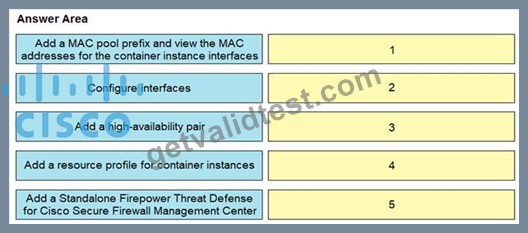
Answer:
Explanation: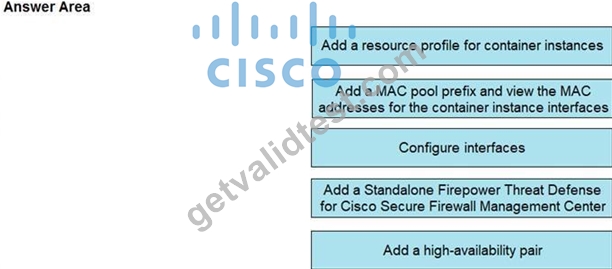
NEW QUESTION # 88
Refer to the exhibit.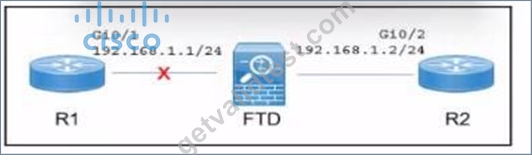
A Cisco Secure Firewall Threat Defense (FTD) device is deployed in inline mode with an inline set. The network engineer wants router R2 to remove the directly connected route M 68.1.0/24 from its routing table when the cable between routed R1 and the Secure FTD device Is disconnected. Which action must the engineer take?
1
- A. Establish a routing protocol between R1 and R2.
- B. Disable hardware bypass on the Secure FTD device.
- C. Implement autostate functionality on the Gi0/2 interface of R2
- D. Implement the Propagate Link Stale option on the Secure FTD device
Answer: D
Explanation:
To ensure that router R2 removes the directly connected route for 192.168.1.0/24 from its routing table when the cable between router R1 and the Secure FTD device is disconnected, the network engineer must implement the "Propagate Link State" option on the Secure FTD device. This option allows the FTD to propagate the link state changes to adjacent devices, ensuring that the disconnection is recognized and the routing table is updated accordingly.
Steps:
* Access the FTD device configuration via FMC.
* Navigate to the interface settings for the relevant interfaces.
* Enable the "Propagate Link State" option for the interfaces connected to R1 and R2.
* Deploy the changes to the FTD device.
This configuration ensures that the link state changes are communicated to router R2, prompting it to remove the disconnected route from its routing table.
References: Cisco Secure Firewall Threat Defense Configuration Guide, Chapter on Interface Settings and Link State Propagation.
NEW QUESTION # 89
Due to an Increase in malicious events, a security engineer must generate a threat report to include intrusion events, malware events, and security intelligence events. How Is this information collected in a single report?
- A. Generate a malware report.
- B. Create a Custom report.
- C. Run the default Firepower report.
- D. Export the Attacks Risk report.
Answer: B
NEW QUESTION # 90
An engineer is configuring URL filtering for a Cisco FTD device in Cisco FMC. Users must receive a warning when they access http:/'www.Dac'additstte.corn with the option of continuing to the website if they choose to. No other websites should be blacked. Which two actions must the engineer lake to meet these requirements? (Choose two.)
- A. On the HTTP Responses tab of the access control policy editor, sot the Interactive Block Response Page to system-provided.
- B. Configure an access control rule that matches an URL object for http://www.badaduitslte.com; and set the action to interactive Block.
- C. On the HTTP Responses tab of the access control policy editor, set the Block Response Page to Custom.
- D. Configure an access control rule that matches the Adult URL category and se: the action to interactive Block.
- E. Configure the default action for the access control policy to Interactive Block.
Answer: A,B
Explanation:
To configure URL filtering for a Cisco FTD device in Cisco FMC, and to meet the requirements of the question, the engineer must do the following:
On the HTTP Responses tab of the access control policy editor, set the Interactive Block Response Page to system-provided. This will enable the system to display a warning page to the users when they try to access a blocked URL, and give them the option to continue or cancel. The system-provided page is a default page that contains a generic message and a logo1.
Configure
an access control rule that matches an URL object for http://www.badadultsite.com; and set the action to Interactive Block. This will apply the interactive block action to the specific URL that is defined in the URL object. The interactive block action will trigger the interactive block response page that was configured in the previous step1.
The other options are incorrect because:
On the HTTP Responses tab of the access control policy editor, setting the Block Response Page to Custom will not affect the interactive block action. The block response page is used when the action is set to Block, not Interactive Block1.
Configuring the default action for the access control policy to Interactive Block will apply the interactive block action to all URLs that are not matched by any access control rule. This will not meet the requirement of blocking no other websites1.
Configuring
an access control rule that matches the Adult URL category and sets the action to Interactive Block will apply the interactive block action to all URLs that belong to the Adult category. This will not meet the requirement of blocking only http://www.badadultsite.com1.
NEW QUESTION # 91
Which license type is required on Cisco ISE to integrate with Cisco FMC pxGrid?
- A. apex
- B. base
- C. plus
- D. mobility
Answer: C
NEW QUESTION # 92
Which two types of objects are reusable and supported by Cisco FMC? (Choose two.)
- A. dynamic key mapping objects that help link HTTP and HTTPS GET requests to Layer 7 application protocols.
- B. reputation-based objects, such as URL categories
- C. network-based objects that represent FQDN mappings and networks, port/protocol pairs, VXLAN tags, security zones and origin/destination country
- D. reputation-based objects that represent Security Intelligence feeds and lists, application filters based on category and reputation, and file lists
- E. network-based objects that represent IP address and networks, port/protocols pairs, VLAN tags, security zones, and origin/destination country
Answer: D,E
Explanation:
Reference: https://www.cisco.com/c/en/us/td/docs/security/firepower/620/configuration/guide/fpmc-config-guide-v62/reusable_objects.html#ID-2243-00000414
NEW QUESTION # 93 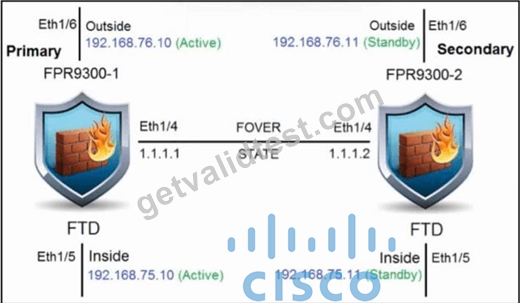
Refer to the exhibit. An engineer is configuring a high-availability solution that has the hardware devices and software versions:
two Cisco Secure Firewall 9300 Security Appliances with FXOS SW 2.0(1.23) software Cisco Secure Firewall Threat Defense 6.0.1.1 (build 1023) on both appliances one Cisco Secure Firewall Management Center with SW 6.0.1.1 (build 1023) Which condition must be met to complete the high-availability configuration?
- A. The version numbers must have the same patch number.
- B. DHCP must be configured on at least one firewall interface.
- C. Both firewalls must be in transparent mode.
- D. Both firewalls must have the same number of interfaces.
Answer: D
NEW QUESTION # 94
Encrypted Visibility Engine (EVE) is enabled under which tab on an access control policy in Cisco Secure Firewall Management Center?
- A. Advanced
- B. Network Analysis Policy
- C. SSL
- D. Security Intelligence
Answer: A
Explanation:
Available under the Advanced tab of the access control policy, to enable or disable EVE.
https://www.cisco.com/c/en/us/td/docs/security/secure-firewall/management- center/snort/720/snort3-configuration-guide-v72/m_encrypted-visibility-engine.pdf
NEW QUESTION # 95
An engineer must build redundancy into the network and traffic must continuously flow if a redundant switch in front of the firewall goes down.
What must be configured to accomplish this task?
- A. vPC on the switches to the interface mode on the firewall duster
- B. redundant interfaces on the firewall cluster mode and switches
- C. redundant interfaces on the firewall noncluster mode and switches
- D. vPC on the switches to the span EtherChannel on the firewall cluster
Answer: D
Explanation:
Virtual Port Channels (vPC) are common EtherChannel deployments, especially in the data center, and allow multiple devices to share multiple interfaces EtherChannel Interface requires stack, VSS or vPC when connected to multiple switches.
NEW QUESTION # 96
A VPN user is unable to conned lo web resources behind the Cisco FTD device terminating the connection.
While troubleshooting, the network administrator determines that the DNS responses are not getting through the Cisco FTD What must be done to address this issue while still utilizing Snort IPS rules?
- A. Modify the Snort rules to allow legitimate DNS traffic to the VPN users.
- B. Disable the intrusion rule threshes to optimize the Snort processing.
- C. Decrypt the packet after the VPN flow so the DNS queries are not inspected
- D. Uncheck the "Drop when Inline" box in the intrusion policy to allow the traffic.
Answer: A
NEW QUESTION # 97
Which group within Cisco does the Threat Response team use for threat analysis and research?
- A. Cisco Talos
- B. Cisco Deep Analytics
- C. OpenDNS Group
- D. Cisco Network Response
Answer: A
Explanation:
Section: Management and Troubleshooting
Explanation/Reference: https://www.cisco.com/c/en/us/products/security/threat-response.html#~benefits
NEW QUESTION # 98
An organization wants to secure traffic from their branch office to the headquarter building using Cisco Firepower devices, They want to ensure that their Cisco Firepower devices are not wasting resources on inspecting the VPN traffic. What must be done to meet these requirements?
- A. Configure the Cisco Firepower devices to bypass the access control policies for VPN traffic.
- B. Tune the intrusion policies in order to allow the VPN traffic through without inspection
- C. Configure the Cisco Firepower devices to ignore the VPN traffic using prefilter policies
- D. Enable a flexconfig policy to re-classify VPN traffic so that it no longer appears as interesting traffic
Answer: A
Explanation:
Explanation
When you configure the Cisco Firepower devices to bypass the access control policies for VPN traffic, the devices will not inspect the VPN traffic and thus will not waste resources on it. This is the best option to ensure that the VPN traffic is not wasting resources on the Cisco Firepower devices.
Reference:
https://www.cisco.com/c/en/us/support/docs/security/firepower-ngfw/219759-configure-bypass-policies-on-the-c
NEW QUESTION # 99
An engineer is creating an URL object on Cisco FMC How must it be configured so that the object will match for HTTPS traffic in an access control policy?
- A. Use the FQDN including the subdomain for the website
- B. Specify the protocol to match (HTTP or HTTPS).
- C. Use the subject common name from the website certificate
- D. Define the path to the individual webpage that uses HTTPS.
Answer: A
NEW QUESTION # 100
An administrator must use Cisco FMC to install a backup route within the Cisco FTD to route traffic in case of a routing failure with the primary route. Which action accomplishes this task?
- A. Create the backup route and use route tracking on both routes to a destination IP address in the network.
- B. Install the static backup route and modify the metric to be less than the primary route.
- C. Configure EIGRP routing on the FMC to ensure that dynamic routes are always updated.
- D. Use a default route on the FMC instead of having multiple routes contending for priority.
Answer: A
NEW QUESTION # 101
Refer to the exhibit.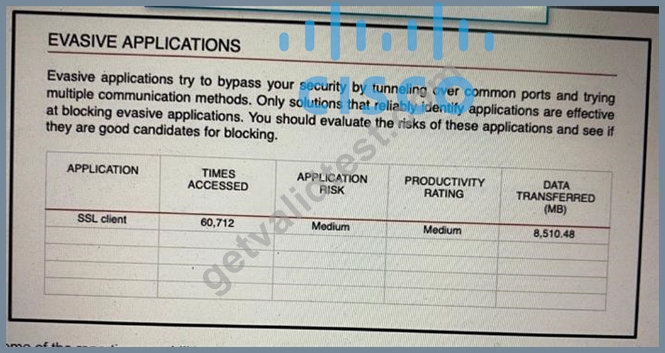
An administrator is looking at some of the reporting capabilities for Cisco Firepower and noticed this section of the Network Risk report showing a lot of SSL activity that cloud be used for evasion. Which action will mitigate this risk?
- A. Use encrypted traffic analytics to detect attacks
- B. Use SSL decryption to analyze the packets.
- C. Use Cisco Tetration to track SSL connections to servers.
- D. Use Cisco AMP for Endpoints to block all SSL connection
Answer: B
Explanation:
Reference:
https://www.cisco.com/c/en/us/td/docs/security/firepower/623/fdm/fptd-fdm-config-guide-623/fptd-fdm-ssl-decryption.html
NEW QUESTION # 102
A company wants a solution to aggregate the capacity of two Cisco FTD devices to make the best use of resources such as bandwidth and connections per second. Which order of steps must be taken across the Cisco FTDs with Cisco FMC to meet this requirement?
- A. Configure the Cisco FTD interfaces and cluster members, add members to Cisco FMC, and create the cluster in Cisco FMC
- B. Add members to Cisco FMC, configure Cisco FTD interfaces in Cisco FMC, configure cluster members in Cisco FMC, create cluster in Cisco FMC, and configure cluster members in Cisco FMC
- C. Add members to the Cisco FMC, configure Cisco FTD interfaces, create the cluster in Cisco FMC, and configure cluster members in Cisco FMC
- D. Configure the Cisco FTD interfaces, add members to FMC, configure cluster members in FMC, and create cluster in Cisco FMC
Answer: A
Explanation:
In Chassis manager, you (STEP1) config the interfaces, create the cluster and add nodes, then you (STEP2) switch to FMC to add the units to FMC and build the cluster there.
https://www.cisco.com/c/en/us/td/docs/security/firepower/fxos/clustering/ftd-4100-9300- cluster.html#task_tqm_ghj_qgb
NEW QUESTION # 103
......
Correct and Up-to-date Cisco 300-710 BrainDumps: https://www.getvalidtest.com/300-710-exam.html
Current 300-710 dumps Preparation through Our Practice Test: https://drive.google.com/open?id=1f4sqIiCCsC-rLqRcCCQQ0pE4jbgh9GXQ