


Updated Dec 20, 2021 DP-300 Exam Dumps - PDF Questions and Testing Engine
New (2021) Microsoft DP-300 Exam Dumps
NEW QUESTION 61
You have an Azure subscription that contains a server named Server1. Server1 hosts two Azure SQL databases named DB1 and DB2.
You plan to deploy a Windows app named App1 that will authenticate to DB2 by using SQL authentication.
You need to ensure that App1 can access DB2. The solution must meet the following requirements:
App1 must be able to view only DB2.
Administrative effort must be minimized.
What should you create?
- A. a contained database user from an external provider for App1 on DB2
- B. a login for App1 on Server1
- C. a contained database user for App1 on DB2
- D. a contained database user from a Windows login for App1 on DB2
Answer: C
Explanation:
Reference:
https://docs.microsoft.com/en-us/sql/relational-databases/security/contained-database-users-making-your-database-portable?view=sql-server-ver15
NEW QUESTION 62
DRAG DROP
You need to apply 20 built-in Azure Policy definitions to all new and existing Azure SQL Database deployments
in an Azure subscription. The solution must minimize administrative effort.
Which three actions should you perform in sequence? To answer, move the appropriate actions from the list of
actions to the answer area and arrange them in the correct order.
Select and Place: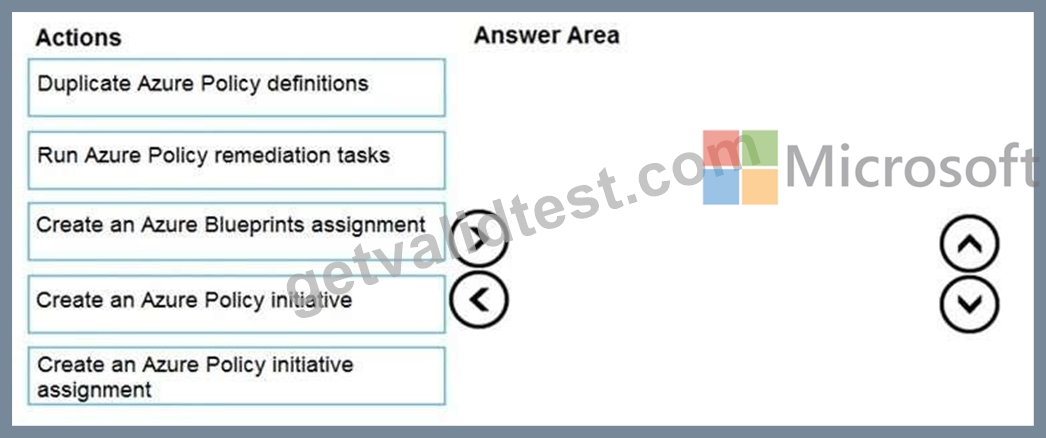
Answer:
Explanation: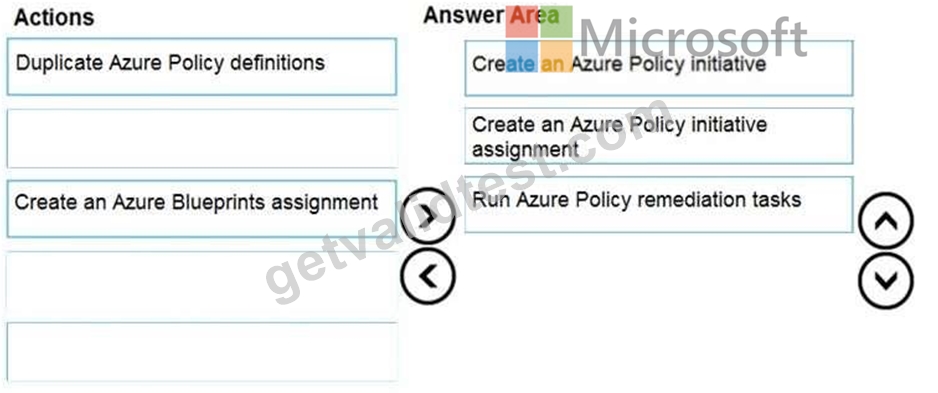
Section: [none]
Explanation:
Step 1: Create an Azure Policy Initiative
The first step in enforcing compliance with Azure Policy is to assign a policy definition. A policy definition
defines under what condition a policy is enforced and what effect to take.
With an initiative definition, you can group several policy definitions to achieve one overarching goal. An
initiative evaluates resources within scope of the assignment for compliance to the included policies.
Step 2: Create an Azure Policy Initiative assignment
Assign the initiative definition you created in the previous step.
Step 3: Run Azure Policy remediation tasks
To apply the Policy Initiative to the existing SQL databases.
Reference:
https://docs.microsoft.com/en-us/azure/governance/policy/tutorials/create-and-manage
NEW QUESTION 63
You have SQL Server 2019 on an Azure virtual machine that runs Windows Server 2019. The virtual machine
has 4 vCPUs and 28 GB of memory.
You scale up the virtual machine to 8 vCPUSs and 64 GB of memory.
You need to provide the lowest latency for tempdb.
What is the total number of data files that tempdb should contain?
- A. 0
- B. 1
- C. 2
- D. 3
Answer: C
Explanation:
Section: [none]
Explanation:
The number of files depends on the number of (logical) processors on the machine. As a general rule, if the
number of logical processors is less than or equal to eight, use the same number of data files as logical
processors. If the number of logical processors is greater than eight, use eight data files and then if contention
continues, increase the number of data files by multiples of 4 until the contention is reduced to acceptable
levels or make changes to the workload/code.
Reference:
https://docs.microsoft.com/en-us/sql/relational-databases/databases/tempdb-database
Testlet 1
This is a case study. Case studies are not timed separately. You can use as much exam time as you
would like to complete each case. However, there may be additional case studies and sections on this exam.
You must manage your time to ensure that you are able to complete all questions included on this exam in the
time provided.
To answer the questions included in a case study, you will need to reference information that is provided in the
case study. Case studies might contain exhibits and other resources that provide more information about the
scenario that is described in the case study. Each question is independent of the other questions in this case
study.
At the end of this case study, a review screen will appear. This screen allows you to review your answers and to
make changes before you move to the next section of the exam. After you begin a new section, you cannot
return to this section.
To start the case study
To display the first question in this case study, click the Next button. Use the buttons in the left pane to explore
the content of the case study before you answer the questions. Clicking these buttons displays information such
as business requirements, existing environment, and problem statements. If the case study has an All
Information tab, note that the information displayed is identical to the information displayed on the subsequent
tabs. When you are ready to answer a question, click the Question button to return to the question.
Overview
Litware, Inc. is a renewable energy company that has a main office in Boston. The main office hosts a sales
department and the primary datacenter for the company.
Physical Locations
Existing Environment
Litware has a manufacturing office and a research office is separate locations near Boston. Each office has its
own datacenter and internet connection.
The manufacturing and research datacenters connect to the primary datacenter by using a VPN.
Network Environment
The primary datacenter has an ExpressRoute connection that uses both Microsoft peering and private peering.
The private peering connects to an Azure virtual network named HubVNet.
Identity Environment
Litware has a hybrid Azure Active Directory (Azure AD) deployment that uses a domain named litwareinc.com.
All Azure subscriptions are associated to the litwareinc.com Azure AD tenant.
Database Environment
The sales department has the following database workload:
* An on-premises named SERVER1 hosts an instance of Microsoft SQL Server 2012 and two 1-TB
databases.
* A logical server named SalesSrv01A contains a geo-replicated Azure SQL database named SalesSQLDb1.
SalesSQLDb1 is in an elastic pool named SalesSQLDb1Pool. SalesSQLDb1 uses database firewall rules
and contained database users.
* An application named SalesSQLDb1App1 uses SalesSQLDb1.
The manufacturing office contains two on-premises SQL Server 2016 servers named SERVER2 and
SERVER3. The servers are nodes in the same Always On availability group. The availability group contains a
database named ManufacturingSQLDb1
Database administrators have two Azure virtual machines in HubVnet named VM1 and VM2 that run Windows
Server 2019 and are used to manage all the Azure databases.
Licensing Agreement
Litware is a Microsoft Volume Licensing customer that has License Mobility through Software Assurance.
Current Problems
SalesSQLDb1 experiences performance issues that are likely due to out-of-date statistics and frequent blocking
queries.
Requirements
Planned Changes
Litware plans to implement the following changes:
* Implement 30 new databases in Azure, which will be used by time-sensitive manufacturing apps that have
varying usage patterns. Each database will be approximately 20 GB.
* Create a new Azure SQL database named ResearchDB1 on a logical server named ResearchSrv01.
ResearchDB1 will contain Personally Identifiable Information (PII) data.
* Develop an app named ResearchApp1 that will be used by the research department to populate and access
ResearchDB1.
* Migrate ManufacturingSQLDb1 to the Azure virtual machine platform.
* Migrate the SERVER1 databases to the Azure SQL Database platform.
Technical Requirements
Litware identifies the following technical requirements:
* Maintenance tasks must be automated.
* The 30 new databases must scale automatically.
* The use of an on-premises infrastructure must be minimized.
* Azure Hybrid Use Benefits must be leveraged for Azure SQL Database deployments.
* All SQL Server and Azure SQL Database metrics related to CPU and storage usage and limits must be
analyzed by using Azure built-in functionality.
Security and Compliance Requirements
Litware identifies the following security and compliance requirements:
* Store encryption keys in Azure Key Vault.
* Retain backups of the PII data for two months.
* Encrypt the PII data at rest, in transit, and in use.
* Use the principle of least privilege whenever possible.
* Authenticate database users by using Active Directory credentials.
* Protect Azure SQL Database instances by using database-level firewall rules.
* Ensure that all databases hosted in Azure are accessible from VM1 and VM2 without relying on public
endpoints.
Business Requirements
Litware identifies the following business requirements:
* Meet an SLA of 99.99% availability for all Azure deployments.
* Minimize downtime during the migration of the SERVER1 databases.
* Use the Azure Hybrid Use Benefits when migrating workloads to Azure.
* Once all requirements are met, minimize costs whenever possible.
NEW QUESTION 64
HOTSPOT
You have an Azure subscription that is linked to a hybrid Azure Active Directory (Azure AD) tenant. The subscription contains an Azure Synapse Analytics SQL pool named Pool1.
You need to recommend an authentication solution for Pool1. The solution must support multi-factor authentication (MFA) and database-level authentication.
Which authentication solution or solutions should you include in the recommendation? To answer, select the appropriate options in the answer area.
NOTE: Each correct selection is worth one point.
Hot Area: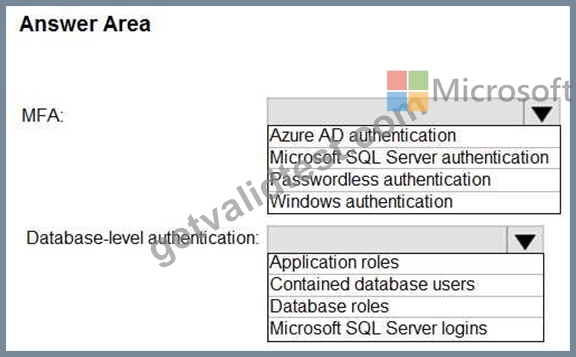
Answer:
Explanation:
Section: [none]
Explanation:
Box 1: Azure AD authentication
Azure Active Directory authentication supports Multi-Factor authentication through Active Directory Universal Authentication.
Box 2: Contained database users
Azure Active Directory Uses contained database users to authenticate identities at the database level.
Incorrect:
SQL authentication: To connect to dedicated SQL pool (formerly SQL DW), you must provide the following information:
* Fully qualified servername
* Specify SQL authentication
* Username
* Password
* Default database (optional)
Reference:
https://docs.microsoft.com/en-us/azure/synapse-analytics/sql-data-warehouse/sql-data-warehouse- authentication
NEW QUESTION 65
You have 20 Azure SQL databases provisioned by using the vCore purchasing model.
You plan to create an Azure SQL Database elastic pool and add the 20 databases.
Which three metrics should you use to size the elastic pool to meet the demands of your workload? Each correct answer presents part of the solution.
NOTE: Each correct selection is worth one point.
- A. total number of databases * average CPU utilization per database
- B. number of concurrently peaking databases * peak CPU utilization per database
- C. geo-replication support
- D. total size of all the databases
- E. maximum number of concurrent sessions for all the databases
Answer: A,B,D
Explanation:
CE: Estimate the vCores needed for the pool as follows:
For vCore-based purchasing model: MAX(<Total number of DBs X average vCore utilization per DB>,
<Number of concurrently peaking DBs X Peak vCore utilization per DB)
A: Estimate the storage space needed for the pool by adding the number of bytes needed for all the databases in the pool.
Reference:
https://docs.microsoft.com/en-us/azure/azure-sql/database/elastic-pool-overview Implement a Secure Environment Testlet 1 This is a case study. Case studies are not timed separately. You can use as much exam time as you would like to complete each case. However, there may be additional case studies and sections on this exam. You must manage your time to ensure that you are able to complete all questions included on this exam in the time provided.
To answer the questions included in a case study, you will need to reference information that is provided in the case study. Case studies might contain exhibits and other resources that provide more information about the scenario that is described in the case study. Each question is independent of the other questions in this case study.
At the end of this case study, a review screen will appear. This screen allows you to review your answers and to make changes before you move to the next section of the exam. After you begin a new section, you cannot return to this section.
To start the case study
To display the first question in this case study, click the Next button. Use the buttons in the left pane to explore the content of the case study before you answer the questions. Clicking these buttons displays information such as business requirements, existing environment, and problem statements. If the case study has an All Information tab, note that the information displayed is identical to the information displayed on the subsequent tabs. When you are ready to answer a question, click the Question button to return to the question.
Existing Environment
Network Environment
The manufacturing and research datacenters connect to the primary datacenter by using a VPN.
The primary datacenter has an ExpressRoute connection that uses both Microsoft peering and private peering.
The private peering connects to an Azure virtual network named HubVNet.
Identity Environment
Litware has a hybrid Azure Active Directory (Azure AD) deployment that uses a domain named litwareinc.com.
All Azure subscriptions are associated to the litwareinc.com Azure AD tenant.
Database Environment
The sales department has the following database workload:
* An on-premises named SERVER1 hosts an instance of Microsoft SQL Server 2012 and two 1-TB databases.
* A logical server named SalesSrv01A contains a geo-replicated Azure SQL database named SalesSQLDb1.
SalesSQLDb1 is in an elastic pool named SalesSQLDb1Pool. SalesSQLDb1 uses database firewall rules and contained database users.
* An application named SalesSQLDb1App1 uses SalesSQLDb1.
The manufacturing office contains two on-premises SQL Server 2016 servers named SERVER2 and SERVER3. The servers are nodes in the same Always On availability group. The availability group contains a database named ManufacturingSQLDb1 Database administrators have two Azure virtual machines in HubVnet named VM1 and VM2 that run Windows Server 2019 and are used to manage all the Azure databases.
Licensing Agreement
Litware is a Microsoft Volume Licensing customer that has License Mobility through Software Assurance.
Current Problems
SalesSQLDb1 experiences performance issues that are likely due to out-of-date statistics and frequent blocking queries.
Requirements
Planned Changes
Litware plans to implement the following changes:
* Implement 30 new databases in Azure, which will be used by time-sensitive manufacturing apps that have varying usage patterns. Each database will be approximately 20 GB.
* Create a new Azure SQL database named ResearchDB1 on a logical server named ResearchSrv01.
ResearchDB1 will contain Personally Identifiable Information (PII) data.
* Develop an app named ResearchApp1 that will be used by the research department to populate and access ResearchDB1.
* Migrate ManufacturingSQLDb1 to the Azure virtual machine platform.
* Migrate the SERVER1 databases to the Azure SQL Database platform.
Technical Requirements
Litware identifies the following technical requirements:
* Maintenance tasks must be automated.
* The 30 new databases must scale automatically.
* The use of an on-premises infrastructure must be minimized.
* Azure Hybrid Use Benefits must be leveraged for Azure SQL Database deployments.
* All SQL Server and Azure SQL Database metrics related to CPU and storage usage and limits must be analyzed by using Azure built-in functionality.
Security and Compliance Requirements
Litware identifies the following security and compliance requirements:
* Store encryption keys in Azure Key Vault.
* Retain backups of the PII data for two months.
* Encrypt the PII data at rest, in transit, and in use.
* Use the principle of least privilege whenever possible.
* Authenticate database users by using Active Directory credentials.
* Protect Azure SQL Database instances by using database-level firewall rules.
* Ensure that all databases hosted in Azure are accessible from VM1 and VM2 without relying on public endpoints.
Business Requirements
Litware identifies the following business requirements:
* Meet an SLA of 99.99% availability for all Azure deployments.
* Minimize downtime during the migration of the SERVER1 databases.
* Use the Azure Hybrid Use Benefits when migrating workloads to Azure.
* Once all requirements are met, minimize costs whenever possible.
Implement a Secure Environment
Question Set 2
NEW QUESTION 66
DRAG DROP
You have SQL Server 2019 on an Azure virtual machine that contains an SSISDB database.
A recent failure causes the master database to be lost.
You discover that all Microsoft SQL Server integration Services (SSIS) packages fail to run on the virtual machine.
Which four actions should you perform in sequence to resolve the issue? To answer, move the appropriate actions from the list of actions to the answer area and arrange them in the correct.
Select and Place:
Answer:
Explanation: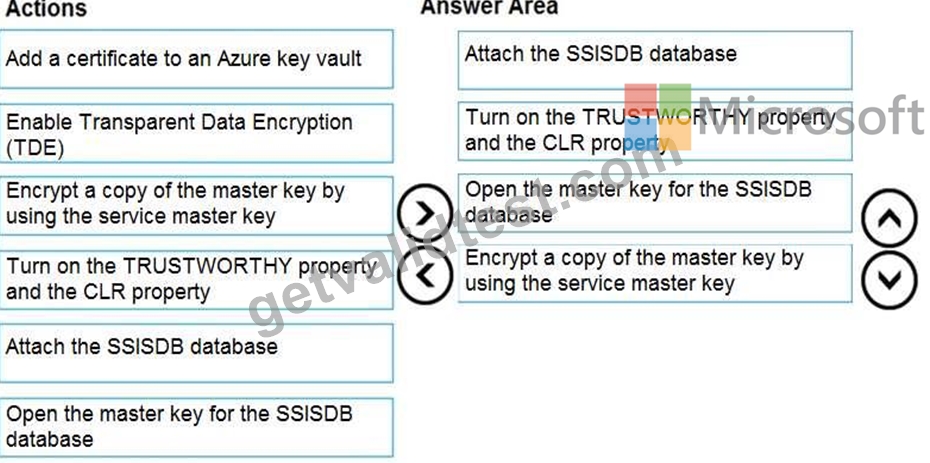
Explanation:
Step 1: Attach the SSISDB database
Step 2: Turn on the TRUSTWORTHY property and the CLR property
If you are restoring the SSISDB database to an SQL Server instance where the SSISDB catalog was never created, enable common language runtime (clr) Step 3: Open the master key for the SSISDB database Restore the master key by this method if you have the original password that was used to create SSISDB.
open master key decryption by password = 'LS1Setup!' --'Password used when creating SSISDB' Alter Master Key Add encryption by Service Master Key Step 4: Encrypt a copy of the mater key by using the service master key Reference:
https://docs.microsoft.com/en-us/sql/integration-services/backup-restore-and-move-the-ssis-catalog Implement a Secure Environment Testlet 1 This is a case study. Case studies are not timed separately. You can use as much exam time as you would like to complete each case. However, there may be additional case studies and sections on this exam. You must manage your time to ensure that you are able to complete all questions included on this exam in the time provided.
To answer the questions included in a case study, you will need to reference information that is provided in the case study. Case studies might contain exhibits and other resources that provide more information about the scenario that is described in the case study. Each question is independent of the other questions in this case study.
At the end of this case study, a review screen will appear. This screen allows you to review your answers and to make changes before you move to the next section of the exam. After you begin a new section, you cannot return to this section.
To start the case study
To display the first question in this case study, click the Next button. Use the buttons in the left pane to explore the content of the case study before you answer the questions. Clicking these buttons displays information such as business requirements, existing environment, and problem statements. If the case study has an All Information tab, note that the information displayed is identical to the information displayed on the subsequent tabs. When you are ready to answer a question, click the Question button to return to the question.
Existing Environment
Network Environment
The manufacturing and research datacenters connect to the primary datacenter by using a VPN.
The primary datacenter has an ExpressRoute connection that uses both Microsoft peering and private peering.
The private peering connects to an Azure virtual network named HubVNet.
Identity Environment
Litware has a hybrid Azure Active Directory (Azure AD) deployment that uses a domain named litwareinc.com.
All Azure subscriptions are associated to the litwareinc.com Azure AD tenant.
Database Environment
The sales department has the following database workload:
* An on-premises named SERVER1 hosts an instance of Microsoft SQL Server 2012 and two 1-TB databases.
* A logical server named SalesSrv01A contains a geo-replicated Azure SQL database named SalesSQLDb1.
SalesSQLDb1 is in an elastic pool named SalesSQLDb1Pool. SalesSQLDb1 uses database firewall rules and contained database users.
* An application named SalesSQLDb1App1 uses SalesSQLDb1.
The manufacturing office contains two on-premises SQL Server 2016 servers named SERVER2 and SERVER3. The servers are nodes in the same Always On availability group. The availability group contains a database named ManufacturingSQLDb1 Database administrators have two Azure virtual machines in HubVnet named VM1 and VM2 that run Windows Server 2019 and are used to manage all the Azure databases.
Licensing Agreement
Litware is a Microsoft Volume Licensing customer that has License Mobility through Software Assurance.
Current Problems
SalesSQLDb1 experiences performance issues that are likely due to out-of-date statistics and frequent blocking queries.
Requirements
Planned Changes
Litware plans to implement the following changes:
* Implement 30 new databases in Azure, which will be used by time-sensitive manufacturing apps that have varying usage patterns. Each database will be approximately 20 GB.
* Create a new Azure SQL database named ResearchDB1 on a logical server named ResearchSrv01.
ResearchDB1 will contain Personally Identifiable Information (PII) data.
* Develop an app named ResearchApp1 that will be used by the research department to populate and access ResearchDB1.
* Migrate ManufacturingSQLDb1 to the Azure virtual machine platform.
* Migrate the SERVER1 databases to the Azure SQL Database platform.
Technical Requirements
Litware identifies the following technical requirements:
* Maintenance tasks must be automated.
* The 30 new databases must scale automatically.
* The use of an on-premises infrastructure must be minimized.
* Azure Hybrid Use Benefits must be leveraged for Azure SQL Database deployments.
* All SQL Server and Azure SQL Database metrics related to CPU and storage usage and limits must be analyzed by using Azure built-in functionality.
Security and Compliance Requirements
Litware identifies the following security and compliance requirements:
* Store encryption keys in Azure Key Vault.
* Retain backups of the PII data for two months.
* Encrypt the PII data at rest, in transit, and in use.
* Use the principle of least privilege whenever possible.
* Authenticate database users by using Active Directory credentials.
* Protect Azure SQL Database instances by using database-level firewall rules.
* Ensure that all databases hosted in Azure are accessible from VM1 and VM2 without relying on public endpoints.
Business Requirements
Litware identifies the following business requirements:
* Meet an SLA of 99.99% availability for all Azure deployments.
* Minimize downtime during the migration of the SERVER1 databases.
* Use the Azure Hybrid Use Benefits when migrating workloads to Azure.
* Once all requirements are met, minimize costs whenever possible.
NEW QUESTION 67
HOTSPOT
You have a Microsoft SQL Server database named DB1 that contains a table named Table1.
The database role membership for a user named User1 is shown in the following exhibit.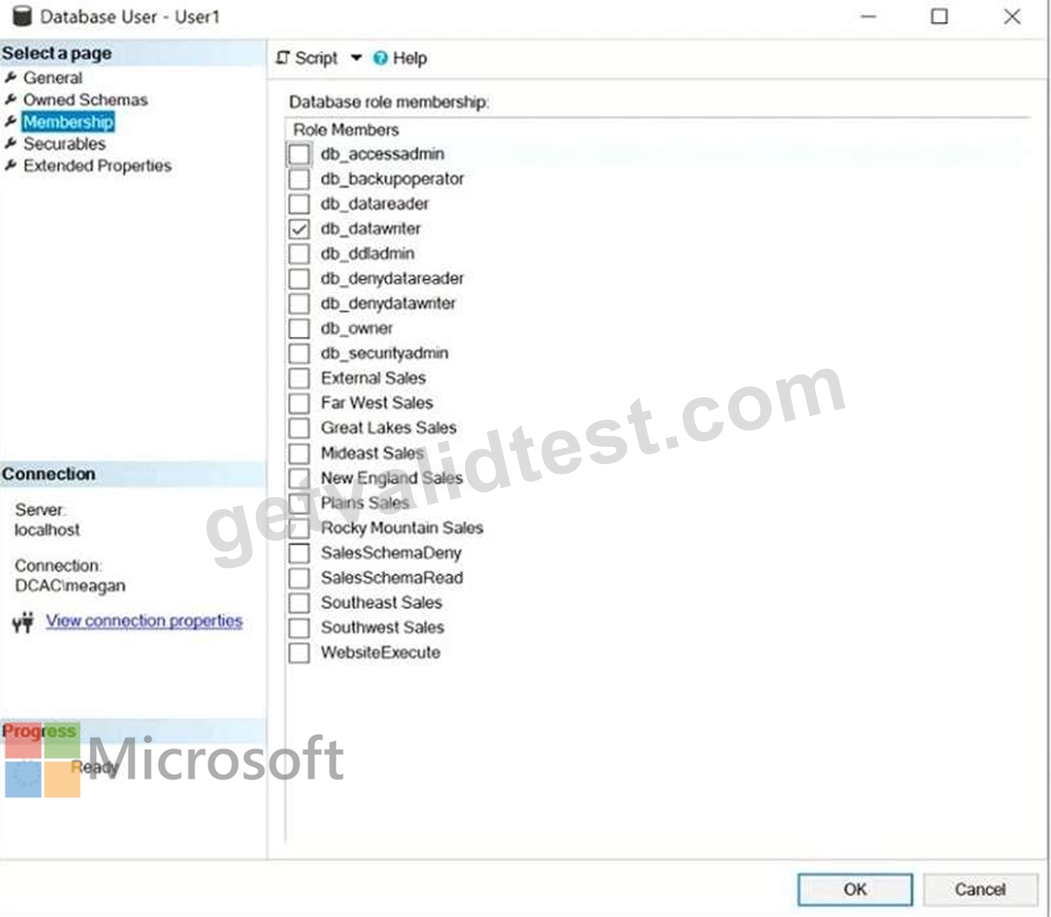
Use the drop-down menus to select the answer choice that completes each statement based on the information presented in the graphic.
NOTE: Each correct selection is worth one point.
Hot Area: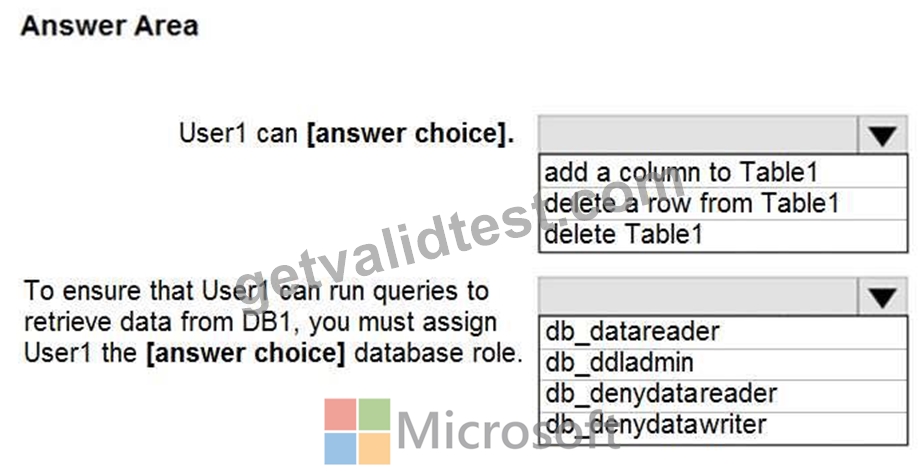
Answer:
Explanation:
Section: [none]
Explanation:
Box 1: delete a row from Table1
Members of the db_datawriter fixed database role can add, delete, or change data in all user tables.
Box 2: db_datareader
Members of the db_datareader fixed database role can read all data from all user tables.
Reference:
https://docs.microsoft.com/en-us/sql/relational-databases/security/authentication-access/database-level-roles
NEW QUESTION 68
You have an Azure SQL database named DB1. You run a query while connected to DB1.
You review the actual execution plan for the query, and you add an index to a table referenced by the query.
You need to compare the previous actual execution plan for the query to the Live Query Statistics.
What should you do first in Microsoft SQL Server Management Studio (SSMS)?
- A. Enable Query Store for DB1.
- B. For DB1, set QUERY_CAPTURE_MODE of Query Store to All.
- C. Run the SET SHOWPLAN_ALLTransact-SQL statement.
- D. Save the actual execution plan.
Answer: D
Explanation:
The Plan Comparison menu option allows side-by-side comparison of two different execution plans, for easier identification of similarities and changes that explain the different behaviors for all the reasons stated above.
This option can compare between:
Two previously saved execution plan files (.sqlplan extension).
One active execution plan and one previously saved query execution plan.
Two selected query plans in Query Store.
NEW QUESTION 69
You need to recommend a configuration for ManufacturingSQLDb1 after the migration to Azure. The solution must meet the business requirements.
What should you include in the recommendation? To answer, select the appropriate options in the answer area.
NOTE: Each correct selection is worth one point.
Answer:
Explanation: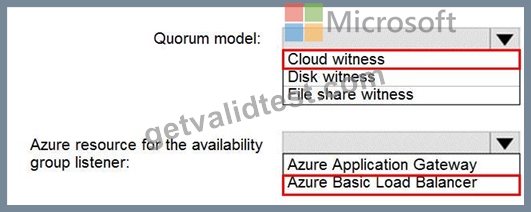
Explanation:
Scenario: Business Requirements
Litware identifies business requirements include: meet an SLA of 99.99% availability for all Azure deployments.
Box 1: Cloud witness
If you have a Failover Cluster deployment, where all nodes can reach the internet (by extension of Azure), it is recommended that you configure a Cloud Witness as your quorum witness resource.
Box 2: Azure Basic Load Balancer
Microsoft guarantees that a Load Balanced Endpoint using Azure Standard Load Balancer, serving two or more Healthy Virtual Machine Instances, will be available 99.99% of the time.
Note: There are two main options for setting up your listener: external (public) or internal. The external (public) listener uses an internet facing load balancer and is associated with a public Virtual IP (VIP) that is accessible over the internet. An internal listener uses an internal load balancer and only supports clients within the same Virtual Network.
Reference:
https://technet.microsoft.com/windows-server-docs/failover-clustering/deploy-cloud-witness
https://azure.microsoft.com/en-us/support/legal/sla/load-balancer/v1_0/
NEW QUESTION 70
DRAG DROP
You need to configure user authentication for the SERVER1 databases. The solution must meet the security and compliance requirements.
Which three actions should you perform in sequence? To answer, move the appropriate actions from the list of actions to the answer area and arrange them in the correct order.
Select and Place:
Answer:
Explanation: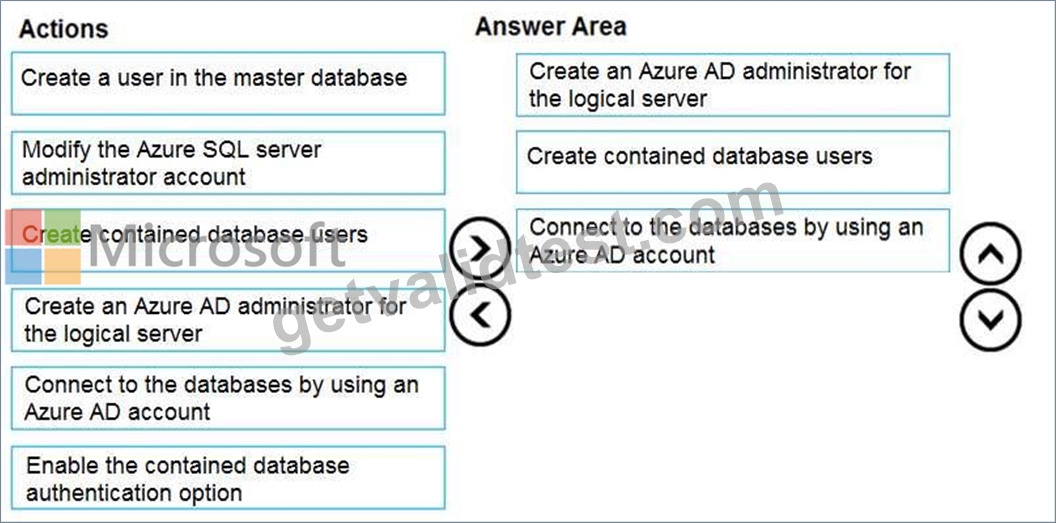
Section: [none]
Explanation:
Scenario: Authenticate database users by using Active Directory credentials.
The configuration steps include the following procedures to configure and use Azure Active Directory authentication.
1. Create and populate Azure AD.
2. Optional: Associate or change the active directory that is currently associated with your Azure Subscription.
3. Create an Azure Active Directory administrator. (Step 1)
4. Configure your client computers.
5. Create contained database users in your database mapped to Azure AD identities. (Step 2)
6. Connect to your database by using Azure AD identities. (Step 3)
Reference:
https://docs.microsoft.com/en-us/azure/azure-sql/database/authentication-aad-overview
NEW QUESTION 71
You have a version-8.0 Azure Database for MySQL database.
You need to identify which database queries consume the most resources.
Which tool should you use?
- A. Alerts
- B. Query Performance Insight
- C. Metrics
- D. Query Store
Answer: D
Explanation:
The Query Store feature in Azure Database for MySQL provides a way to track query performance over time.
Query Store simplifies performance troubleshooting by helping you quickly find the longest running and most resource-intensive queries. Query Store automatically captures a history of queries and runtime statistics, and it retains them for your review. It separates data by time windows so that you can see database usage patterns.
Data for all users, databases, and queries is stored in the mysql schema database in the Azure Database for MySQL instance.
Reference:
https://docs.microsoft.com/en-us/azure/mysql/concepts-query-store
NEW QUESTION 72
You have an Azure SQL database named db1 on a server named server1.
You need to modify the MAXDOP settings for db1.
What should you do?
- A. Connect to db1 and run the sp_configure command.
- B. Connect to the master database of server1 and run the sp_configure command.
- C. Modify the database scoped configuration of db1.
- D. Configure the extended properties of db1.
Answer: C
Explanation:
Reference:
https://docs.microsoft.com/en-us/azure/azure-sql/database/configure-max-degree-of-parallelism
NEW QUESTION 73
You have an Azure Data Factory that contains 10 pipelines.
You need to label each pipeline with its main purpose of either ingest, transform, or load. The labels must be available for grouping and filtering when using the monitoring experience in Data Factory.
What should you add to each pipeline?
- A. a resource tag
- B. a user property
- C. a correlation ID
- D. a run group ID
- E. an annotation
Answer: E
NEW QUESTION 74
You plan to move two 100-GB databases to Azure.
You need to dynamically scale resources consumption based on workloads.
The solution must minimize downtime during scaling operations.
What should you use?
- A. SQL Server on Azure virtual machines
- B. an Azure SQL Database managed instance
- C. Azure SQL databases
- D. An Azure SQL Database elastic pool
Answer: D
NEW QUESTION 75
You have an Azure Synapse Analytics dedicated SQL pool named Pool1 and an Azure Data Lake Storage Gen2 account named Account1.
You plan to access the files in Account1 by using an external table.
You need to create a data source in Pool1 that you can reference when you create the external table.
How should you complete the Transact-SQL statement? To answer, select the appropriate options in the answer area.
NOTE: Each correct selection is worth one point.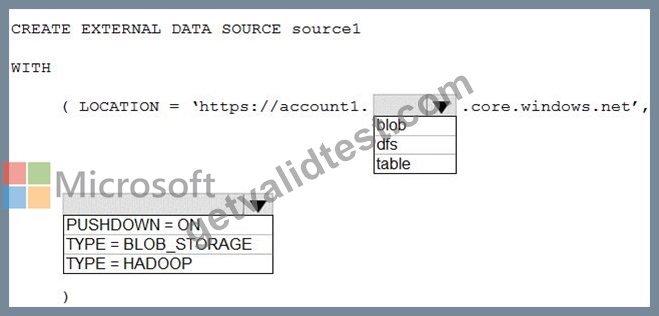
Answer:
Explanation: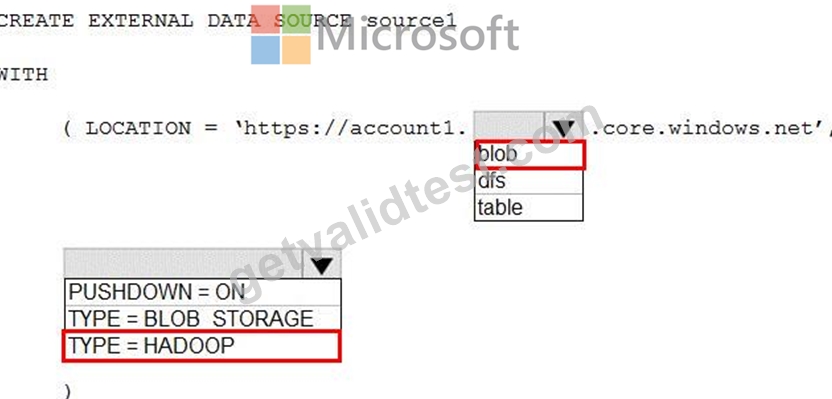
Reference:
https://docs.microsoft.com/en-us/azure/synapse-analytics/sql/develop-tables-external-tables
NEW QUESTION 76
You need to implement the surrogate key for the retail store table. The solution must meet the sales transaction dataset requirements.
What should you create?
- A. a user-defined SEQUENCEobject
- B. a table that has a FOREIGN KEYconstraint
- C. a system-versioned temporal table
- D. a table the has an IDENTITYproperty
Answer: D
Explanation:
Section: [none]
Explanation:
Scenario: Contoso requirements for the sales transaction dataset include:
* Implement a surrogate key to account for changes to the retail store addresses.
A surrogate key on a table is a column with a unique identifier for each row. The key is not generated from the table data. Data modelers like to create surrogate keys on their tables when they design data warehouse models. You can use the IDENTITY property to achieve this goal simply and effectively without affecting load performance.
Reference:
https://docs.microsoft.com/en-us/azure/synapse-analytics/sql-data-warehouse/sql-data-warehouse-tables- identity
NEW QUESTION 77
You have a Microsoft SQL Server 2019 database named DB1 that uses the following database-level and instance-level features.
* Clustered columnstore indexes
* Automatic tuning
* Change tracking
* PolyBase
You plan to migrate DB1 to an Azure SQL database.
What feature should be removed or replaced before DB1 can be migrated?
- A. Change tracking
- B. PolyBase
- C. Automatic tuning
- D. Clustered columnstore indexes
Answer: B
Explanation:
Section: [none]
Explanation:
This table lists the key features for PolyBase and the products in which they're available.
Incorrect Answers:
C: Change tracking is a lightweight solution that provides an efficient change tracking mechanism for applications. It applies to both Azure SQL Database and SQL Server.
D: Azure SQL Database and Azure SQL Managed Instance automatic tuning provides peak performance and stable workloads through continuous performance tuning based on AI and machine learning.
Reference:
https://docs.microsoft.com/en-us/sql/relational-databases/polybase/polybase-versioned-feature-summary
NEW QUESTION 78
......
Get information about the cost of Microsoft DP-300 Exam
- The price of the Microsoft DP-300 Exam is $165 USD.
Updated Verified Pass DP-300 Exam - Real Questions & Answers: https://www.getvalidtest.com/DP-300-exam.html
Best Way To Study For Microsoft DP-300 Exam Brilliant DP-300 Exam Questions PDF: https://drive.google.com/open?id=1n_UNTIrpwdkflLtiQ5JmgClXRqi_RIjO