


Real DP-300 are Uploaded by GetValidTest provide 2021 Latest DP-300 Practice Tests Dumps.
All DP-300 Dumps and Administering Relational Databases on Microsoft Azure Training Courses Help candidates to study and pass the Administering Relational Databases on Microsoft Azure Exams hassle-free!
NEW QUESTION 78
Note: This question is part of a series of questions that present the same scenario. Each question in the series contains a unique solution that might meet the stated goals. Some question sets might have more than one correct solution, while others might not have a correct solution.
After you answer a question in this section, you will NOT be able to return to it. As a result, these questions will not appear in the review screen.
You have an Azure Synapse Analytics dedicated SQL pool that contains a table named Table1.
You have files that are ingested and loaded into an Azure Data Lake Storage Gen2 container named container1.
You plan to insert data from the files into Table1 and transform the dat a. Each row of data in the files will produce one row in the serving layer of Table1.
You need to ensure that when the source data files are loaded to container1, the DateTime is stored as an additional column in Table1.
Solution: You use a dedicated SQL pool to create an external table that has an additional DateTime column.
Does this meet the goal?
- A. No
- B. Yes
Answer: A
Explanation:
Instead use a serverless SQL pool to create an external table with the extra column.
Note: In dedicated SQL pools you can only use Parquet native external tables. Native external tables are generally available in serverless SQL pools.
Reference:
https://docs.microsoft.com/en-us/azure/synapse-analytics/sql/create-use-external-tables
NEW QUESTION 79
What should you do after a failover of SalesSQLDb1 to ensure that the database remains accessible to SalesSQLDb1App1?
- A. Update the users in SalesSQLDb1.
- B. Update the connection strings of SalesSQLDb1App1.
- C. Configure SalesSQLDb1 as writable.
- D. Update the firewall rules of SalesSQLDb1.
Answer: D
Explanation:
Scenario: SalesSQLDb1 uses database firewall rules and contained database users.
Plan and Implement a High Availability and Disaster Recovery (HADR) Environment Question Set 2
NEW QUESTION 80
You need to recommend an availability strategy for an Azure SQL database. The strategy must meet the following requirements:
* Support failovers that do not require client applications to change their connection strings.
* Replicate the database to a secondary Azure region.
* Support failover to the secondary region.
What should you include in the recommendation?
- A. Availability Zones
- B. failover groups
- C. geo-replication
- D. transactional replication
Answer: C
Explanation:
Active geo-replication is an Azure SQL Database feature that allows you to create readable secondary databases of individual databases on a server in the same or different data center (region).
Incorrect Answers:
C: Availability Zones are unique physical locations within a region. Each zone is made up of one or more datacenters equipped with independent power, cooling, and networking.
Reference:
https://docs.microsoft.com/en-us/azure/azure-sql/database/active-geo-replication-overview
Topic 1, Litware Existing Environment
Network Environment
The manufacturing and research datacenters connect to the primary datacenter by using a VPN.
The primary datacenter has an ExpressRoute connection that uses both Microsoft peering and private peering. The private peering connects to an Azure virtual network named HubVNet.
Identity Environment
Litware has a hybrid Azure Active Directory (Azure AD) deployment that uses a domain named litwareinc.com. All Azure subscriptions are associated to the litwareinc.com Azure AD tenant.
Database Environment
The sales department has the following database workload:
* An on-premises named SERVER1 hosts an instance of Microsoft SQL Server 2012 and two 1-TB databases.
* A logical server named SalesSrv01A contains a geo-replicated Azure SQL database named SalesSQLDb1. SalesSQLDb1 is in an elastic pool named SalesSQLDb1Pool. SalesSQLDb1 uses database firewall rules and contained database users.
* An application named SalesSQLDb1App1 uses SalesSQLDb1.
The manufacturing office contains two on-premises SQL Server 2016 servers named SERVER2 and SERVER3. The servers are nodes in the same Always On availability group. The availability group contains a database named ManufacturingSQLDb1 Database administrators have two Azure virtual machines in HubVnet named VM1 and VM2 that run Windows Server 2019 and are used to manage all the Azure databases.
Licensing Agreement
Litware is a Microsoft Volume Licensing customer that has License Mobility through Software Assurance.
Current Problems
SalesSQLDb1 experiences performance issues that are likely due to out-of-date statistics and frequent blocking queries.
Requirements
Planned Changes
Litware plans to implement the following changes:
* Implement 30 new databases in Azure, which will be used by time-sensitive manufacturing apps that have varying usage patterns. Each database will be approximately 20 GB.
* Create a new Azure SQL database named ResearchDB1 on a logical server named ResearchSrv01. ResearchDB1 will contain Personally Identifiable Information (PII) data.
* Develop an app named ResearchApp1 that will be used by the research department to populate and access ResearchDB1.
* Migrate ManufacturingSQLDb1 to the Azure virtual machine platform.
* Migrate the SERVER1 databases to the Azure SQL Database platform.
Technical Requirements
Litware identifies the following technical requirements:
* Maintenance tasks must be automated.
* The 30 new databases must scale automatically.
* The use of an on-premises infrastructure must be minimized.
* Azure Hybrid Use Benefits must be leveraged for Azure SQL Database deployments.
* All SQL Server and Azure SQL Database metrics related to CPU and storage usage and limits must be analyzed by using Azure built-in functionality.
Security and Compliance Requirements
Litware identifies the following security and compliance requirements:
* Store encryption keys in Azure Key Vault.
* Retain backups of the PII data for two months.
* Encrypt the PII data at rest, in transit, and in use.
* Use the principle of least privilege whenever possible.
* Authenticate database users by using Active Directory credentials.
* Protect Azure SQL Database instances by using database-level firewall rules.
* Ensure that all databases hosted in Azure are accessible from VM1 and VM2 without relying on public endpoints.
Business Requirements
Litware identifies the following business requirements:
* Meet an SLA of 99.99% availability for all Azure deployments.
* Minimize downtime during the migration of the SERVER1 databases.
* Use the Azure Hybrid Use Benefits when migrating workloads to Azure.
* Once all requirements are met, minimize costs whenever possible.
NEW QUESTION 81
You are building a database in an Azure Synapse Analytics serverless SQL pool.
You have data stored in Parquet files in an Azure Data Lake Storage Gen2 container.
Records are structured as shown in the following sample.
The records contain two applicants at most.
You need to build a table that includes only the address fields.
How should you complete the Transact-SQL statement? To answer, select the appropriate options in the answer area.
NOTE: Each correct selection is worth one point.
Answer:
Explanation: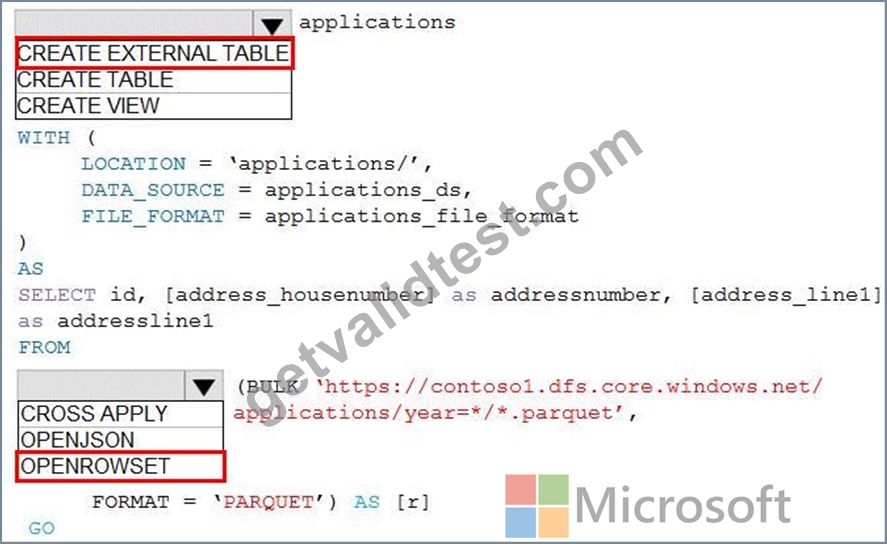
Reference:
https://docs.microsoft.com/en-us/azure/synapse-analytics/sql/develop-tables-external-tables
NEW QUESTION 82
Note: This question is part of a series of questions that present the same scenario. Each question in the series contains a unique solution that might meet the stated goals. Some question sets might have more than one correct solution, while others might not have a correct solution.
After you answer a question in this section, you will NOT be able to return to it. As a result, these questions will not appear in the review screen.
You have SQL Server 2019 on an Azure virtual machine.
You are troubleshooting performance issues for a query in a SQL Server instance.
To gather more information, you query sys.dm_exec_requests and discover that the wait type is PAGELATCH_UP and the wait_resource is 2:3:905856.
You need to improve system performance.
Solution: You shrink the transaction log file.
Does this meet the goal?
- A. No
- B. Yes
Answer: A
Explanation:
Reference:
https://docs.microsoft.com/en-US/troubleshoot/sql/performance/recommendations-reduce-allocation-contention
NEW QUESTION 83
Note: This question is part of a series of questions that present the same scenario. Each question in the series contains a unique solution that might meet the stated goals. Some question sets might have more than one correct solution, while others might not have a correct solution.
After you answer a question in this section, you will NOT be able to return to it. As a result, these questions will not appear in the review screen.
You have two Azure SQL Database servers named Server1 and Server2. Each server contains an Azure SQL database named Database1.
You need to restore Database1 from Server1 to Server2. The solution must replace the existing Database1 on Server2.
Solution: You run the Remove-AzSqlDatabase PowerShell cmdlet for Database1 on Server2. You run the Restore-AzSqlDatabase PowerShell cmdlet for Database1 on Server2.
Does this meet the goal?
- A. No
- B. Yes
Answer: A
Explanation:
Instead restore Database1 from Server1 to the Server2 by using the RESTORE Transact-SQL command and the REPLACE option.
Note: REPLACE should be used rarely and only after careful consideration. Restore normally prevents accidentally overwriting a database with a different database. If the database specified in a RESTORE statement already exists on the current server and the specified database family GUID differs from the database family GUID recorded in the backup set, the database is not restored. This is an important safeguard.
Reference:
https://docs.microsoft.com/en-us/sql/t-sql/statements/restore-statements-transact-sql
NEW QUESTION 84
Note: This question is part of a series of questions that present the same scenario. Each question in the series contains a unique solution that might meet the stated goals. Some question sets might have more than one correct solution, while others might not have a correct solution.
After you answer a question in this section, you will NOT be able to return to it. As a result, these questions will not appear in the review screen.
You have two Azure SQL Database servers named Server1 and Server2. Each server contains an Azure SQL database named Database1.
You need to restore Database1 from Server1 to Server2. The solution must replace the existing Database1 on Server2.
Solution: You restore Database1 from Server1 to the Server2 by using the RESTORE Transact-SQL command and the REPLACE option.
Does this meet the goal?
- A. No
- B. Yes
Answer: B
Explanation:
The REPLACE option overrides several important safety checks that restore normally performs. The overridden checks are as follows:
* Restoring over an existing database with a backup taken of another database.
With the REPLACE option, restore allows you to overwrite an existing database with whatever database is in the backup set, even if the specified database name differs from the database name recorded in the backup set. This can result in accidentally overwriting a database by a different database.
Reference:
https://docs.microsoft.com/en-us/sql/t-sql/statements/restore-statements-transact-sql
NEW QUESTION 85
You need to implement the monitoring of SalesSQLDb1. The solution must meet the technical requirements.
How should you collect and stream metrics? To answer, select the appropriate options in the answer area.
NOTE: Each correct selection is worth one point.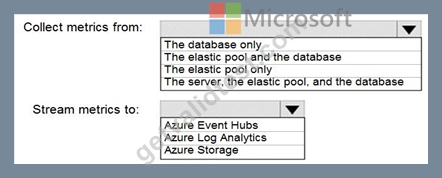
Answer:
Explanation:
Explanation:
Box 1: The server, the elastic pool, and the database
Senario:
SalesSQLDb1 is in an elastic pool named SalesSQLDb1Pool.
Litware technical requirements include: all SQL Server and Azure SQL Database metrics related to CPU and storage usage and limits must be analyzed by using Azure built-in functionality.
Box 2: Azure Event hubs
Scenario: Migrate ManufacturingSQLDb1 to the Azure virtual machine platform.
Event hubs are able to handle custom metrics.
Incorrect Answers:
Azure Log Analytics
Azure metric and log data are sent to Azure Monitor Logs, previously known as Azure Log Analytics, directly by Azure. Azure SQL Analytics is a cloud only monitoring solution supporting streaming of diagnostics telemetry for all of your Azure SQL databases.
However, because Azure SQL Analytics does not use agents to connect to Azure Monitor, it does not support monitoring of SQL Server hosted on-premises or in virtual machines.
NEW QUESTION 86
You need to apply 20 built-in Azure Policy definitions to all new and existing Azure SQL Database deployments in an Azure subscription. The solution must minimize administrative effort.
Which three actions should you perform in sequence? To answer, move the appropriate actions from the list of actions to the answer area and arrange them in the correct order.
Answer:
Explanation: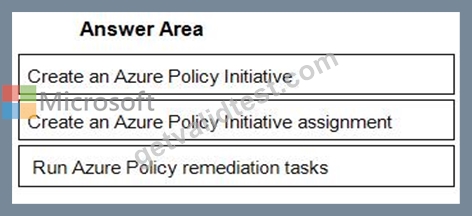
1 - Create an Azure Policy Initiative
2 - Create an Azure Policy Initiative assignment
3 - Run Azure Policy remediation tasks
Reference:
https://docs.microsoft.com/en-us/azure/governance/policy/tutorials/create-and-manage
NEW QUESTION 87
You have 40 Azure SQL databases, each for a different customer. All the databases reside on the same Azure
SQL Database server.
You need to ensure that each customer can only connect to and access their respective database.
Which two actions should you perform? Each correct answer presents part of the solution.
NOTE: Each correct selection is worth one point.
- A. Configure the server firewall.
- B. Implement Always Encrypted.
- C. Implement row-level security (RLS).
- D. Create logins in the master database.
- E. Configure the database firewall.
- F. Create users in each database.
Answer: E,F
Explanation:
Section: [none]
Explanation:
Manage database access by adding users to the database, or allowing user access with secure connection
strings.
Database-level firewall rules only apply to individual databases.
Incorrect Answers:
B: Server-level IP firewall rules apply to all databases within the same server.
Reference:
https://docs.microsoft.com/en-us/azure/azure-sql/database/secure-database-tutorial
NEW QUESTION 88
You have an Azure SQL database named DB1 that contains two tables named Table1 and Table2. Both tables contain a column named a Column1. Column1 is used for joins by an application named App1.
You need to protect the contents of Column1 at rest, in transit, and in use.
How should you protect the contents of Column1? To answer, select the appropriate options in the answer area.
NOTE: Each correct selection is worth one point.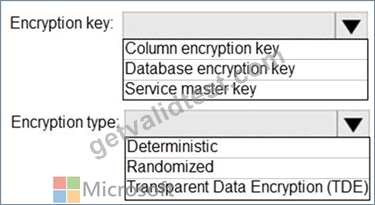
Answer:
Explanation: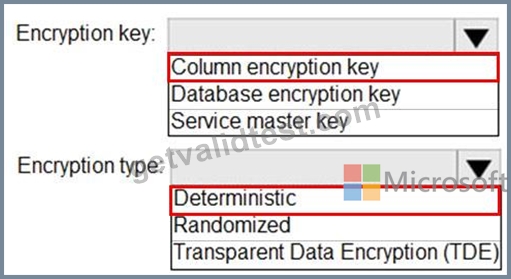
Explanation:
Box 1: Column encryption Key
Always Encrypted uses two types of keys: column encryption keys and column master keys. A column encryption key is used to encrypt data in an encrypted column. A column master key is a key-protecting key that encrypts one or more column encryption keys.
Incorrect Answers:
TDE encrypts the storage of an entire database by using a symmetric key called the Database Encryption Key (DEK).
Box 2: Deterministic
Always Encrypted is a feature designed to protect sensitive data, such as credit card numbers or national identification numbers (for example, U.S. social security numbers), stored in Azure SQL Database or SQL Server databases. Always Encrypted allows clients to encrypt sensitive data inside client applications and never reveal the encryption keys to the Database Engine (SQL Database or SQL Server).
Always Encrypted supports two types of encryption: randomized encryption and deterministic encryption.
Deterministic encryption always generates the same encrypted value for any given plain text value. Using deterministic encryption allows point lookups, equality joins, grouping and indexing on encrypted columns.
Reference:
https://docs.microsoft.com/en-us/sql/relational-databases/security/encryption/always-encrypted-database-engine
NEW QUESTION 89
You create five Azure SQL Database instances on the same logical server.
In each database, you create a user for an Azure Active Directory (Azure AD) user named User1.
User1 attempts to connect to the logical server by using Azure Data Studio and receives a login error.
You need to ensure that when User1 connects to the logical server by using Azure Data Studio, User1 can see all the databases.
What should you do?
- A. Create User1 in the master database.
- B. Assign User1 the db_datareader role for the databases that Userl creates.
- C. Grant select on sys.databases to public in the master database.
- D. Assign User1 the db_datareader role for the master database.
Answer: A
Explanation:
Reference:
https://docs.microsoft.com/en-us/azure/azure-sql/database/logins-create-manage
NEW QUESTION 90
Which audit log destination should you use to meet the monitoring requirements?
- A. Azure Log Analytics
- B. Azure Event Hubs
- C. Azure Storage
Answer: A
Explanation:
Section: [none]
Explanation:
Scenario: Use a single dashboard to review security and audit data for all the PaaS databases.
With dashboards can bring together operational data that is most important to IT across all your Azure
resources, including telemetry from Azure Log Analytics.
Note: Auditing for Azure SQL Database and Azure Synapse Analytics tracks database events and writes them
to an audit log in your Azure storage account, Log Analytics workspace, or Event Hubs.
Reference:
https://docs.microsoft.com/en-us/azure/azure-monitor/visualize/tutorial-logs-dashboards
Question Set 3
NEW QUESTION 91
DRAG DROP
You are building an Azure virtual machine.
You allocate two 1-TiB, P30 premium storage disks to the virtual machine. Each disk provides 5,000 IOPS.
You plan to migrate an on-premises instance of Microsoft SQL Server to the virtual machine. The instance has
a database that contains a 1.2-TiB data file. The database requires 10,000 IOPS.
You need to configure storage for the virtual machine to support the database.
Which three objects should you create in sequence? To answer, move the appropriate objects from the list of
objects to the answer area and arrange them in the correct order.
Select and Place: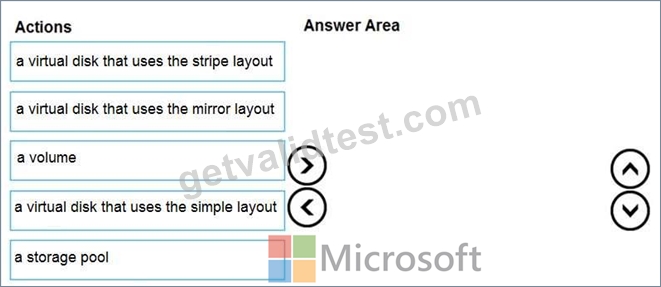
Answer:
Explanation:
Section: [none]
Explanation:
Follow these same steps to create striped virtual disk:
* Create Log Storage Pool.
* Create Virtual Disk
* Create Volume
Box 1: a storage pool
Box 2: a virtual disk that uses stripe layout
Disk Striping: Use multiple disks and stripe them together to get a combined higher IOPS and Throughput limit.
The combined limit per VM should be higher than the combined limits of attached premium disks.
Box 3: a volume
Reference:
https://hanu.com/hanu-how-to-striping-of-disks-for-azure-sql-server/
NEW QUESTION 92
You have a Microsoft SQL Server 2019 database named DB1 that uses the following database-level and instance-level features.
Clustered columnstore indexes
Automatic tuning
Change tracking
PolyBase
You plan to migrate DB1 to an Azure SQL database.
What feature should be removed or replaced before DB1 can be migrated?
- A. Automatic tuning
- B. PolyBase
- C. Change tracking
- D. Clustered columnstore indexes
Answer: B
Explanation:
This table lists the key features for PolyBase and the products in which they're available.
Reference:
https://docs.microsoft.com/en-us/sql/relational-databases/polybase/polybase-versioned-feature-summary
NEW QUESTION 93
You are planning the migration of the SERVER1 databases. The solution must meet the business requirements.
What should you include in the migration plan? To answer, select the appropriate options in the answer area.
NOTE: Each correct selection is worth one point.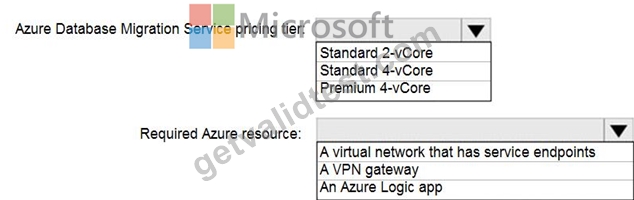
Answer:
Explanation: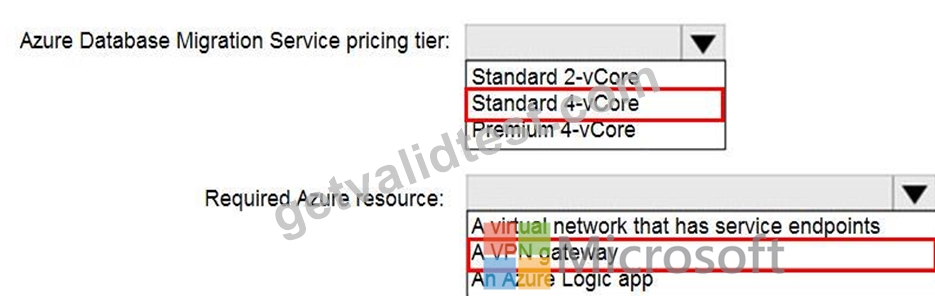
Reference:
https://azure.microsoft.com/pricing/details/database-migration/
https://docs.microsoft.com/en-us/azure/dms/tutorial-sql-server-azure-sql-online
NEW QUESTION 94
You have an Azure SQL Database managed instance named SQLMI1. A Microsoft SQL Server Agent job runs on SQLMI1.
You need to ensure that an automatic email notification is sent once the job completes.
What should you include in the solution?
- A. From SQL Server Management Studio (SSMS), run sp_set_sqlagent_properties
- B. From SQL Server Management Studio (SSMS), create a Database Mail profile
- C. From the Azure portal, create an Azure Monitor action group that has an Email/SMS/Push/Voice action
- D. From SQL Server Configuration Manager (SSMS), enable SQL Server Agent
Answer: B
Explanation:
To send a notification in response to an alert, you must first configure SQL Server Agent to send mail.
Using SQL Server Management Studio; to configure SQL Server Agent to use Database Mail:
1. In Object Explorer, expand a SQL Server instance.
2. Right-click SQL Server Agent, and then click Properties.
3. Click Alert System.
4. Select Enable Mail Profile.
5. In the Mail system list, select Database Mail.
6. In the Mail profile list, select a mail profile for Database Mail.
7. Restart SQL Server Agent.
Note: Prerequisites include:
* Enable Database Mail.
* Create a Database Mail account for the SQL Server Agent service account to use.
* Create a Database Mail profile for the SQL Server Agent service account to use and add the user to the DatabaseMailUserRole in the msdb database.
* Set the profile as the default profile for the msdb database.
Reference:
https://docs.microsoft.com/en-us/sql/relational-databases/database-mail/configure-sql-server-agent-mail-to- use-database-mail Plan and Implement a High Availability and Disaster Recovery (HADR) Environment Testlet 1 This is a case study. Case studies are not timed separately. You can use as much exam time as you would like to complete each case. However, there may be additional case studies and sections on this exam. You must manage your time to ensure that you are able to complete all questions included on this exam in the time provided.
To answer the questions included in a case study, you will need to reference information that is provided in the case study. Case studies might contain exhibits and other resources that provide more information about the scenario that is described in the case study. Each question is independent of the other questions in this case study.
At the end of this case study, a review screen will appear. This screen allows you to review your answers and to make changes before you move to the next section of the exam. After you begin a new section, you cannot return to this section.
To start the case study
To display the first question in this case study, click the Next button. Use the buttons in the left pane to explore the content of the case study before you answer the questions. Clicking these buttons displays information such as business requirements, existing environment, and problem statements. If the case study has an All Information tab, note that the information displayed is identical to the information displayed on the subsequent tabs. When you are ready to answer a question, click the Question button to return to the question.
Existing Environment
Network Environment
The manufacturing and research datacenters connect to the primary datacenter by using a VPN.
The primary datacenter has an ExpressRoute connection that uses both Microsoft peering and private peering.
The private peering connects to an Azure virtual network named HubVNet.
Identity Environment
Litware has a hybrid Azure Active Directory (Azure AD) deployment that uses a domain named litwareinc.com.
All Azure subscriptions are associated to the litwareinc.com Azure AD tenant.
Database Environment
The sales department has the following database workload:
* An on-premises named SERVER1 hosts an instance of Microsoft SQL Server 2012 and two 1-TB databases.
* A logical server named SalesSrv01A contains a geo-replicated Azure SQL database named SalesSQLDb1.
SalesSQLDb1 is in an elastic pool named SalesSQLDb1Pool. SalesSQLDb1 uses database firewall rules and contained database users.
* An application named SalesSQLDb1App1 uses SalesSQLDb1.
The manufacturing office contains two on-premises SQL Server 2016 servers named SERVER2 and SERVER3. The servers are nodes in the same Always On availability group. The availability group contains a database named ManufacturingSQLDb1 Database administrators have two Azure virtual machines in HubVnet named VM1 and VM2 that run Windows Server 2019 and are used to manage all the Azure databases.
Licensing Agreement
Litware is a Microsoft Volume Licensing customer that has License Mobility through Software Assurance.
Current Problems
SalesSQLDb1 experiences performance issues that are likely due to out-of-date statistics and frequent blocking queries.
Requirements
Planned Changes
Litware plans to implement the following changes:
* Implement 30 new databases in Azure, which will be used by time-sensitive manufacturing apps that have varying usage patterns. Each database will be approximately 20 GB.
* Create a new Azure SQL database named ResearchDB1 on a logical server named ResearchSrv01.
ResearchDB1 will contain Personally Identifiable Information (PII) data.
* Develop an app named ResearchApp1 that will be used by the research department to populate and access ResearchDB1.
* Migrate ManufacturingSQLDb1 to the Azure virtual machine platform.
* Migrate the SERVER1 databases to the Azure SQL Database platform.
Technical Requirements
Litware identifies the following technical requirements:
* Maintenance tasks must be automated.
* The 30 new databases must scale automatically.
* The use of an on-premises infrastructure must be minimized.
* Azure Hybrid Use Benefits must be leveraged for Azure SQL Database deployments.
* All SQL Server and Azure SQL Database metrics related to CPU and storage usage and limits must be analyzed by using Azure built-in functionality.
Security and Compliance Requirements
Litware identifies the following security and compliance requirements:
* Store encryption keys in Azure Key Vault.
* Retain backups of the PII data for two months.
* Encrypt the PII data at rest, in transit, and in use.
* Use the principle of least privilege whenever possible.
* Authenticate database users by using Active Directory credentials.
* Protect Azure SQL Database instances by using database-level firewall rules.
* Ensure that all databases hosted in Azure are accessible from VM1 and VM2 without relying on public endpoints.
Business Requirements
Litware identifies the following business requirements:
* Meet an SLA of 99.99% availability for all Azure deployments.
* Minimize downtime during the migration of the SERVER1 databases.
* Use the Azure Hybrid Use Benefits when migrating workloads to Azure.
* Once all requirements are met, minimize costs whenever possible.
Plan and Implement a High Availability and Disaster Recovery (HADR) Environment Question Set 2
NEW QUESTION 95
You have the following Azure Data Factory pipelines:
Ingest Data from System1
Ingest Data from System2
Populate Dimensions
Populate Facts
Ingest Data from System1 and Ingest Data from System2 have no dependencies. Populate Dimensions must execute after Ingest Data from System1 and Ingest Data from System2. Populate Facts must execute after the Populate Dimensions pipeline. All the pipelines must execute every eight hours.
What should you do to schedule the pipelines for execution?
- A. Create a parent pipeline that contains the four pipelines and use a schedule trigger.
- B. Add a schedule trigger to all four pipelines.
- C. Create a parent pipeline that contains the four pipelines and use an event trigger.
- D. Add an event trigger to all four pipelines.
Answer: A
Explanation:
Reference:
https://www.mssqltips.com/sqlservertip/6137/azure-data-factory-control-flow-activities-overview/
NEW QUESTION 96
......
Valid Way To Pass Microsoft's DP-300 Exam with : https://www.getvalidtest.com/DP-300-exam.html
Free Test Engine For Administering Relational Databases on Microsoft Azure Certification Exams: https://drive.google.com/open?id=1n_UNTIrpwdkflLtiQ5JmgClXRqi_RIjO