


Updated Oct 20, 2025 Verified Pass DP-300 Exam in First Attempt Guaranteed
Free DP-300 Sample Questions and 100% Cover Real Exam Questions (Updated 464 Questions)
Optimize and Monitor Operational Resources: 15-20%
- Monitor Performance & Activity: The examinees must have competence in interpreting performance metrics, preparing performance baseline operations, and establishing performance metrics sources, among others.
- Configure the User Database for Maximum Performance: The students should be able to configure IQP, compute resources, and implement database-scoped configuration.
- Implement Performance-Related Maintenance Functions: This objective covers the learners’ skills in managing storage capacity, configuring database auto-tuning, and implementing index & statistics maintenance functions.
- Configure Resources for Maximum Performance: This module requires your skills in configuring Resource Governors, storage & infrastructure resources, as well as service & server account settings.
- Determine Performance-Related Concerns: The applicants need to possess competence in identifying sessions causing blocking, evaluating fragmentation/growth of logs and database, as well as evaluating the parameters for the configuration of a performance-related database.
NEW QUESTION # 128
Hotspot Question
You have a SQL Server on Azure Virtual Machines instance that hosts a 10-TB SQL database named DB1.
You need to identify and repair any physical or logical corruption in DB1. The solution must meet the following requirements:
- Minimize how long it takes to complete the procedure.
- Minimize data loss.
How should you complete the command? To answer, select the appropriate options in the answer area.
NOTE: Each correct selection is worth one point.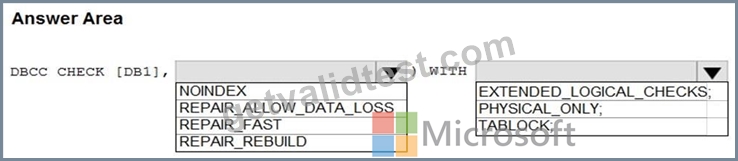
Answer:
Explanation: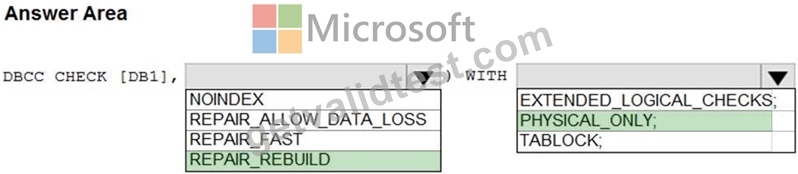
Explanation:
Box 1: REPAIR_REBUILD
Performs repairs that have no possibility of data loss. This option may include quick repairs, such as repairing missing rows in nonclustered indexes, and more time-consuming repairs, such as rebuilding an index.
Box 2: PHYSICAL_ONLY
Limits the checking to the integrity of the physical structure of the page and record headers and the allocation consistency of the database. This check is designed to provide a small overhead check of the physical consistency of the database, but it can also detect torn pages, checksum failures, and common hardware failures that can compromise a user's data.
Incorrect:
TABLOCK
Causes DBCC CHECKDB to obtain locks instead of using an internal database snapshot. This includes a short-term exclusive (X) lock on the database.
TABLOCK will cause DBCC CHECKDB to run faster on a database under heavy load, but will decrease the concurrency available on the database while DBCC CHECKDB is running.
EXTENDED_LOGICAL_CHECKS
If the compatibility level is 100 ( SQL Server 2008) or higher, performs logical consistency checks on an indexed view, XML indexes, and spatial indexes, where present.
Reference:
https://docs.microsoft.com/en-us/sql/t-sql/database-console-commands/dbcc-checkdb-transact-sql
NEW QUESTION # 129
You plan to create a table in an Azure Synapse Analytics dedicated SQL pool.
Data in the table will be retained for five years. Once a year, data that is older than five years will be deleted.
You need to ensure that the data is distributed evenly across partitions. The solutions must minimize the amount of time required to delete old data.
How should you complete the Transact-SQL statement? To answer, drag the appropriate values to the correct targets. Each value may be used once, more than once, or not at all.
You may need to drag the split bar between panes or scroll to view content.
NOTE: Each correct selection is worth one point.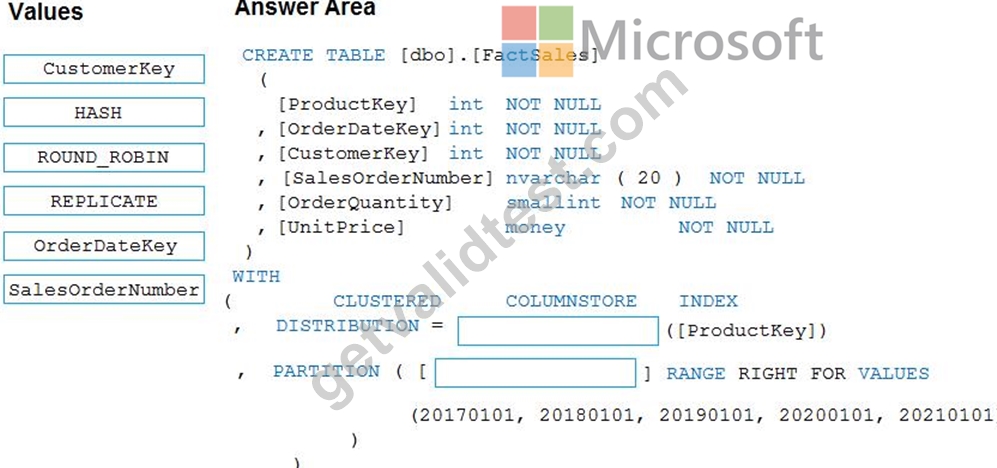
Answer:
Explanation: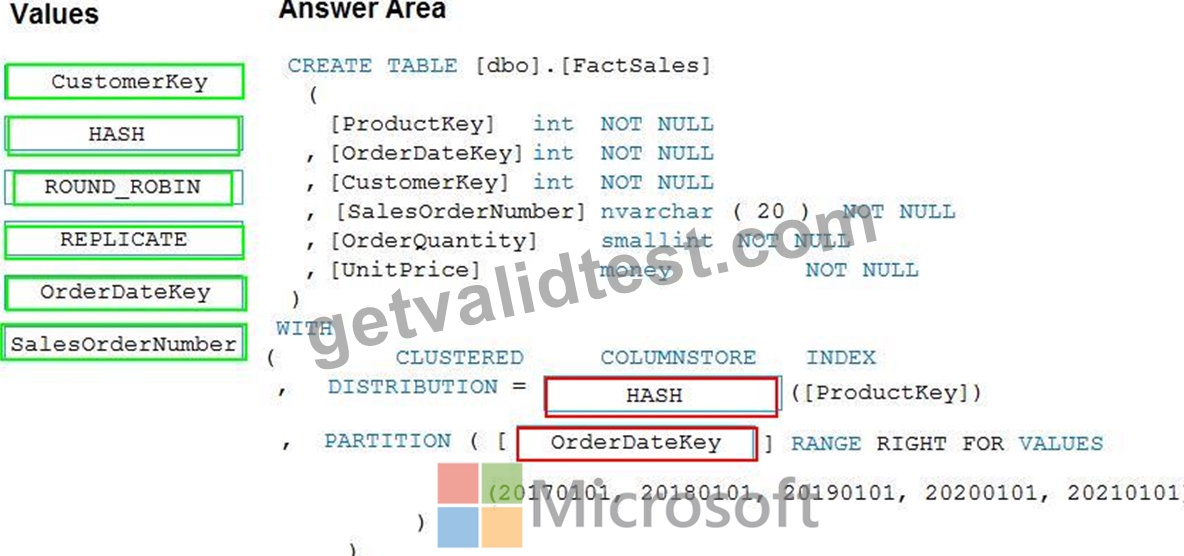
Reference:
https://docs.microsoft.com/en-us/sql/t-sql/statements/create-table-azure-sql-data-warehouse
https://docs.microsoft.com/en-us/azure/synapse-analytics/sql/best-practices-dedicated-sql-pool
NEW QUESTION # 130
You have an Azure subscription.
You need to deploy an Azure SQL resource that will support cross database queries by using an Azure Resource Manager (ARM) template.
How should you complete the ARM template? To answer, select the appropriate options in the answer area.
NOTE: Each correct selection is worth one point.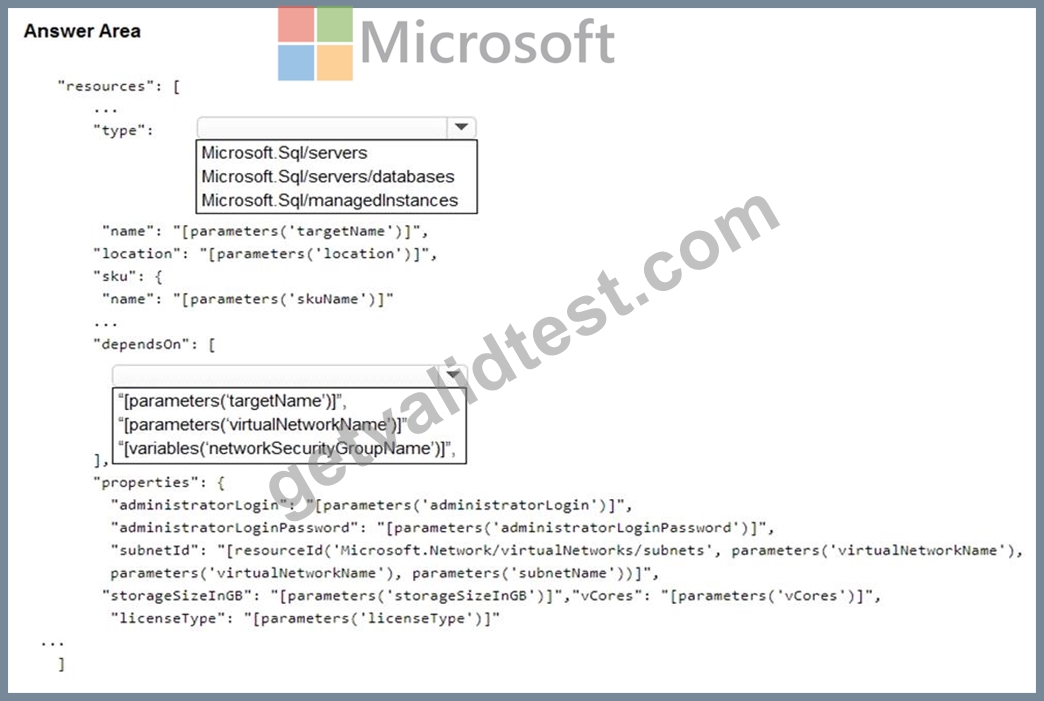
Answer:
Explanation: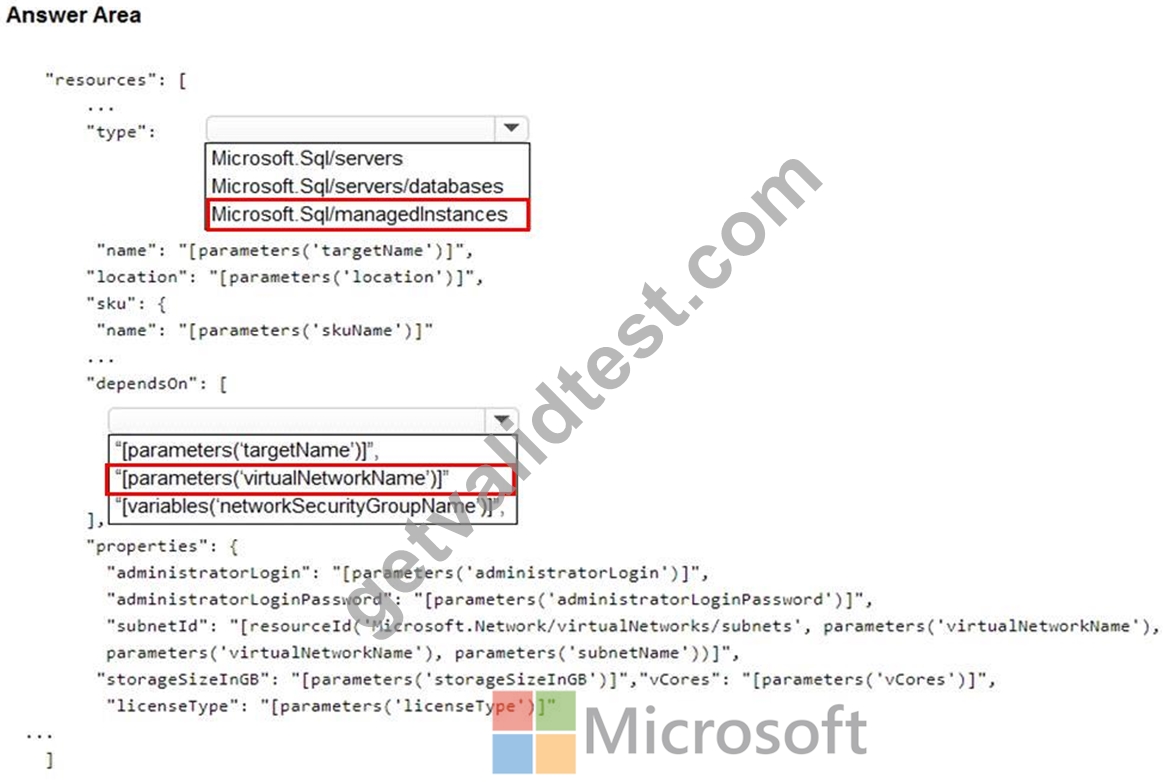
Reference:
https://docs.microsoft.com/en-us/azure/azure-sql/managed-instance/create-template-quickstart?tabs=azure-powershell
NEW QUESTION # 131
Which windowing function should you use to perform the streaming aggregation of the sales data?
- A. Sliding
- B. Session
- C. Tumbling
- D. Hopping
Answer: C
Explanation:
Scenario: The sales data, including the documents in JSON format, must be gathered as it arrives and analyzed online by using Azure Stream Analytics. The analytics process will perform aggregations that must be done continuously, without gaps, and without overlapping.
Tumbling window functions are used to segment a data stream into distinct time segments and perform a function against them, such as the example below. The key differentiators of a Tumbling window are that they repeat, do not overlap, and an event cannot belong to more than one tumbling window.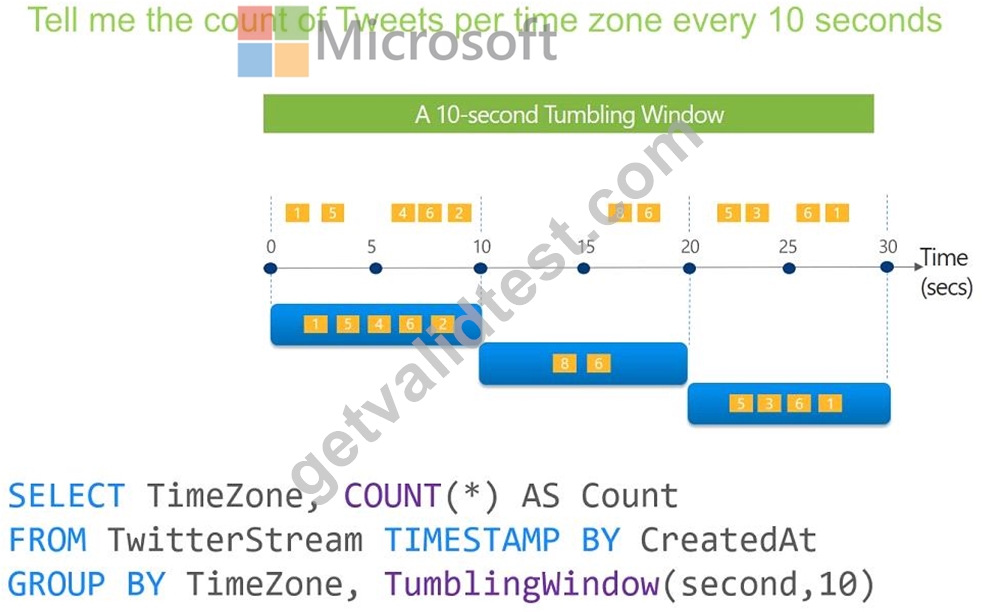
Reference:
https://github.com/MicrosoftDocs/azure-docs/blob/master/articles/stream-analytics/stream-analytics-window-functions.md
NEW QUESTION # 132
You have an on-premises Microsoft SQL Server 2019 instance that hosts a database named DB1.
You plan to perform an online migration of DB1 to an Azure SQL managed instance by using the Azure Database Migration Service.
You need to create a backup of DB1 that is accessible to the Azure Database Migration Service.
What should you run for the backup and where should you store the backup? To answer, select the appropriate options in the answer area.
NOTE: Each correct selection is worth one point.
Answer:
Explanation: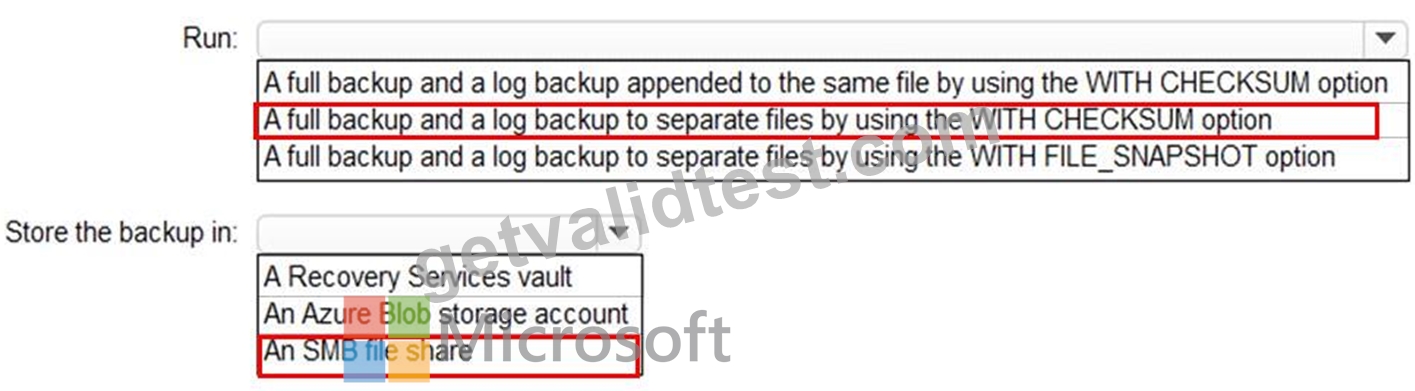
Reference:
https://docs.microsoft.com/en-us/azure/dms/tutorial-sql-server-managed-instance-online
NEW QUESTION # 133
You configure version control for an Azure Data Factory instance as shown in the following exhibit.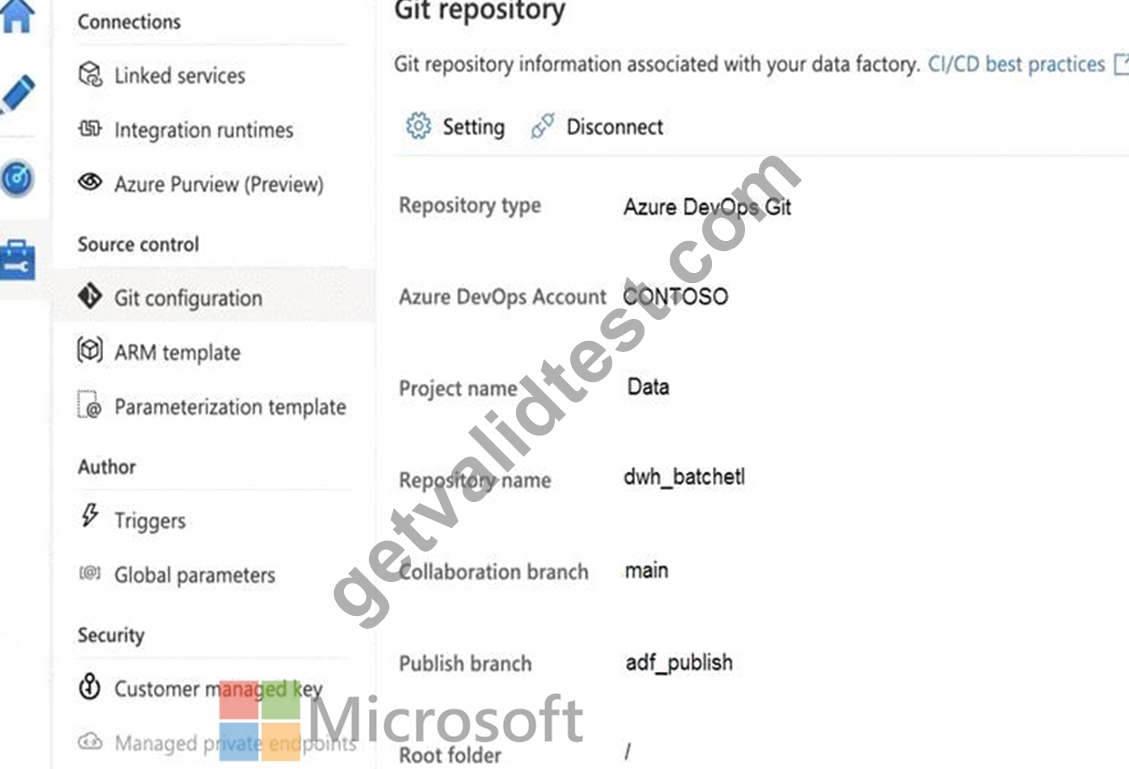
Use the drop-down menus to select the answer choice that completes each statement based on the information presented in the graphic.
NOTE:Each correct selection is worth one point.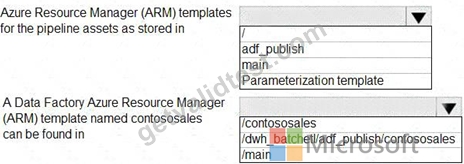
Answer:
Explanation: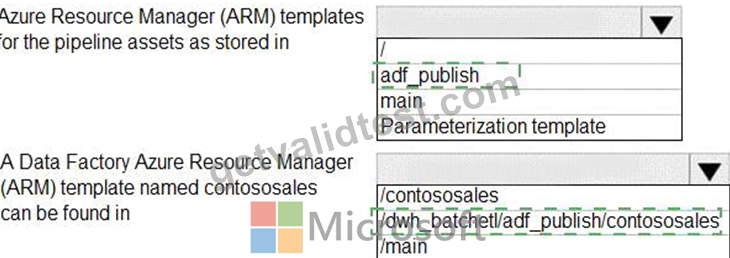
Explanation
Graphical user interface, text, application Description automatically generated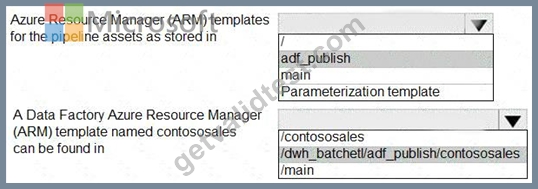
Box 1: adf_publish
By default, data factory generates the Resource Manager templates of the published factory and saves them into a branch called adf_publish. To configure a custom publish branch, add a publish_config.json file to the root folder in the collaboration branch. When publishing, ADF reads this file, looks for the field publishBranch, and saves all Resource Manager templates to the specified location. If the branch doesn't exist, data factory will automatically create it. And example of what this file looks like is below:
{
"publishBranch": "factory/adf_publish"
}
Box 2: /dwh_barchlet/ adf_publish/contososales
RepositoryName: Your Azure Repos code repository name. Azure Repos projects contain Git repositories to manage your source code as your project grows. You can create a new repository or use an existing repository that's already in your project.
Reference:
https://docs.microsoft.com/en-us/azure/data-factory/source-control
NEW QUESTION # 134
You have 50 Azure SQL databases.
You need to notify the database owner when the database settings, such as the database size and pricing tier, are modified in Azure.
What should you do?
- A. Create an alert rule that uses an Activity Log signal type.
- B. Create an alert rule that uses a Metric signal type.
- C. Create a diagnostic setting for the activity log that has the Security log enabled.
- D. For the database, create a diagnostic setting that has the InstanceAndAppAdvanced metric enabled.
Answer: A
Explanation:
Section: [none]
Explanation:
Activity log events - An alert can trigger on every event, or, only when a certain number of events occur.
Incorrect Answers:
C: Metric values - The alert triggers when the value of a specified metric crosses a threshold you assign in either direction. That is, it triggers both when the condition is first met and then afterwards when that condition is no longer being met.
Reference:
https://docs.microsoft.com/en-us/azure/azure-sql/database/alerts-insights-configure-portal
NEW QUESTION # 135
You have an Azure SQL database named DB1. The automatic tuning options for DB1 are configured as shown in the following exhibit.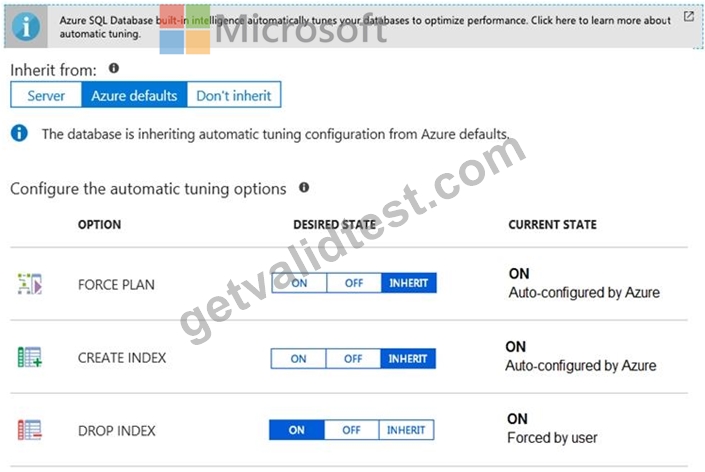
For each of the following statements, select Yes if the statement is true. Otherwise, select No.
NOTE:Each correct selection is worth one point.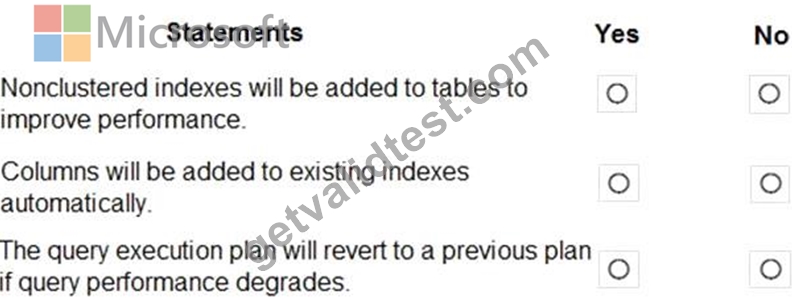
Answer:
Explanation: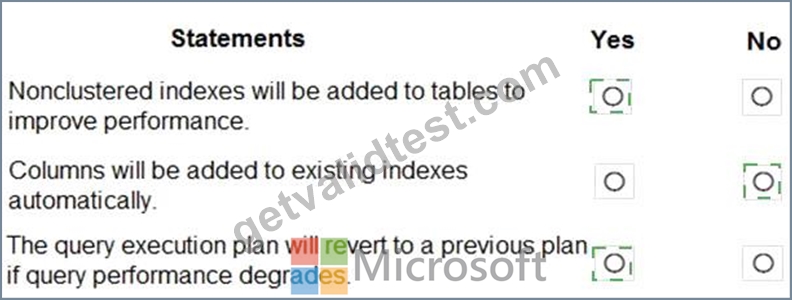
Explanation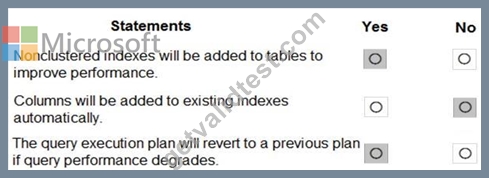
Box 1: Yes
We see: Tuning option: Create index ON
CREATE INDEX - Identifies indexes that may improve performance of your workload, creates indexes, and automatically verifies that performance of queries has improved.
Box 2: No
Box 3: Yes
FORCE LAST GOOD PLAN (automatic plan correction) - Identifies Azure SQL queries using an execution plan that is slower than the previous good plan, and queries using the last known good plan instead of the regressed plan.
NEW QUESTION # 136
You have an Azure subscription that contains a resource group named RG1. RG1 contains an instance of SQL Server on Azure Virtual Machines named SQL You need to use PowerShell to enable and configure automated patching for SQL The solution must include both SQL Server and Windows security updates.
How should you complete the command? To answer, select the appropriate options in the answer area.
NOTE: Each correct selection is worth one point.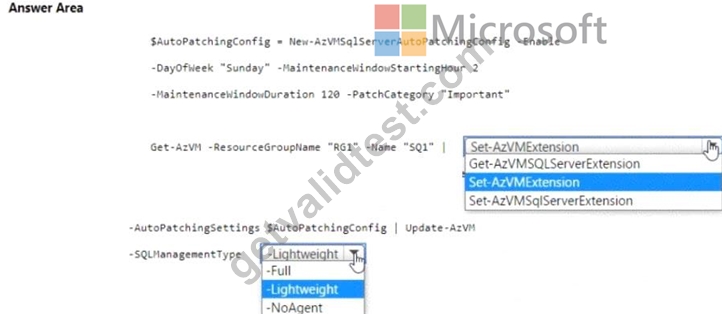
Answer:
Explanation: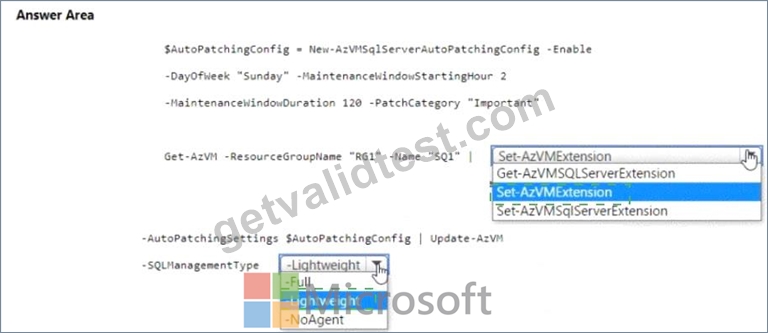
Explanation: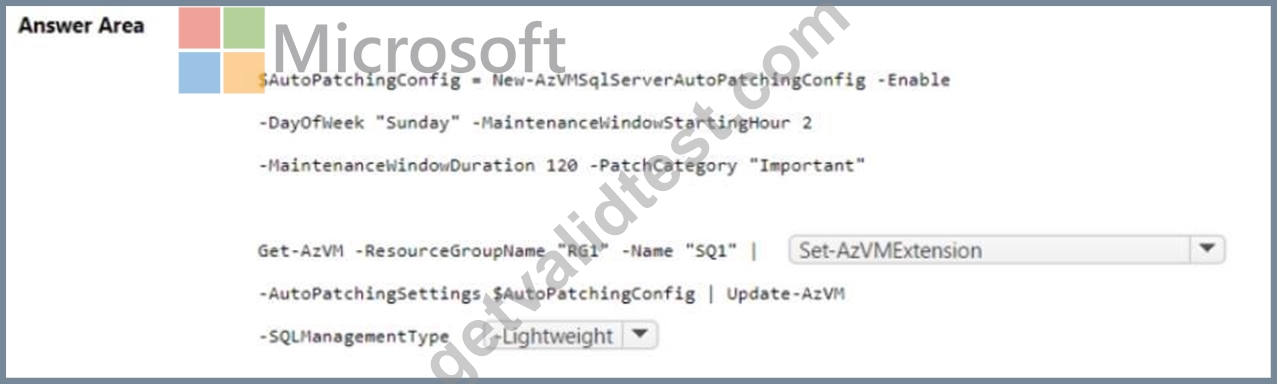
NEW QUESTION # 137
You have a Microsoft SQL Server 2017 server.
You need to migrate the server to Azure. The solution must meet the following requirements:
* Ensure that the latest version of SQL Server is used.
* Support the SQL Server Agent service.
Minimize administrative effort.
What should you use?
- A. an Azure SQL Database elastic pool
- B. Azure SQL Database
- C. Azure SQL Managed Instance
- D. SQL Server on Azure Virtual Machines
Answer: D
NEW QUESTION # 138
You have an on-premises Microsoft SQL Server 2019 instance that hosts a database named DB1.
You plan to perform an online migration of DB1 to an Azure SQL managed instance by using the Azure Database Migration Service.
You need to create a backup of DB1 that is accessible to the Azure Database Migration Service.
What should you run for the backup and where should you store the backup? To answer, select the appropriate options in the answer area.
NOTE: Each correct selection is worth one point.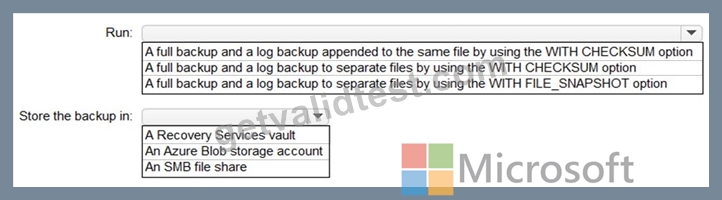
Answer:
Explanation: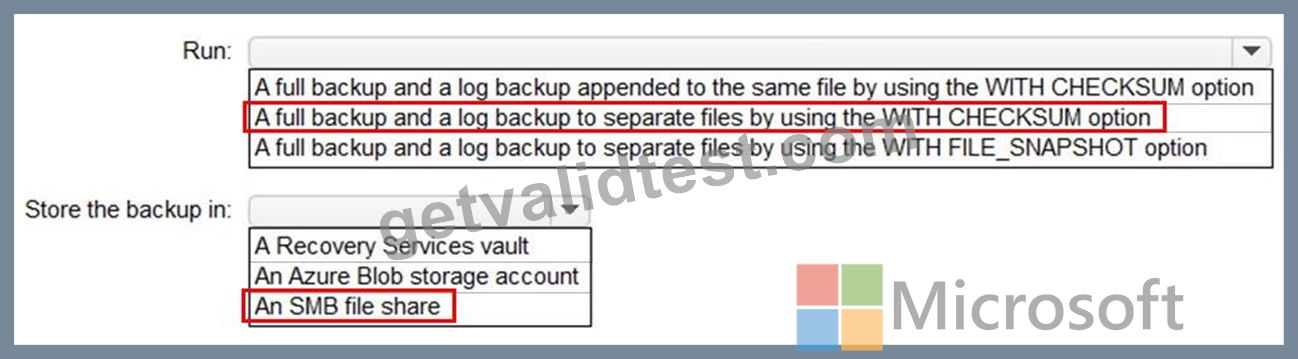
Reference:
https://docs.microsoft.com/en-us/azure/dms/tutorial-sql-server-managed-instance-online
NEW QUESTION # 139
You are building an Azure virtual machine.
You allocate two 1-TiB, P30 premium storage disks to the virtual machine. Each disk provides 5,000 IOPS.
You plan to migrate an on-premises instance of Microsoft SQL Server to the virtual machine. The instance has a database that contains a 1.2-TiB data file. The database requires 10,000 IOPS.
You need to configure storage for the virtual machine to support the database.
Which three objects should you create in sequence? To answer, move the appropriate objects from the list of objects to the answer area and arrange them in the correct order.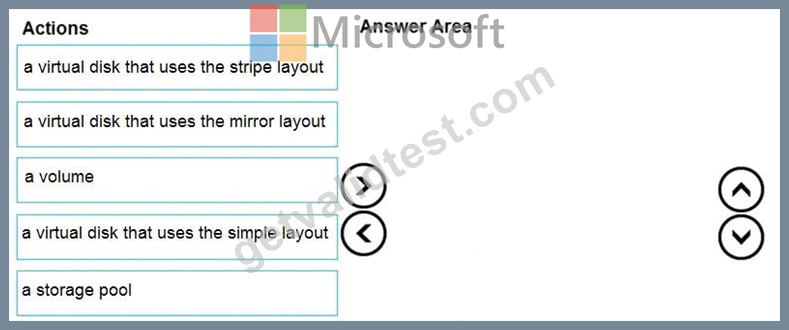
Answer:
Explanation: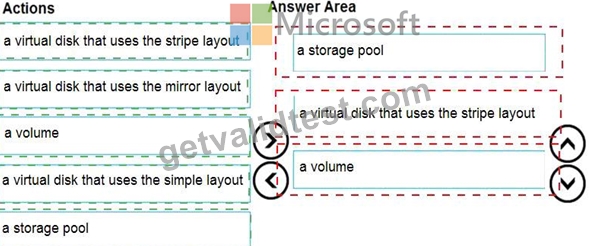
Explanation: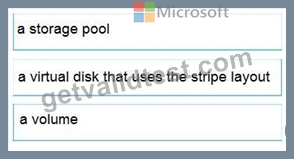
Follow these same steps to create striped virtual disk:
* Create Log Storage Pool.
* Create Virtual Disk
* Create Volume
Box 1: a storage pool
Box 2: a virtual disk that uses stripe layout
Disk Striping: Use multiple disks and stripe them together to get a combined higher IOPS and Throughput limit. The combined limit per VM should be higher than the combined limits of attached premium disks.
Box 3: a volume
Reference:
https://hanu.com/hanu-how-to-striping-of-disks-for-azure-sql-server/
NEW QUESTION # 140
Note: This question is part of a series of questions that present the same scenario. Each question in the series contains a unique solution that might meet the stated goals. Some question sets might have more than one correct solution, while others might not have a correct solution.
After you answer a question in this section, you will NOT be able to return to it. As a result, these questions will not appear in the review screen.
You have SQL Server 2019 on an Azure virtual machine.
You are troubleshooting performance issues for a query in a SQL Server instance.
To gather more information, you query sys.dm_exec_requests and discover that the wait type is PAGELATCH_UP and the wait_resource is 2:3:905856.
You need to improve system performance.
Solution: You shrink the transaction log file.
Does this meet the goal?
- A. No
- B. Yes
Answer: A
Explanation:
Reference:
https://docs.microsoft.com/en-US/troubleshoot/sql/performance/recommendations-reduce-allocation-contention
NEW QUESTION # 141
You have an Azure SQL database named DB1 in the General Purpose service tier.
The performance metrics for DB1 are shown in the following exhibit.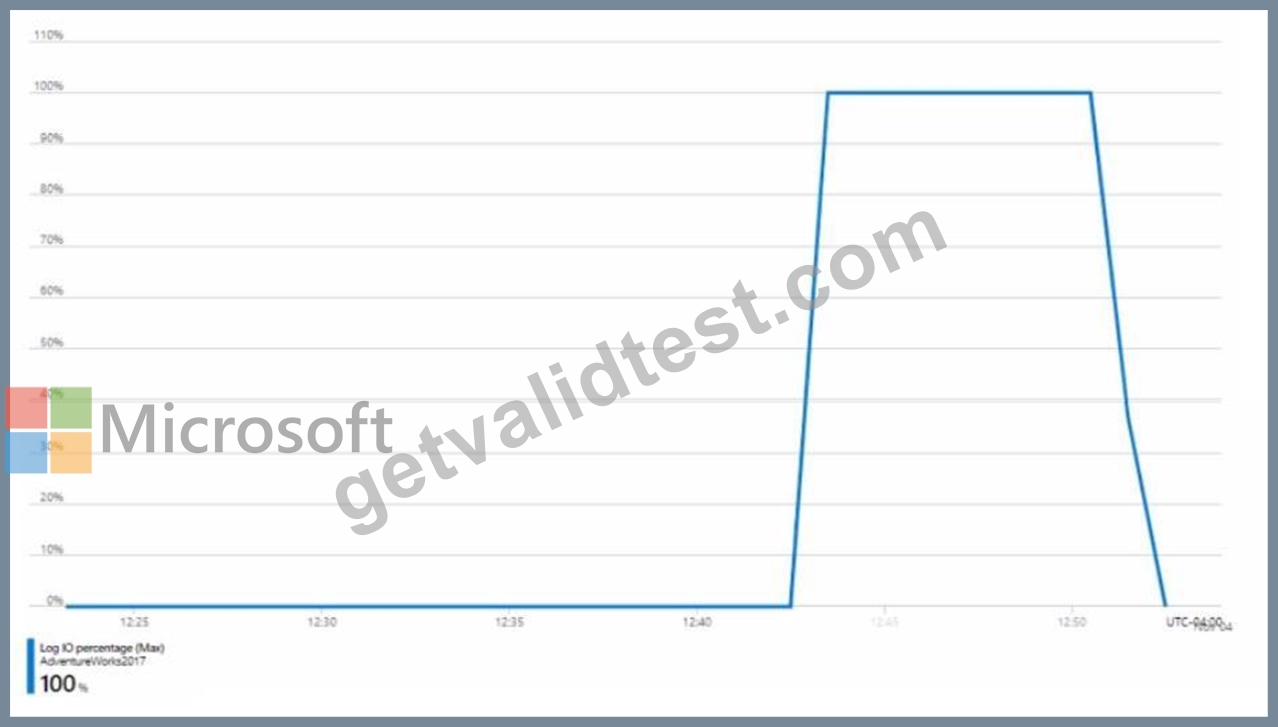
You need to reduce the Log 10 percentage. The solution must minimize costs.
What should you do?
- A. Change Service tier to Business Critical.
- B. B. Change Recovery model to Simple.
- C. Perform a checkpoint operation.
- D. Increase the number of vCores.
Answer: A
NEW QUESTION # 142
You are building a database in an Azure Synapse Analytics serverless SQL pool.
You have data stored in Parquet files in an Azure Data Lake Storage Gen2 container.
Records are structured as shown in the following sample.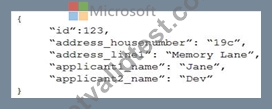
The records contain two applicants at most.
You need to build a table that includes only the address fields.
How should you complete the Transact-SQL statement? To answer, select the appropriate options in the answer area.
NOTE: Each correct selection is worth one point.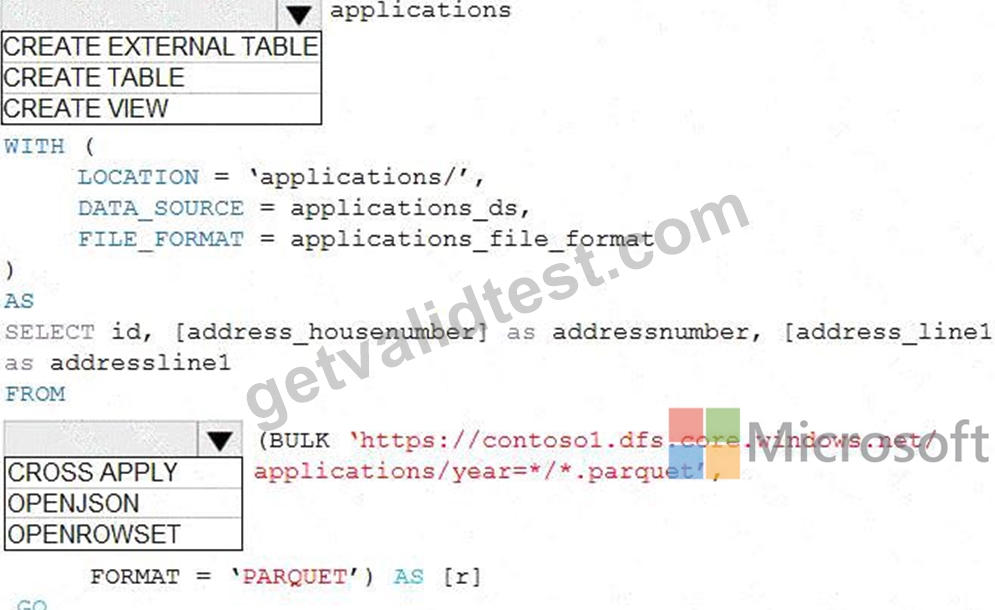
Answer:
Explanation: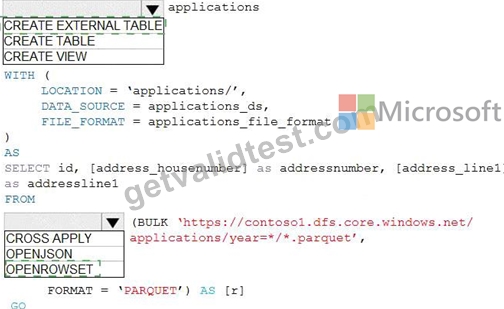
Explanation: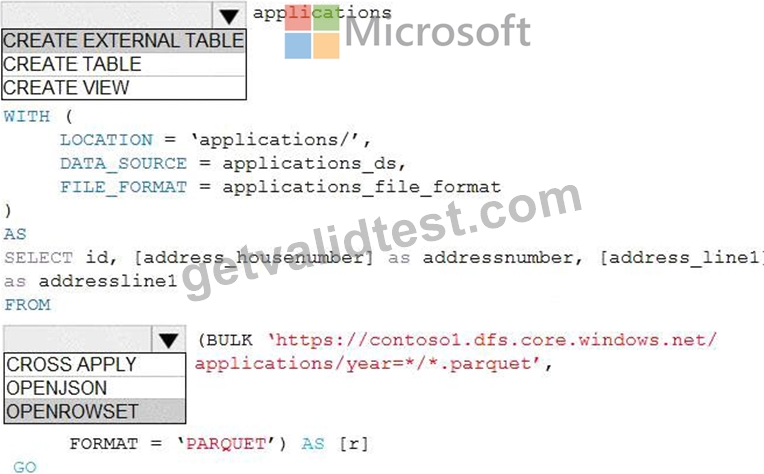
Box 1: CREATE EXTERNAL TABLE
An external table points to data located in Hadoop, Azure Storage blob, or Azure Data Lake Storage. External tables are used to read data from files or write data to files in Azure Storage. With Synapse SQL, you can use external tables to read external data using dedicated SQL pool or serverless SQL pool.
Syntax:
CREATE EXTERNAL TABLE { database_name.schema_name.table_name | schema_name.table_name | table_name } ( <column_definition> [ ,...n ] ) WITH ( LOCATION = 'folder_or_filepath', DATA_SOURCE = external_data_source_name, FILE_FORMAT = external_file_format_name Box 2. OPENROWSET When using serverless SQL pool, CETAS is used to create an external table and export query results to Azure Storage Blob or Azure Data Lake Storage Gen2.
Example:
AS
SELECT decennialTime, stateName, SUM(population) AS population
FROM
OPENROWSET(BULK 'https://azureopendatastorage.blob.core.windows.net/censusdatacontainer/release
/us_population_county/year=*/*.parquet',
FORMAT='PARQUET') AS [r]
GROUP BY decennialTime, stateName
GO
Reference:
https://docs.microsoft.com/en-us/azure/synapse-analytics/sql/develop-tables-external-tables
NEW QUESTION # 143
Drag and Drop Question
You have an Azure subscription that contains a virtual network named VNet1 and two SQL Server on Azure Virtual Machines instances named SQLVM1 and SQLVM2. SQLVM1 and SQLVM2 are connected to VNet1.
You plan to deploy a domain-independent availability group that will be hosted on SQLVM1 and SQLVM2.
You create the required security principals.
You need to complete the deployment.
In which order should you run the commands? To answer, move all commands from the list of commands to the answer area and arrange them in the correct order.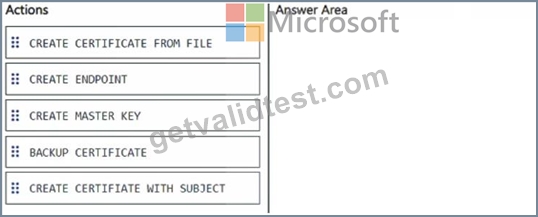
Answer:
Explanation: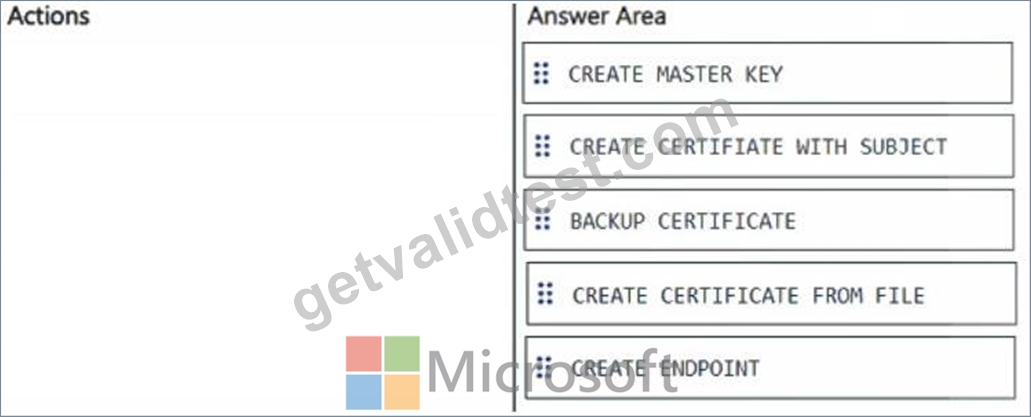
NEW QUESTION # 144
......
Exam Details
Microsoft DP-300 may contain 40-60 questions and last for 180 minutes. This test evaluates the ability of the candidates to perform different technical tasks covering the exam topics. It includes the skills in planning and implementing resources for data platforms, implementing secure environments, and performing automation tasks, among others. The students can take the test in English, Korean, Japanese, or Simplified Chinese. To register, they must go through the Pearson VUE website and pay the fee of $165. The sum is for a single delivery of the exam. This means that those who do not pass the test will need to pay a new fee to retake the exam.
Microsoft DP-300: Administering Relational Databases on Microsoft Azure exam is designed for database administrators who work with Microsoft Azure SQL databases. Administering Relational Databases on Microsoft Azure certification exam validates the skills of a candidate in managing and administering relational databases on Microsoft Azure. DP-300 exam measures the candidate's ability to perform various tasks such as configuring and managing databases, setting up security, monitoring and optimizing performance, and implementing high availability and disaster recovery solutions.
Download Real Microsoft DP-300 Exam Dumps Test Engine Exam Questions: https://www.getvalidtest.com/DP-300-exam.html
Verified DP-300 Dumps Q&As - DP-300 Test Engine with Correct Answers: https://drive.google.com/open?id=1n_UNTIrpwdkflLtiQ5JmgClXRqi_RIjO